📌 UPDATE — June 18, 2026
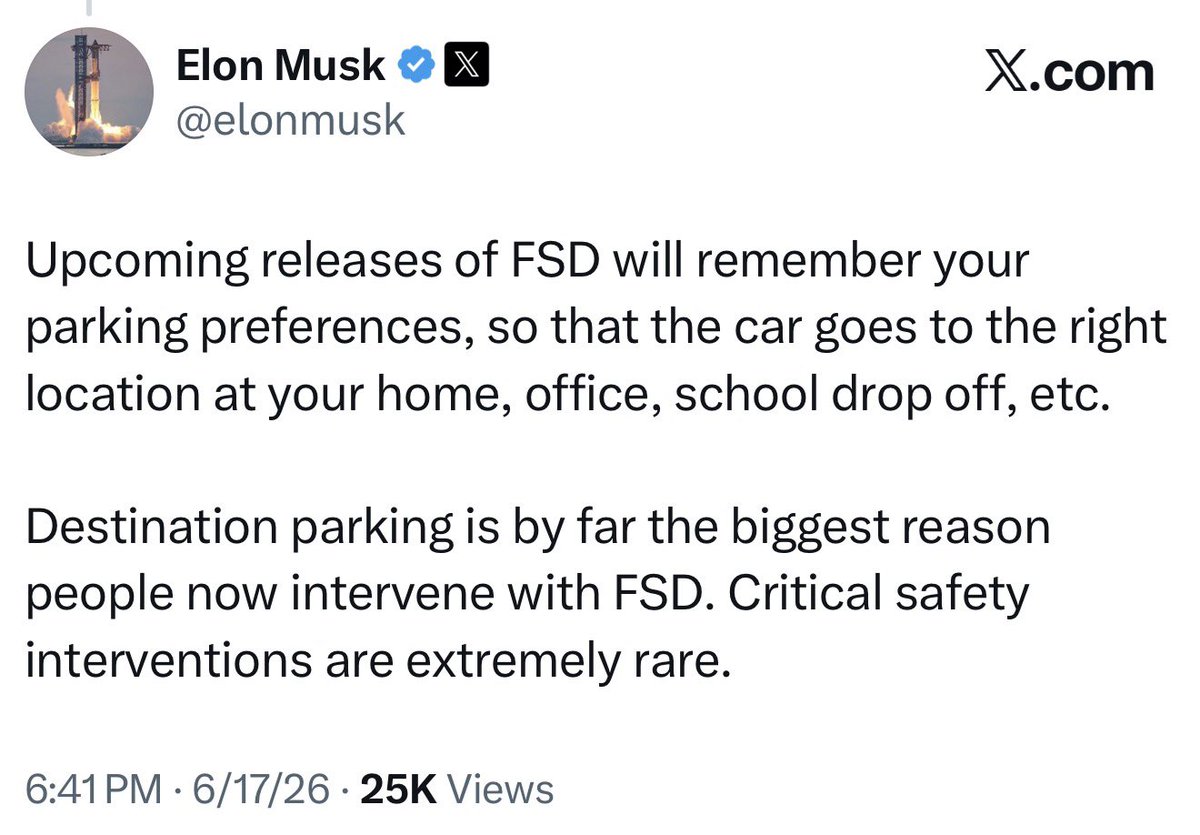
Elon Musk has confirmed that FSD will soon remember parking preferences per location — meaning if you always park in a specific spot at your gym or office, FSD will learn and replicate that choice automatically. More notably, Elon stated that safety-critical disengagements are now mostly a thing of the past, with the vast majority of current interventions stemming from parking preferences or the vehicle stopping too far from the destination. This marks a meaningful milestone: the intervention problem has effectively shifted from safety concerns to comfort and convenience — a sign of how far FSD reliability has progressed.

Tesla's in-car FSD feedback popups have produced a clear verdict: destination parking is far and away the most common reason drivers take back control, while genuine safety interventions have become extremely rare. Elon Musk acknowledged the data publicly and confirmed that upcoming FSD releases will teach the car to remember where you actually like to park.

The finding reframes how we think about FSD maturity. For a long time, the conversation centered on whether the system could handle highway merges, unprotected lefts, and emergency scenarios. The data suggests those edge cases have largely been solved — or at least reduced to the point where parking has become the dominant friction point. That's a meaningful shift, even if it doesn't make for the most dramatic headline.

The parking problem isn't new. Even with FSD v14.3.4 — which rolled out in June 2026 and specifically added "increased decisiveness of parking spot selection" and improved parking location pin prediction — owners have reported the car gravitating toward disabled spaces, stopping in striped no-park zones, or aiming for sidewalk ramps. The system can complete the physical maneuver cleanly; it's the where that keeps frustrating people. Musk's proposed fix — persistent memory for preferred parking spots at familiar destinations like home, the office, or a school drop-off — targets exactly that gap. Rather than letting FSD pick the nearest open space, the car would learn your habits and navigate accordingly.
For context, FSD Supervised completed an 850-mile zero-intervention journey back in April 2026, including autonomous Supercharger stops and parking. The hardware and core driving logic are clearly capable. What's lagging is the personalization layer — the system knowing that you always park in spot B7 at your gym, not the first space it finds near the entrance. Memory-based parking would close that loop and, based on the survey data, eliminate the single biggest reason most owners still feel the need to grab the wheel.
No timeline was given for the feature's arrival, but Musk's direct acknowledgment of the survey results suggests it's actively in development rather than on a distant roadmap. If you're using FSD regularly, it's worth paying attention to the next few release notes — this one has a clear user-data mandate behind it.
📋 Tracking Tesla software? See every firmware, FSD and app version in one place in our Tesla Software Update Tracker.
Related Gear
Gear up your Tesla with tested, custom-fit BASENOR accessories — shop Tesla accessories →
Sources & reporting notes
The links below identify the material source records used for this report.
- @SawyerMerritt on X (2026-06-17T23:02:15.000Z) — Direct source
- @wholemars on X (2026-06-17T23:03:41.000Z) — Direct source
- @teslascope on X (2026-06-18T01:07:59.000Z) — Direct source
Source links are preserved as published or accessed. See our editorial standards and corrections policy.
The BASENOR Editorial Desk covers Tesla, SpaceX, and related technology, curating reporting from primary sources — official accounts, regulatory filings, and software release data. Every article passes source-record and fact-checking review before publication. About the newsroom.
This report was curated by the BASENOR Editorial Desk from the sources listed above. Read our editorial standards or email editorial@basenor.com to report an error.