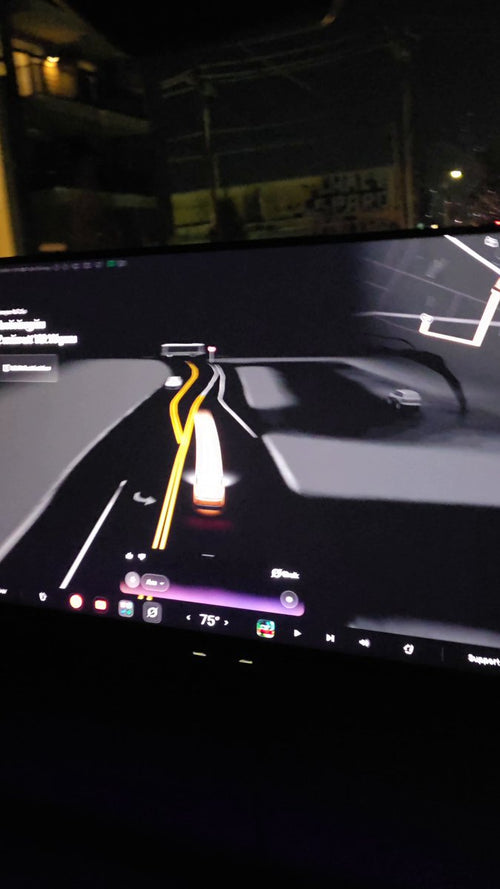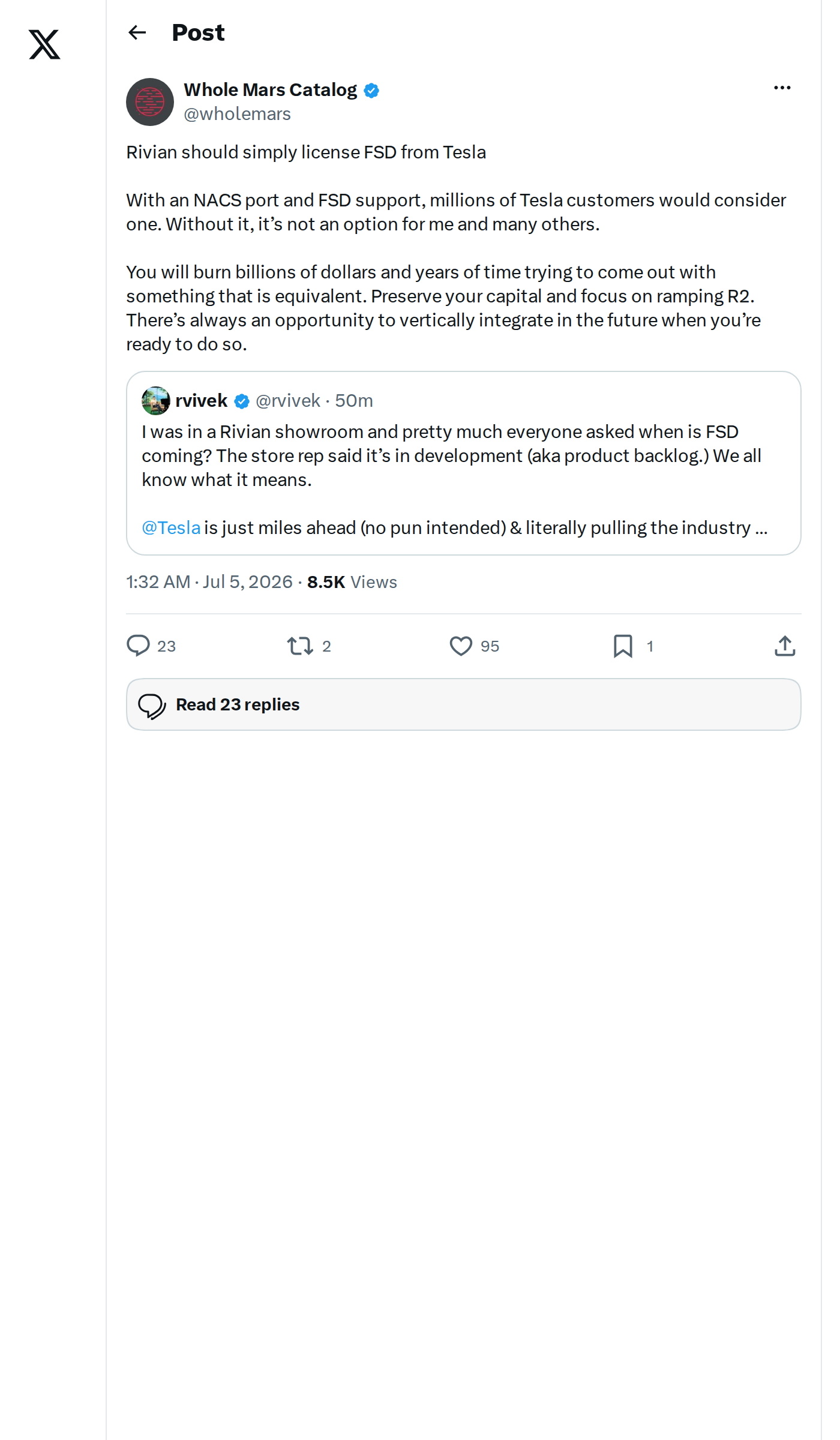
Whole Mars Catalog, one of the more closely-watched voices in the Tesla community, posted a pointed argument this weekend: Rivian should simply license Full Self-Driving from Tesla. Pair that with a native NACS port, the argument goes, and Rivian would instantly become a real option for millions of Tesla loyalists who currently won't consider anything else. Without both, it's a non-starter for a significant slice of the EV market.

It's a clean argument on its face. But the reality of where FSD licensing actually stands — and where Rivian is headed on both fronts — makes it considerably more complicated.
The FSD Licensing Wall
Tesla CEO Elon Musk first floated the idea of licensing FSD to other automakers back in July 2023, describing early discussions with a "major OEM." Nothing came of it. By late 2025 and into 2026, Musk himself publicly acknowledged that legacy automakers have been unwilling to move forward, citing what he described as "unworkable requirements" on their end.
Rivian's own trajectory points in the opposite direction. The company is developing a proprietary chip for its autonomous driving computer and building its driver-assistance software in-house — a path that mirrors what Ford and other automakers have chosen. The reasons are strategic: brand differentiation, cost control, tighter hardware-software integration, and genuine concern over liability exposure from a system that, for all its progress, remains a Level 2 supervised driver-assistance technology. Regulators and insurers treat that classification seriously, and no automaker wants to inherit Tesla's legal and reputational surface area along with the software license.
None of this means a licensing deal is impossible forever. But there's no indication one is close, and Rivian's current investment trajectory suggests it isn't a priority on their end either.
NACS: Already Happening
The charging half of the argument is a different story — and it's largely already resolved. Rivian signed a Supercharger access agreement with Tesla in June 2023. Rivian drivers have been able to reach more than 12,000 Tesla Superchargers via a NACS adapter since spring 2024. The 2026 R1T and R1S models ship with a native NACS port as standard. The upcoming R2 SUV, with production set to begin in the first half of 2026, has also been spotted with a native NACS connector.
Rivian is also upgrading its own Adventure Network charging outposts to support NACS natively. As of May 2026, 45 of the company's 150 Adventure Network sites are NACS-equipped. The standard itself has been formalized as SAE J3400, meaning automakers don't pay Tesla a licensing fee for the port — though non-Tesla owners may face higher per-kWh rates at Supercharger stalls than Tesla owners do.
So on charging interoperability, the gap @wholemars is describing is already closing on its own timeline.
What This Actually Means for Tesla Owners Considering a Switch
The tweet captures something real about buyer psychology. For Tesla owners who have built their driving habits around Supercharger access and who rely on FSD for daily commutes, cross-shopping anything else involves genuine compromise. NACS parity removes one of those friction points. FSD parity — if it ever existed — would remove the other.
But Rivian's bet is that its own autonomy stack, built on proprietary silicon and developed without Tesla's liability baggage, will eventually be competitive on its own terms. That's a multi-year, multi-billion-dollar wager. Whether it pays off faster than licensing would have is a question the industry won't be able to answer for several years yet.
For now, the NACS piece is table stakes across the industry. The FSD piece remains uniquely Tesla's — and by all current indications, Tesla isn't in a hurry to change that.
Related Gear
Gear up your Tesla with tested, custom-fit BASENOR accessories — shop Tesla accessories →
Sources & reporting notes
The links below identify the material source records used for this report.
- @wholemars on X (2026-07-05T01:32:18.000Z) — Direct source
Source links are preserved as published or accessed. See our editorial standards and corrections policy.
The BASENOR Editorial Desk covers Tesla, SpaceX, and related technology, curating reporting from primary sources — official accounts, regulatory filings, and software release data. Every article passes source-record and fact-checking review before publication. About the newsroom.
This report was curated by the BASENOR Editorial Desk from the sources listed above. Read our editorial standards or email editorial@basenor.com to report an error.