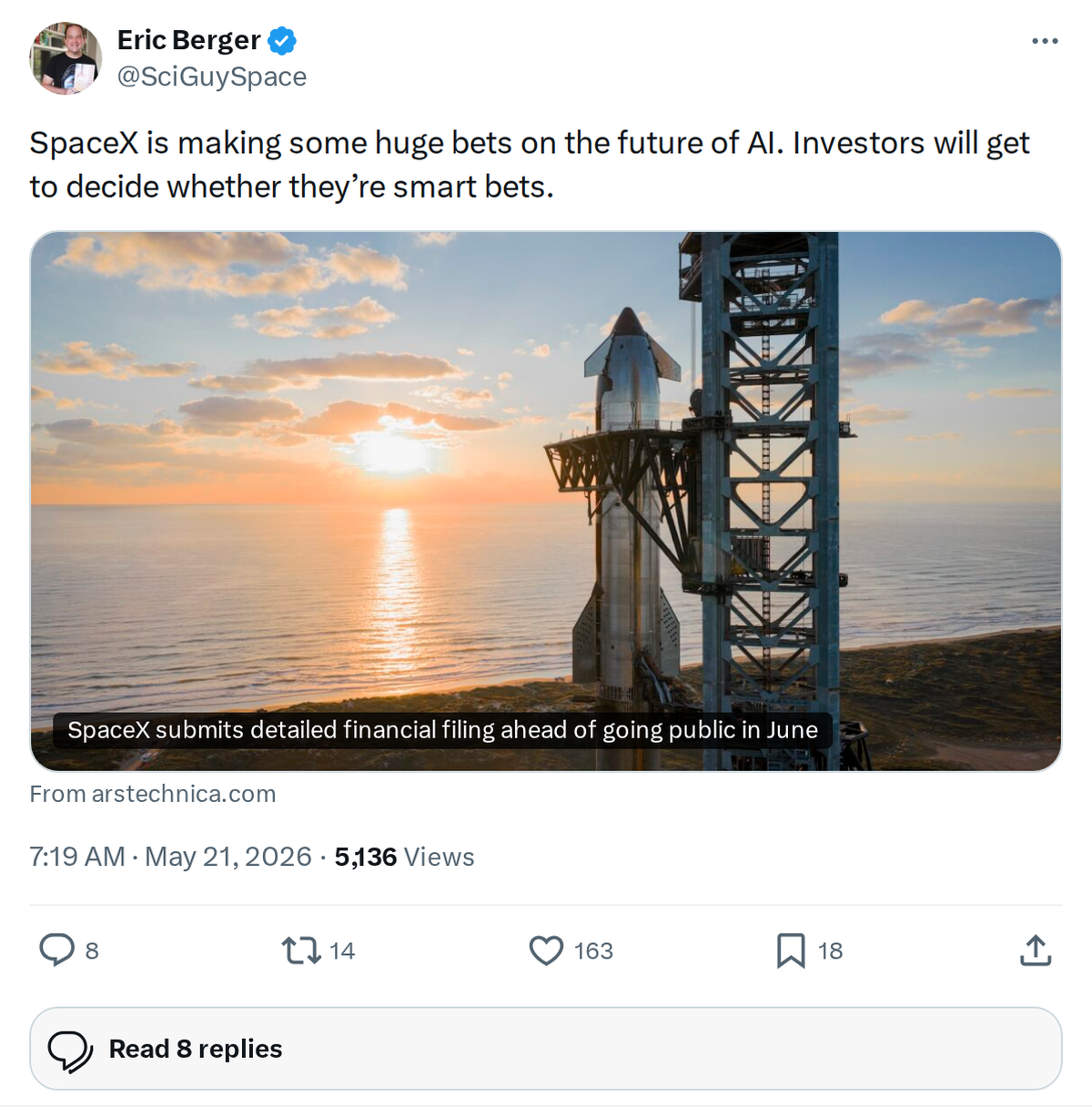
SpaceX is no longer just a rocket company. According to reporting from Eric Berger of Ars Technica, the company is making what he calls 'huge bets' on the future of AI — and the financial data behind those bets is staggering. Whether those bets pay off is now, increasingly, a question for outside investors to weigh.

The Scale of the Bet
The numbers are hard to ignore. According to financial data reported across multiple outlets, SpaceX directed approximately 61% of its $20.74 billion in 2025 capital expenditures toward its AI division — roughly $12.7 billion in a single year. For context, that's more than the entire annual revenue of many aerospace companies.
The AI division generated $3.2 billion in revenue in 2025, but posted an operating loss of $6.4 billion. In Q1 2026 alone, the AI business incurred nearly $2.5 billion in losses. The company overall reported $18.67 billion in revenue for 2025 — a 30% year-over-year increase — but swung to a projected net loss of $4.94 billion, compared to a $791 million profit in 2024. The AI division is, at this moment, the primary driver of that reversal.
| Metric | Figure | Context |
|---|---|---|
| 2025 Total Capex | $20.74B | Full year |
| AI Division Capex | $12.7B | 61% of total |
| AI Revenue (2025) | $3.2B | vs. $6.4B operating loss |
| AI Losses Q1 2026 | ~$2.5B | Single quarter |
| Total 2025 Revenue | $18.67B | +30% YoY |
| 2025 Net Loss (projected) | $4.94B | vs. $791M profit in 2024 |
How xAI Became the Core of the Strategy
The structural shift that made all of this possible happened fast. SpaceX formally absorbed xAI — Elon Musk's AI company — on February 2, 2026, in an all-stock merger that valued the combined entity at $1.25 trillion. The xAI division was then formally established within SpaceX on May 6, 2026, just weeks ago.
The rationale, as Musk has articulated it, is vertical integration at an unprecedented scale: AI, space-based internet (Starlink), rockets, direct-to-mobile communications, and an information platform — all under one roof. The xAI side of the equation brings significant compute infrastructure, most notably the Colossus supercomputer complex in Memphis, Tennessee, which Musk has described as the world's largest AI supercomputer cluster. Plans announced in late 2025 call for Colossus to eventually house at least one million GPUs.
The Orbital Compute Angle
What separates SpaceX's AI play from every other hyperscaler is the space component. The company's stated goal is to launch 100 gigawatts of AI compute capacity annually within three to four years, with an ambition to scale toward 1 terawatt per year. The underlying logic: orbital data centers can access continuous solar power without the land, cooling, and permitting constraints that throttle ground-based AI infrastructure.
It's an audacious claim. For reference, the entire global data center industry currently operates at roughly 40-50 gigawatts of total capacity. SpaceX is essentially proposing to double the world's AI compute — in orbit — within a few years. Whether the physics, the economics, and the launch cadence can actually support that ambition is the central question investors will be pricing.
The Investment Calculus
Berger's framing — that investors will decide whether these are smart bets — is pointed. SpaceX has historically been a private company insulated from quarterly earnings pressure. But as it absorbs xAI and pursues capital at this scale, the investor scrutiny that comes with that territory is unavoidable.
The loss profile is real and growing. A company that earned $791 million in profit in 2024 is now projecting a nearly $5 billion loss in 2025, driven almost entirely by AI spending. The bull case is that SpaceX is buying a dominant position in a market that doesn't fully exist yet — orbital AI infrastructure — before anyone else can. The bear case is simpler: the losses are compounding faster than the revenue, and the orbital compute thesis remains unproven at scale.
What's clear is that SpaceX has made its choice. The question Berger is really asking isn't whether the bets are large — they obviously are — but whether the market will ultimately validate the vision behind them. That verdict is still years away.
Sources & reporting notes
The links below identify the material source records used for this report.
- @SciGuySpace on X (2026-05-20T23:19:36.000Z) — Direct source
Source links are preserved as published or accessed. See our editorial standards and corrections policy.
The BASENOR Editorial Desk covers Tesla, SpaceX, and related technology, curating reporting from primary sources — official accounts, regulatory filings, and software release data. Every article passes source-record and fact-checking review before publication. About the newsroom.
This report was curated by the BASENOR Editorial Desk from the sources listed above. Read our editorial standards or email editorial@basenor.com to report an error.