📌 UPDATE — May 23, 2026
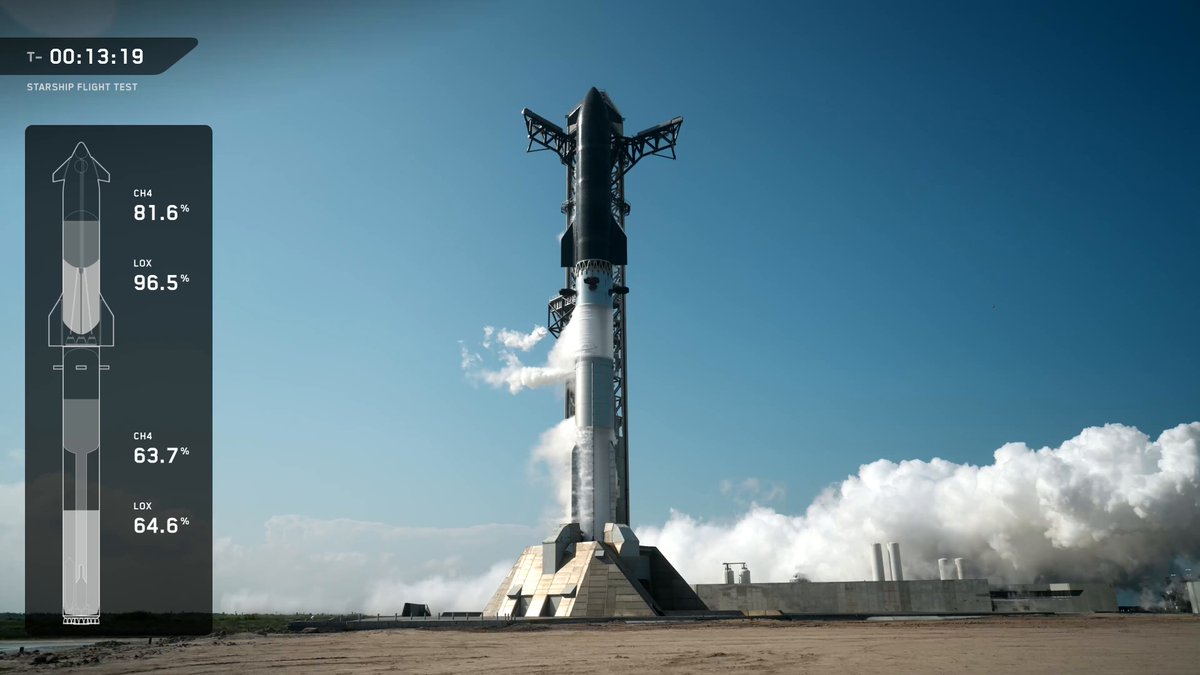
Starship's twelfth flight test has now launched successfully, and Starlink has confirmed it enabled 4K live streaming from liftoff all the way to splashdown — a step up from the real-time video coverage highlighted during Flight 12. SpaceX and Starlink both confirmed the milestone on X, with Starlink sharing imagery from the stream and SpaceX posting liftoff footage. The 4K capability underscores Starlink's growing role as a high-bandwidth backbone for live coverage of extreme-environment missions.
@Starlink · May 23, 2026Starlink enabled 4K live streaming from liftoff to splashdown during Starship's 12th test flight 🛰️🚀

📌 UPDATE — May 23, 2026
Starship Flight 12 has concluded with a successful splashdown confirmed in the Indian Ocean, with the vehicle nailing a precise flip maneuver and touching down next to a Starlink-equipped buoy. In a historic first, a modified Starlink satellite equipped with a camera and light captured live exterior views of Starship in space — the first time the vehicle has ever been photographed from another object in orbit. 🔍 The heat shield performed exceptionally well throughout reentry, and observers noted the vehicle lost only one RVac engine during ascent yet still completed the mission. SpaceX confirmed this was a Starship V3 vehicle, marking a redemption flight after challenges with the V2 series.

▶ Watch the historic external Starship view via @SawyerMerritt

During Starship's twelfth flight test on May 22, 2026, Starlink didn't just come along for the ride — it did real work. The satellite network streamed live video from the vehicle at hypersonic speeds and maintained reliable communication with recovery teams stationed in the remote Indian Ocean, enabling uninterrupted splashdown coverage for a global audience watching the webcast.

What Actually Flew on Flight 12
This wasn't a standard payload mission. According to reporting from Space.com, Starship Flight 12 — the debut of the Starship Version 3 (V3) using Booster 19 and Ship 39 — carried 20 Starlink simulators alongside two specially modified Starlink satellites. These modified satellites, internally nicknamed "Dodger dogs" by SpaceX teams, feature a stretched V2 mini satellite propellant tank and had a specific job during reentry: scan Starship's heat shield and transmit imagery back to operators in real time.
That heat shield data is critical. SpaceX is working toward return-to-launch-site capability for Starship, and understanding exactly how the thermal protection system performs under reentry stress is a prerequisite for that milestone. Starlink was the pipe that made that data transfer possible.

Hypersonic Streaming Is a Different Problem
Maintaining a stable data link at hypersonic velocities — where plasma buildup around the vehicle can disrupt radio signals — is genuinely hard. The fact that Starlink delivered broadcast-quality live video under those conditions, not just telemetry, is a meaningful technical demonstration. SpaceX framed it simply: "Live views brought to you by @Starlink."

The Indian Ocean splashdown location adds another layer of significance. Recovery operations in that region are far beyond the reach of conventional ground-based communications infrastructure. Starlink bridged that gap entirely, keeping mission teams and the public connected to a vehicle splashing down thousands of miles from the nearest cell tower.
Why This Points Forward
The bigger picture here is the Starlink V3 roadmap. According to Space.com, the Starship V3 vehicle is designed to deliver far more powerful Starlink V3 satellites to orbit — each Starship launch expected to add more than 20 times the network capacity compared to a Falcon 9 launch of V2 Starlinks. Full V3 deployment via Starship is anticipated to begin in 2027.
Flight 12 was therefore a two-way test: Starship proving it can carry and deploy next-generation Starlink hardware, and Starlink proving it can support the very missions that will scale its own constellation. The network is becoming the backbone of the program that builds it — a feedback loop that gets more capable with every flight.
🚀 Following the Starship program? See every test flight, official outcome and the next launch window in our SpaceX Starship Tracker.
Sources & reporting notes
The links below identify the material source records used for this report.
- @SpaceX on X (2026-05-22T22:43:59.000Z) — Direct source
- @Starlink on X (2026-05-22T22:47:04.000Z) — Direct source
- @Starlink on X (2026-05-22T22:22:57.000Z) — Direct source
- @elonmusk on X (2026-05-22T23:57:00.000Z) — Direct source
- @SawyerMerritt on X (2026-05-22T23:38:20.000Z) — Direct source
- @SawyerMerritt on X (2026-05-22T23:31:30.000Z) — Direct source
- @SawyerMerritt on X (2026-05-22T23:11:03.000Z) — Direct source
- @SciGuySpace on X (2026-05-22T23:39:15.000Z) — Direct source
- @SciGuySpace on X (2026-05-22T23:34:21.000Z) — Direct source
- @CSI_Starbase on X (2026-05-22T23:39:34.000Z) — Direct source
- @SpaceX on X (2026-05-22T23:38:55.000Z) — Direct source
- @SpaceX on X (2026-05-23T22:25:25.000Z) — Direct source
- @Starlink on X (2026-05-23T22:02:15.000Z) — Direct source
Source links are preserved as published or accessed. See our editorial standards and corrections policy.
The BASENOR Editorial Desk covers Tesla, SpaceX, and related technology, curating reporting from primary sources — official accounts, regulatory filings, and software release data. Every article passes source-record and fact-checking review before publication. About the newsroom.
This report was curated by the BASENOR Editorial Desk from the sources listed above. Read our editorial standards or email editorial@basenor.com to report an error.