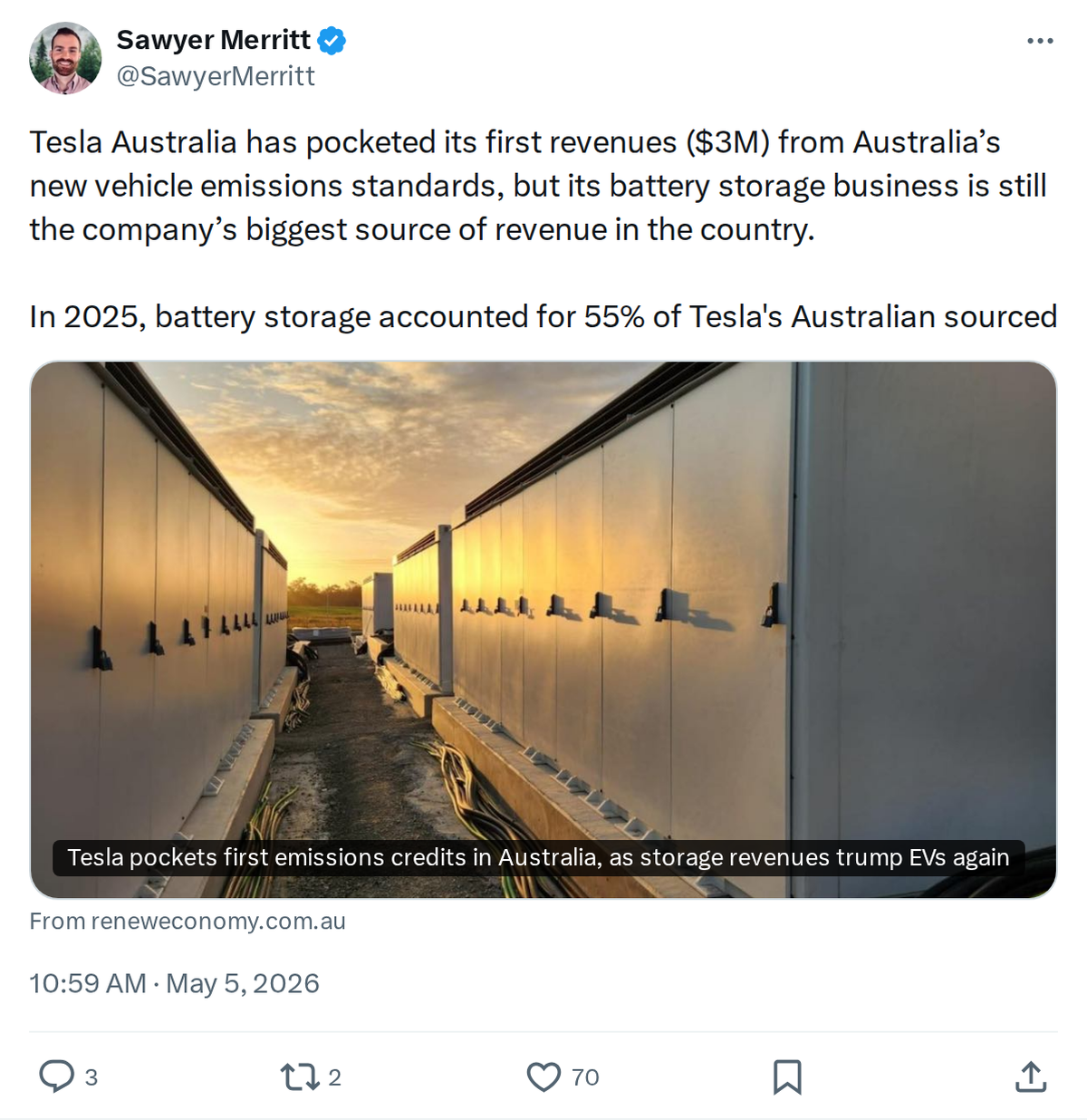
Tesla Australia is quietly becoming a different kind of business. While the company is best known for selling EVs, its 2025 financials tell a story where battery storage has firmly taken the top spot — and a brand-new revenue stream from Australia's vehicle emissions rules is just getting started.

Battery Storage Has Taken Over
In 2025, Tesla's energy generation and storage products generated $2.5 billion in Australian revenue — surpassing vehicle sales, which came in at $1.92 billion. That gives battery storage a 55% share of Tesla Australia's total sourced revenue for the year.
The shift has been rapid. As recently as 2023, storage accounted for just 15% of Australian revenue. By 2024, it had crossed the 50% threshold for the first time at 50.4%, generating $2.55 billion compared to $2.44 billion from EV sales. The 2025 figure of 55% cements what is now a structural reality, not a one-year anomaly.
It's worth noting that storage revenue in Australia was essentially flat between 2024 and 2025 — $2.55 billion versus $2.495 billion — suggesting the percentage gain came partly from softer vehicle sales rather than explosive storage growth. Significant price reductions across the battery industry have also compressed revenue even as deployment volumes have held up. Globally, Tesla's energy division posted approximately $12.8 billion in annual revenue for 2025, up 26.6% year-over-year, so the Australian market is tracking broadly in line with the worldwide trend.
The Emissions Credits Windfall — Small Now, Worth Watching
Australia's New Vehicle Efficiency Standard (NVES) came into effect on July 1, 2025, and Tesla wasted no time positioning itself as a major credit generator. Between July 1 and December 31, 2025, Tesla banked 2.2 million credits under the scheme. Those credits — sold to other manufacturers who need to offset their higher-emission fleets — generated $3 million in its first half-year of operation.
Three million dollars is a rounding error against a $2.5 billion storage business, but the trajectory matters. This is year one, covering only six months of a scheme that will tighten over time. As legacy automakers face steeper compliance requirements, demand for Tesla's surplus credits should grow — and so should the price. It's the same playbook Tesla ran in the United States with ZEV credits for years, which at peak contributed hundreds of millions of dollars annually to Tesla's bottom line.
What This Means for Tesla's Australian Strategy
The combination of these two data points — storage dominance and a new regulatory credit income stream — signals that Tesla's Australian business is increasingly insulated from EV sales cycles. Vehicle sales can fluctuate with consumer confidence, interest rates, and competition. Megapack and grid-scale storage contracts tend to be longer-term and less discretionary. Regulatory credits, once a market is established, are essentially a byproduct of Tesla's existing EV business that costs nothing extra to generate.
For a market where Tesla has faced real competitive pressure on the vehicle side from Chinese manufacturers, this diversification looks less like a strategic choice and more like a structural advantage that has quietly compounded over several years. The 2025 numbers make it official: in Australia, Tesla Energy is the main event.
Related Gear
Gear up your Tesla with tested, custom-fit BASENOR accessories — shop Tesla accessories →
Sources & reporting notes
The links below identify the material source records used for this report.
- @SawyerMerritt on X (2026-05-05T02:59:47.000Z) — Direct source
Source links are preserved as published or accessed. See our editorial standards and corrections policy.
The BASENOR Editorial Desk covers Tesla, SpaceX, and related technology, curating reporting from primary sources — official accounts, regulatory filings, and software release data. Every article passes source-record and fact-checking review before publication. About the newsroom.
This report was curated by the BASENOR Editorial Desk from the sources listed above. Read our editorial standards or email editorial@basenor.com to report an error.