30-Second Brief
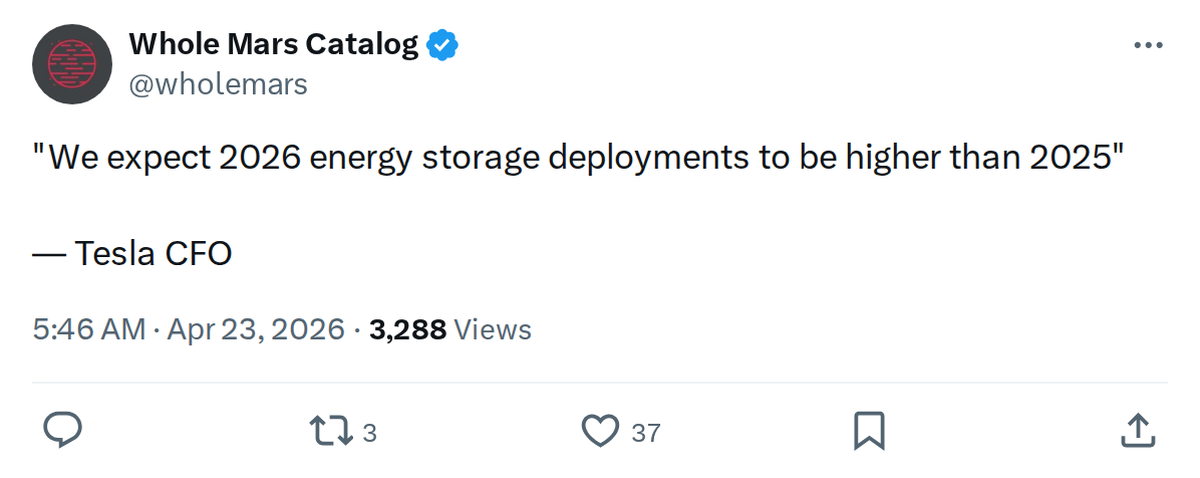
The News: Tesla CFO Vaibhav Taneja stated during the Q1 2026 earnings call that the company expects energy storage deployments in 2026 to exceed 2025's record-setting 46.7 GWh.
Why It Matters: Despite a soft Q1 2026 and incoming margin pressure, Tesla's energy division is positioned as a major growth engine — with new products, new factories, and a strong global backlog backing that outlook.
Source: @wholemars on X
Tesla CFO Calls for Record Energy Storage Growth in 2026 — Despite a Rocky Q1
Tesla's energy business just had its worst quarter in a year — and the CFO is still bullish. During the Q1 2026 earnings call on April 22, CFO Vaibhav Taneja told investors that Tesla expects full-year 2026 energy storage deployments to come in higher than 2025. That's a significant commitment given that 2025 itself was a record year.

📊 Key Figures
| Metric | Value | Context |
|---|---|---|
| Q1 2026 Deployments | 8.8 GWh | −38% vs Q4 2025 |
| Q4 2025 Deployments (record) | 14.2 GWh | All-time quarterly high |
| Full-Year 2025 Deployments | 46.7 GWh | +49% YoY |
| Energy Segment Revenue (2025) | $12.8B | +26.6% YoY |
| Analyst Est. Energy Revenue (2026) | ~$18.3B | +43% vs 2025 |
| Analyst Est. Gross Profit (2026) | ~$5.3B | ~29% margin |
| Planned 2026 CapEx | >$20B | Factories, cells, AI infra |
The Q1 Dip: Seasonal or Structural?
Tesla deployed 8.8 GWh of energy storage in Q1 2026 — down 15% year-over-year and a sharp 38% drop from the record 14.2 GWh set in Q4 2025. On the surface, that looks alarming. But Q1 sequential declines are a recurring pattern in the energy business, driven by project timing, permitting cycles, and the natural lumpiness of utility-scale contracts. The Q1 2026 figure mirrors the same dynamic seen heading into 2025's record run.
The more important signal is the full-year trajectory. Tesla closed 2025 with 46.7 GWh deployed — a 49% year-over-year jump. The CFO's guidance that 2026 will top that figure implies Tesla needs to average well above 11.7 GWh per quarter for the remaining three quarters, which is achievable given the Q4 2025 precedent and the product pipeline now in place.
What's Driving the Growth Outlook
CFO Taneja pointed to three concrete growth catalysts backing the 2026 guidance:
- Megapack 3: The next-generation Megapack, offering higher energy density and lower cost per MWh, is expected to ramp through 2026 and expand Tesla's competitive position in utility-scale storage.
- Megablock (20 MWh): The new 20 MWh Megablock solution targets larger grid-scale deployments, opening Tesla up to project sizes that were previously out of reach with standard Megapack configurations.
- Global backlog: Taneja cited a robust global order book as the foundation for confidence in the full-year outlook — demand is not the constraint, execution is.
Tesla is also investing aggressively in the infrastructure to support that growth. The company has outlined capital expenditure exceeding $20 billion in 2026, directed at new and existing Battery Energy Storage System (BESS) factories, cell production facilities, an advanced lithium refinery, and AI compute infrastructure.
The Margin Warning You Shouldn't Ignore
The CFO's optimism on volume came with an important caveat: margins are under pressure. Taneja warned that 2026 will see margin compression in the energy segment due to three converging forces — heightened competition from low-cost manufacturers, policy uncertainty affecting project economics, and the direct impact of tariffs on component costs.
Wall Street analysts currently estimate the energy segment's gross margin will hold near 29% in 2026, roughly flat with recent quarters. But that estimate carries real downside risk if tariff exposure worsens or competition accelerates faster than Tesla's cost reduction roadmap. More deployments at thinner margins is still a net positive for absolute gross profit — analysts project segment gross profit rising to approximately $5.3 billion in 2026 — but it's a dynamic worth watching closely through the year.
🔭 The BASENOR Take
Timeline: Full-year 2026 outlook | Q1 results released April 22, 2026
Impact Level: High — Energy is becoming a material share of Tesla's total revenue and profit
Confidence: Medium-High — CFO guidance is directional, not a hard number; execution risk remains
Tesla's energy business is no longer a side story. At $12.8 billion in 2025 revenue and growing faster than the auto segment, it's becoming a genuine second pillar of the company. The CFO's 2026 guidance — backed by new products and a strong backlog — is credible, but the margin warning is the real headline for investors. Volume growth that erodes profitability is a different story than the high-margin energy business Tesla has been building.
For Tesla owners watching the company's long-term health, the energy division's trajectory matters. A profitable, scaling energy business funds the R&D and infrastructure that eventually shows up in your car — better Supercharger coverage, faster software development cycles, and the financial runway to see FSD and Optimus through to commercialization. The Q1 dip is noise. The full-year setup is the signal.
📰 Deep Dive
The structural shift happening inside Tesla Energy is worth understanding. Megapack started as a product Tesla built to use its own battery expertise — it has evolved into one of the most sought-after utility-scale storage solutions globally. The transition from Megapack 2 to Megapack 3, combined with the new 20 MWh Megablock format, signals Tesla is moving up the project size ladder. Larger individual deployments mean fewer contracts needed to hit the same GWh target, which can simplify logistics and improve project economics at scale.
The tariff and competition dynamic is more nuanced than it might appear. Low-cost competition — primarily from Chinese manufacturers — is real, but Tesla's advantage in software integration, grid management capabilities, and its established relationships with major utilities provides meaningful differentiation beyond raw cost-per-kWh. The question for 2026 is whether that differentiation holds as competitors close the technology gap.
The $20 billion-plus CapEx commitment is the most underappreciated part of this story. Tesla is not treating energy storage as a mature, harvest-mode business — it is investing at a rate that suggests the company sees the current market share as just the beginning. New BESS factories, cell production expansion, and a lithium refinery point to a vertically integrated energy business that could structurally lower costs over the next three to five years. Whether the market rewards that investment depends heavily on how the policy environment — particularly in the U.S. and Europe — evolves through the rest of the decade.
Related Gear
Gear up your Tesla with tested, custom-fit BASENOR accessories — shop Tesla accessories →
Sources & reporting notes
The links below identify the material source records used for this report.
- @wholemars on X (2026-04-22T21:46:36.000Z) — Direct source
Source links are preserved as published or accessed. See our editorial standards and corrections policy.
The BASENOR Editorial Desk covers Tesla, SpaceX, and related technology, curating reporting from primary sources — official accounts, regulatory filings, and software release data. Every article passes source-record and fact-checking review before publication. About the newsroom.
This report was curated by the BASENOR Editorial Desk from the sources listed above. Read our editorial standards or email editorial@basenor.com to report an error.