30-Second Brief
The News: Tesla has produced its final V3 Supercharger cabinet at Gigafactory New York, ending a seven-year production run of 15,000+ units, and is now ramping V4 cabinet manufacturing with 500 kW charging capability.
Why It Matters: Cybertruck owners gain access to dramatically faster charging, and every Tesla owner will benefit from a more capable, higher-throughput Supercharger network as V4 stations multiply.
Source: @TeslaNewswire on X
Tesla Ends V3 Supercharger Production at Giga New York — The 500 kW V4 Era Has Officially Begun
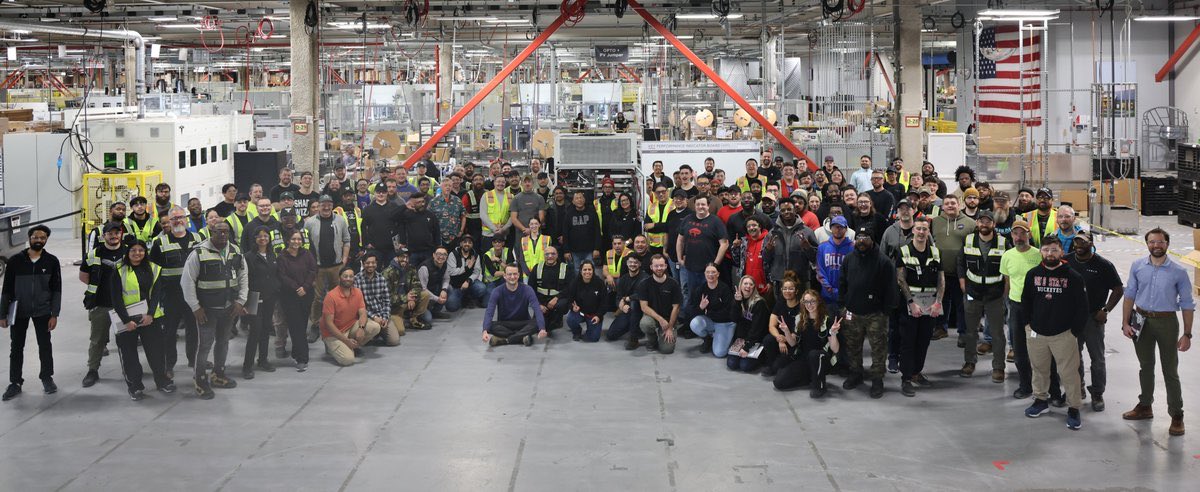
After seven years and more than 15,000 units, Tesla has rolled the last V3 Supercharger cabinet off the production line at Gigafactory New York. It's a quiet milestone with a loud implication: the next generation of Tesla charging infrastructure is no longer a roadmap promise — it's in active production and ramping now.

📊 Key Figures
| Metric | V3 Cabinet | V4 Cabinet |
|---|---|---|
| Peak Charging Speed (Cars) | 250 kW | 500 kW |
| Peak Output (Tesla Semi) | N/A | 1.2 MW |
| Stalls per Cabinet | Up to 4 | Up to 8 |
| Voltage Architecture Support | 400V | 400V – 1000V |
| Total V3 Units Produced (Giga NY) | 15,000+ | Ramping |
| Production Run (V3) | 7 years (2019–2026) | Ongoing |
The End of an Era at Giga New York
Gigafactory New York — Tesla's Buffalo facility — began producing Supercharger hardware in 2020, and over the following years became the backbone of the world's most expansive DC fast-charging network. The V3 Supercharger, capable of up to 250 kW, was a genuine leap when it launched and enabled the rapid expansion of Tesla's charging footprint across North America and beyond. Crossing 15,000 units produced is no small feat for a single factory line.
But the V3 cabinet's 250 kW ceiling has become a constraint — particularly for the Cybertruck, which is engineered to accept far more power than any existing cabinet could deliver. The production shutdown isn't a retreat; it's a deliberate pivot to hardware that matches where Tesla's vehicle lineup is heading.
What the V4 Cabinet Actually Delivers
The V4 Supercharger cabinet is a fundamentally different piece of infrastructure. Each cabinet can supply a total of 1.2 MW of power and serve up to eight dispensers (stalls) — double the stall count of a V3 cabinet. That means fewer cabinets needed per site, lower installation complexity, and more stalls per square foot of real estate.
The headline number is 500 kW per stall for compatible vehicles. Right now, the Cybertruck is the only Tesla model that can utilize the full 500 kW — representing roughly a 30% improvement over the 325 kW some Cybertrucks could access at V3-cabinet sites with V4 stalls. According to Tesla's Director of Charging North America, Max de Zegher, less than 1 MW across eight posts is needed to deliver maximum power to cars 99% of the time, meaning the cabinet's 1.2 MW headroom is well-matched to real-world demand.
For Model 3, Model Y, Model S, and Model X owners, the V4 cabinet doesn't change your peak charging speed — those vehicles will still top out at 250 kW. But what you will notice is less power-sharing congestion. When a V4 cabinet can serve eight stalls instead of four, the math on shared power allocation improves significantly during busy charging sessions.
The V4 cabinet also supports vehicle battery architectures from 400V all the way to 1000V, which positions Tesla's network to handle not just today's lineup but future high-voltage platforms — and potentially non-Tesla vehicles on higher-voltage architectures.
First V4 Stations Already Live
This isn't purely a future story. Tesla opened its first true V4 Supercharger station — with V4 cabinets, not just V4 stalls on V3 cabinets — on September 29, 2025, in Redwood City, California. A second full V4 station followed in Taylorsville, Utah, on January 23, 2026. With Giga New York now fully transitioned to V4 cabinet production, the pace of new V4 station openings should accelerate meaningfully through 2026.
🔭 The BASENOR Take
| Timeline | V4 production ramping now; first stations live since Sept 2025 |
| Impact Level | 🟠 High — Cybertruck owners immediate; all owners long-term |
| Confidence | 🟢 High — confirmed production milestone, verified station openings |
The significance of this production transition is easy to underestimate. Tesla's Supercharger network is one of its most durable competitive advantages, and the shift to V4 cabinets is the biggest infrastructure upgrade the network has seen since V3 launched in 2019. The doubling of stalls per cabinet is arguably as important as the raw speed increase — it means Tesla can expand charging capacity at existing sites without proportional increases in installation cost or grid connection complexity.
For Cybertruck owners specifically, the math is compelling: 500 kW charging means roughly 30% faster top-up sessions compared to what was achievable even at the best V3-cabinet sites. As V4 stations multiply through 2026, that benefit becomes increasingly accessible on real road trips rather than just at the two currently-open flagship sites.
The broader fleet — Model 3, Y, S, X — won't see a speed bump at V4 sites, but they will benefit from a network that's being built with more headroom, less congestion, and future-proof voltage support. That's a meaningful quality-of-life improvement that will compound over time as V4 stations replace and supplement the existing V3 footprint. For more on Tesla's charging infrastructure developments, see our charging news coverage.
📰 Deep Dive
The 15,000-unit V3 production milestone at Giga New York tells you something important about Tesla's manufacturing discipline: they don't announce a transition until the replacement is genuinely ready to ramp. The fact that V4 cabinet production is beginning at the same facility that mastered V3 suggests Tesla isn't starting from scratch — the tooling, workforce expertise, and supply chain are largely in place, which should compress the time between production start and meaningful network deployment.
There's also a strategic signal in the cabinet's 1000V architecture support. Tesla's current passenger vehicles top out at 400V, but the Semi operates at higher voltages, and future platforms — both Tesla's own and third-party vehicles that may use the Supercharger network — are trending toward 800V and above. Building that compatibility into the cabinet now means the infrastructure investment made today won't need to be replaced again in five years.
Watch for V4 station openings to accelerate sharply in Q2 and Q3 2026. With Giga New York fully committed to V4 output, the bottleneck shifts from manufacturing to site permitting and grid interconnection — the same constraints that have always governed Supercharger expansion speed. The hardware is no longer the limiting factor.
Related Gear
Gear up your Cybertruck with tested, custom-fit BASENOR accessories — shop Cybertruck accessories →
Sources & reporting notes
The links below identify the material source records used for this report.
- @TeslaNewswire on X (2026-03-16T16:58:34.000Z) — Direct source
Source links are preserved as published or accessed. See our editorial standards and corrections policy.
The BASENOR Editorial Desk covers Tesla, SpaceX, and related technology, curating reporting from primary sources — official accounts, regulatory filings, and software release data. Every article passes source-record and fact-checking review before publication. About the newsroom.
This report was curated by the BASENOR Editorial Desk from the sources listed above. Read our editorial standards or email editorial@basenor.com to report an error.