📌 UPDATE — April 24, 2026
New data puts Tesla's Q1 FSD subscriber surge in even sharper relief: paid FSD users grew nearly 10x faster than overall vehicle deliveries in the quarter. This stark divergence signals that existing Tesla owners — not just new buyers — are driving the adoption wave, as more customers opt into FSD subscriptions on cars already in their driveways. The ratio underscores that FSD monetization is increasingly decoupled from Tesla's vehicle sales cycle, a potentially significant shift in how the company generates software revenue going forward.

📌 UPDATE — April 23, 2026
Revised Q1 figures break down the 1.3M+ total FSD users into 823,900 outright purchases and 476,100 active subscribers — the latter up 44% sequentially from 330,000 in Q4 2025, implying an annualized growth rate of ~333%. Tesla CFO Vaibhav Taneja also confirmed on the earnings call that FSD subscriber churn is declining, a key retention signal. Meanwhile, the share of paid users opting for the full purchase package slipped from 70% last quarter to 63.3%, suggesting the subscription model is gaining relative traction. On the revenue side, Tesla is now generating an estimated $565M in ARR from subscriptions alone, with cumulative FSD package sales estimated at roughly $6.6 billion (assuming an ~$8,000 average selling price).


| Metric | Q4 2025 | Q1 2026 |
|---|---|---|
| FSD Subscribers | 330,000 | 476,100 (+44%) |
| Full Purchases | ~70% of paid users | 63.3% (823,900) |
| Subscription ARR | — | ~$565M |
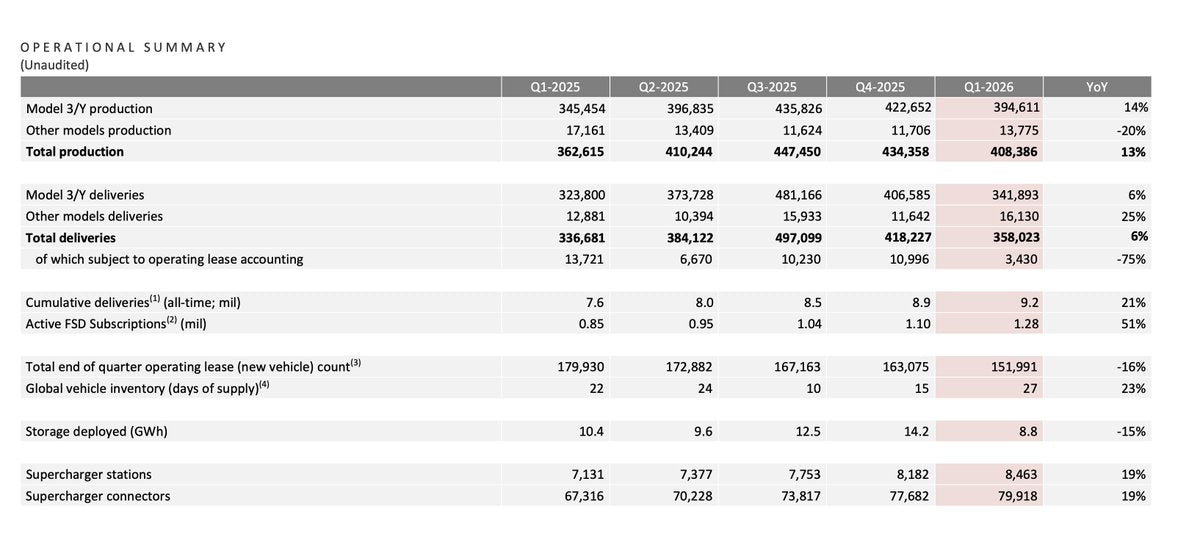
The News: Tesla set a new record for FSD subscriptions in Q1 2026, adding 180,000 new subscribers to reach 1.28 million total — a 51% increase from Q4 2025.
Why It Matters: This is the clearest signal yet that Tesla's shift to a subscription-only FSD model is paying off, generating $17.8 million in monthly recurring revenue and building the data flywheel that powers autonomous driving development.
Source: @SawyerMerritt on X
Tesla FSD Subscriptions Hit 1.28 Million in Q1 2026 — A Record Quarter
Tesla's Full Self-Driving program just posted its biggest subscriber quarter ever. The company added 180,000 new FSD subscribers in Q1 2026, pushing the total active base to 1.28 million — a 51% surge from the 1.1 million recorded at the end of Q4 2025. The numbers, first reported by @SawyerMerritt, confirm what Tesla officially disclosed: this was a record quarter for new FSD subscription additions.

📊 Key Figures
| Metric | Value | vs Prior Period |
|---|---|---|
| Total Active FSD Subscribers (Q1 2026) | 1.28 million | +51% vs Q4 2025 |
| New Subscribers Added (Q1 2026) | 180,000 | Record quarter |
| Total Active FSD Subscribers (Q4 2025) | 1.1 million | Prior baseline |
| Monthly Recurring Revenue (FSD) | $17.8 million/mo | Tied to record sub count |

🔭 The BASENOR Take
Timeline: Q1 2026 (January – March 2026)
Impact Level: 🟢 High — Record growth in a core recurring revenue stream
Confidence: ✅ Confirmed — Officially disclosed by Tesla, reported by @SawyerMerritt
The headline number is impressive, but the real story is why it happened. On February 14, 2026, Tesla quietly closed the door on one-time FSD purchases, moving entirely to a subscription model. That structural shift removed the high upfront cost barrier — previously as much as $15,000 — and replaced it with a monthly payment that's far easier for owners to justify. The record Q1 subscriber additions are a direct consequence of that decision.
For context on our FSD coverage: the subscription model also gives Tesla something the one-time purchase never could — a recurring revenue line that scales predictably with fleet size. At 1.28 million subscribers, Tesla is now generating approximately $17.8 million every single month from FSD alone, before accounting for any hardware or vehicle revenue. Annualized, that's over $213 million in high-margin recurring income from a feature that runs on existing hardware.
There's also a strategic incentive layer worth noting. The disclosure of FSD subscription numbers is reportedly tied to Elon Musk's 2025 CEO Performance Award, meaning Tesla has a formal obligation to track and report these figures transparently. That accountability is unusual for a software metric and signals just how central FSD adoption has become to Tesla's long-term valuation story.
📰 Deep Dive
A 51% quarter-over-quarter jump in any subscription product would turn heads in any industry. In the context of Tesla's FSD program — which has faced years of skepticism about its timeline and commercial viability — it's a meaningful inflection point. The shift to subscription-only access in February 2026 was a calculated bet: accept lower per-unit revenue in exchange for a broader, stickier user base. The Q1 numbers suggest that bet is working.
The data flywheel implications are significant. Every new FSD subscriber is also a new data source. More miles driven under FSD supervision means more edge cases captured, more training data generated, and faster iteration cycles for Tesla's neural network. At 1.28 million active subscribers, Tesla is accumulating autonomous driving data at a scale that is difficult for any competitor to replicate. The commercial and technical advantages compound together.
Looking at the revenue picture: $17.8 million per month is a relatively modest figure against Tesla's total quarterly revenue, but the trajectory matters more than the absolute number right now. If Tesla can sustain even half this growth rate through Q2 and Q3 2026, the annual FSD recurring revenue run rate could approach $300 million by year-end — entirely from software, on vehicles already on the road. That's the kind of high-margin revenue that changes how analysts model Tesla's long-term business.
For owners still on the fence about subscribing, the record adoption figures carry a practical signal: the FSD product is clearly resonating with a growing portion of the fleet. Whether that reflects genuine capability improvements, the lower subscription price point, or simply the removal of the one-time purchase option is hard to isolate — but the direction of travel is unambiguous. Tesla's autonomous driving ambitions now have a real, measurable commercial foundation under them.

Marcus covers Tesla's software releases, FSD rollouts, and OTA changes. Background in automotive engineering. Based in Austin.
Sources verified at publish time. Spotted an inaccuracy? Email editorial@basenor.com.