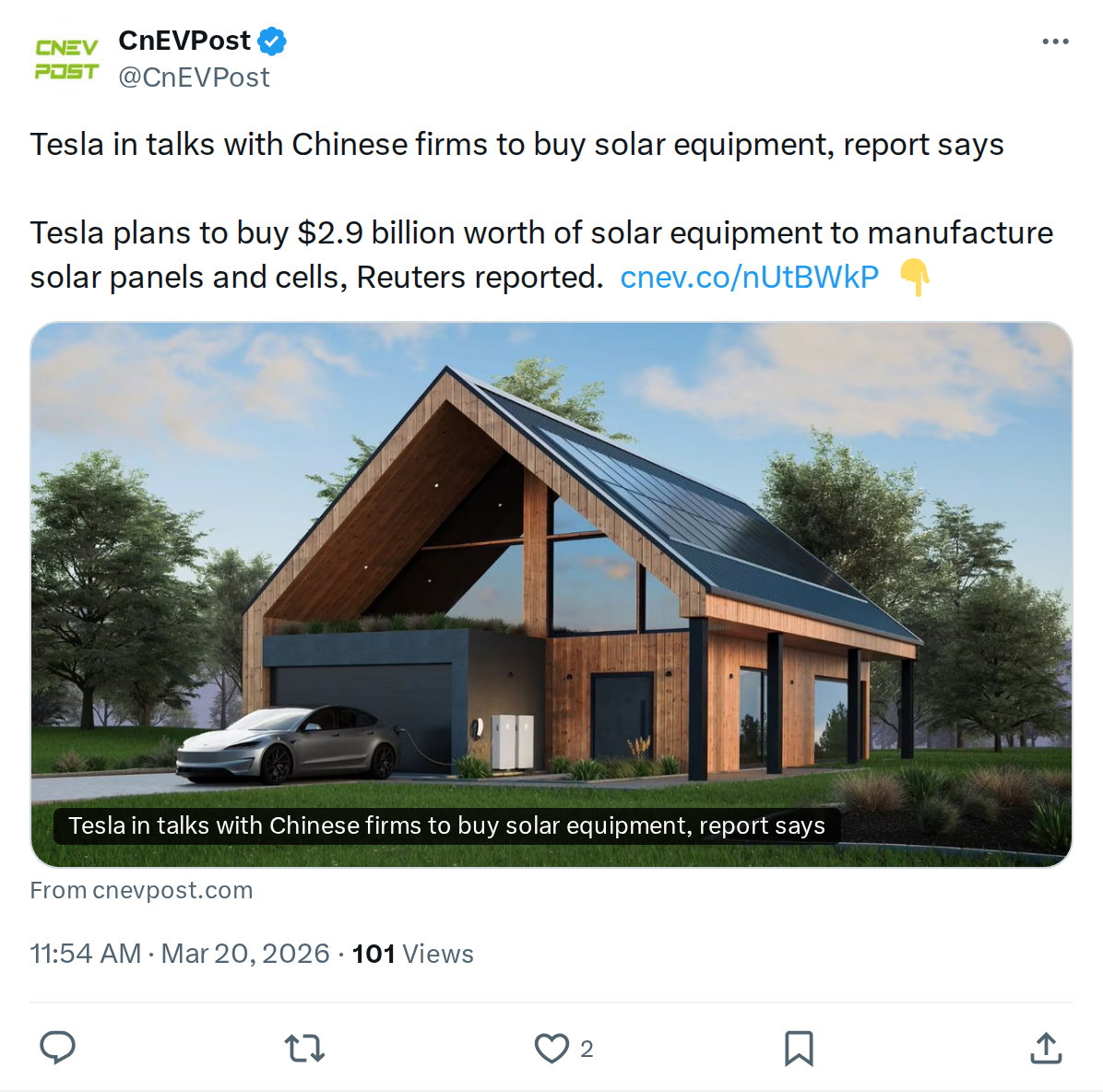
The News: Tesla is in discussions with Chinese manufacturers to purchase approximately $2.9 billion (20 billion yuan) worth of solar manufacturing equipment, according to a Reuters report cited by CnEVPost.
Why It Matters: This is a major step toward Elon Musk's stated goal of 100 GW of U.S. solar production capacity by 2028 — a target that would transform Tesla Energy from a niche product line into a core business pillar.
Source: @CnEVPost on X — March 20, 2026

📊 Key Figures
🇨🇳 Deal at a Glance
| Metric | Detail |
|---|---|
| Deal Value | $2.9 billion (20 billion yuan) |
| Target Capacity | 100 GW U.S. solar production by 2028 |
| Delivery Deadline | Before autumn 2026 |
| Destination | Texas (among other locations) |
| Tariff Status | Exempt (Biden admin, 2024) |
| Export Approval Required | Yes — for screen-printing lines |
The Story Behind the Numbers
According to the Reuters report cited by CnEVPost, Tesla is in active negotiations with at least three Chinese equipment suppliers: Suzhou Maxwell Technologies, Shenzhen S.C New Energy Technology, and Laplace Renewable Energy Technology. Suzhou Maxwell Technologies is reportedly the leading candidate to supply screen-printing equipment — a critical component in solar cell manufacturing.
The equipment is reportedly destined for U.S.-based facilities, with some shipments headed to Texas. Chinese suppliers have been instructed to deliver before autumn 2026, suggesting Tesla is moving with urgency to get production lines operational. Notably, some of the equipment — particularly screen-printing production lines — will require export approval from Chinese regulators before it can ship, adding a layer of geopolitical complexity to the deal.
One detail that makes this deal financially viable: solar manufacturing equipment was excluded from U.S. tariffs by the Biden administration in 2024. That exemption significantly reduces the cost burden of sourcing from China, even amid the broader trade tensions that have complicated U.S.-China commercial relationships.
Why Tesla Is Building Its Own Solar Manufacturing
Tesla's solar business has long been seen as underperforming relative to its potential. The company sells Solar Roof tiles and solar panels, but manufacturing capacity has been a persistent constraint. This deal signals a fundamental shift in strategy: rather than relying on third-party panel suppliers, Tesla appears to be building the infrastructure to manufacture solar cells and panels at scale in-house.
The stated goal of 100 gigawatts of U.S. solar production capacity by 2028 is an extraordinarily ambitious target. For context, total U.S. solar installations in recent years have hovered in the 20-30 GW annual range. Tesla achieving 100 GW of manufacturing capacity would position it as one of the largest solar producers on the planet.
The solar capacity from this equipment is reportedly intended primarily for Tesla's own operations — meaning the energy generated would power Tesla's factories, Supercharger network, and other infrastructure. A portion is also reportedly designated to power SpaceX satellites, reflecting the deep operational overlap between Musk's companies.
🔭 The BASENOR Take
Timeline: Equipment delivery targeted before autumn 2026 | 100 GW capacity goal by 2028
Impact Level: 🟡 Medium-term (significant for Tesla Energy; limited immediate impact on vehicle owners)
Confidence: Medium-High — Reuters sourcing with multiple industry insiders; no official Tesla confirmation yet
This is a story with two layers. On the surface, it's a supply chain move — Tesla buying equipment to build solar panels. But the scale ($2.9 billion, 100 GW target) suggests this is a foundational bet on energy as Tesla's next major revenue driver, not just a supporting business.
For Tesla owners, the most direct implication is long-term: a Tesla that manufactures its own solar at scale is a Tesla that can offer more competitive Powerwall + Solar Roof bundles, potentially lower Supercharger energy costs, and a more vertically integrated energy ecosystem. The vision of a Tesla owner generating power from a Tesla Solar Roof, storing it in a Tesla Powerwall, and charging their Tesla vehicle — all at lower cost — becomes more achievable if Tesla controls the full manufacturing chain.
The geopolitical angle is worth watching. While the equipment itself is tariff-exempt, the export approval requirement from Chinese regulators introduces real risk. If U.S.-China trade tensions escalate further, those approvals could be delayed or denied — potentially setting back Tesla's solar ambitions significantly. The autumn 2026 delivery deadline also leaves little margin for regulatory friction.
Finally, the SpaceX connection is a reminder of how intertwined Musk's ventures have become operationally. Solar capacity that powers SpaceX satellites is capacity that doesn't flow to Tesla's commercial energy products — a tradeoff that Tesla's energy customers may eventually feel. For now, though, the sheer scale of the stated 100 GW target suggests there should be more than enough capacity to go around, if Tesla can execute.

Sarah focuses on Tesla Energy, SpaceX missions, and the broader Musk AI portfolio. Former data analyst in clean energy. Based in San Francisco.
Sources verified at publish time. Spotted an inaccuracy? Email editorial@basenor.com.