📌 UPDATE — April 14, 2026
FSD v14.3 won't arrive as a standalone rollout — it's now confirmed to ship as part of Tesla's broader Spring Update 2026. Beyond the FSD improvements already detailed below, the Spring Update bundles in a dedicated Self-Driving app, "Hey Grok" voice wake, updated Pet Mode with custom avatars and pet naming, refreshed parking car visualization for Model 3/Y, multi-trip tracking in Trip Stats, new Sketchpad creative tools (stickers, emojis, saves), and custom wraps and tints for Model S/X owners.

📌 UPDATE — April 8, 2026
Early real-world footage of FSD v14.3 is reinforcing Tesla's "most humanlike self-driving" claim — but in at least one key scenario, it's performing better than human. Video shared by @TeslaNewswire shows the system reacting with remarkable speed to a pedestrian stepping into the road at night, a situation where human reaction time typically lags. Separately, @wholemars (Whole Mars Catalog) published a dedicated showcase video describing v14.3 as self-driving that "doesn't waste your time," highlighting its smoother, more natural driving style consistent with the 20% faster reaction time noted at launch.


📌 UPDATE — April 8, 2026
Two additional v14.3 improvements have been confirmed in the wild. First, the limited camera visibility warning has been redesigned — it now displays the affected camera feed in a full-window view rather than a small thumbnail, making it significantly easier for drivers to assess the obstruction at a glance. Second, real-world footage is showing off just how sharp that advertised faster reaction time really is: FSD v14.3 brakes with near-instant response when a vehicle pulls out of a parking spot, a scenario that previously caught older versions off guard. Tesla also officially weighed in, highlighting FSD Supervised's ability to reduce the cognitive load and physical tension that makes daily commuting so draining.
🎥 Fast braking reaction — parking lot pullout

via @TeslaNewswire
📷 New full-window camera visibility warning

via @TeslaNewswire
📌 UPDATE — April 8, 2026
Early user feedback on FSD v14.3 is strongly positive, with some drivers noticing the improvements immediately — even those who typically don't notice differences between updates. Prominent Tesla commentator @wholemars reports that his girlfriend, an everyday driver, called out the update unprompted: "The way it stops at stop signs, the confidence… it feels more humanlike." This real-world reaction aligns with Tesla's claimed 20% faster reaction time and points to the stop sign handling improvements being the most perceptible change for passengers and non-enthusiast riders.

📌 UPDATE — April 8, 2026
Tesla AI officially confirmed the v14.3 rollout has begun, with the upgraded Reinforcement Learning stage highlighted as a key change alongside the 20% faster reaction time. Early real-world impressions from @SawyerMerritt back up the release notes: highway follow distance feels more natural, acceleration from stop signs is noticeably snappier, and the lane-change hesitation that plagued previous versions appears resolved in initial testing.


📌 UPDATE — April 7, 2026
Early real-world impressions of FSD v14.3 are coming in, and speed profile behavior is emerging as a notable improvement. Teslascope reports that v14.3 appears to have refined speed profiles, reducing instances where FSD would exceed posted speed limits and delivering a noticeably smoother overall ride. This is separate from the previously documented 20% faster reaction time — it points to more nuanced velocity management throughout a trip, not just in reactive scenarios. If confirmed across a wider sample of drives, this could be one of the more impactful under-the-hood changes in this release. 🔍

📌 UPDATE — April 7, 2026 🔍
Early adopters are now getting hands-on with FSD v14.3, and two parking features are stealing the spotlight. A new 'P' icon appears on the map to help the car predict and pin parking locations more accurately — first spotted in the wild by @TeslaNewswire. More significantly, details are emerging about 'Banish', Tesla's fully end-to-end autonomous parking solution: you exit the vehicle at your destination, it drives off to find parking on its own, then navigates back to you when summoned — in all conditions. Teslascope notes they've received early reports of Banish performing well in real-world testing. Prominent Tesla watchers including @SawyerMerritt and @wholemars have confirmed v14.3 is installed and are beginning video documentation of the new features.


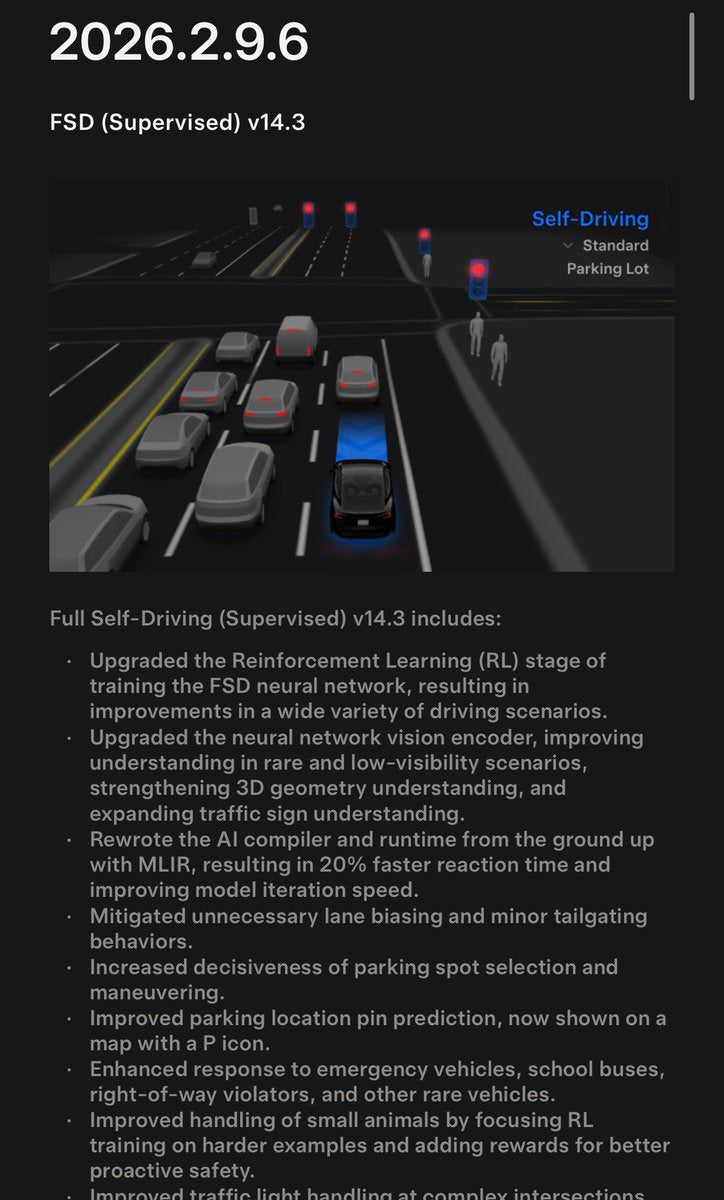
The News: Tesla has begun rolling out FSD (Supervised) v14.3 via software update 2026.2.9.6 to select owners — Elon Musk called this version the one where "the last big piece of the puzzle finally lands."
Why It Matters: This is the most technically significant FSD release in recent memory, delivering a 20% faster AI reaction time, rewritten neural network infrastructure, smarter parking, and improved small-animal detection — all on a single update.
Sources: @SawyerMerritt · @teslascope · @TeslaNewswire
Tesla FSD (Supervised) v14.3 Is Rolling Out Now: Every Change Explained
Tesla FSD (Supervised) v14.3 has officially begun rolling out to select owners via software version 2026.2.9.6, and the scope of changes under the hood is unlike anything in recent FSD history. This isn't a patch — it's a foundational rebuild. Here's everything that changed and exactly what you should do right now.

📊 What Changed in FSD v14.3
| Change | Type | Models |
|---|---|---|
| 20% faster AI reaction time — MLIR-based rewrite of AI compiler and runtime | Official | HW4 vehicles |
| Upgraded neural network vision encoder — better rare/low-visibility scenarios and 3D geometry | Official | HW4 vehicles |
| Upgraded RL training stage — improvements across varied driving situations | Official | HW4 vehicles |
| Parking location pin prediction — now displayed on map with a 'P' icon | Official | HW4 vehicles |
| More decisive parking spot selection and maneuvering | Official | HW4 vehicles |
| Small animal detection — RL training focused on harder examples, added proactive safety rewards | Official | HW4 vehicles |
| Emergency vehicles, school buses, right-of-way violators — enhanced response to rare vehicle types | Official | HW4 vehicles |
| Complex intersection handling — compound lights, curved roads, yellow light stopping via harder RL fleet examples | Official | HW4 vehicles |
| Unusual object detection — improved handling of objects extending, hanging, or leaning into the vehicle's path | Official | HW4 vehicles |

The Headline Number: 20% Faster Reaction Time
The single most significant technical change in v14.3 isn't a feature you'll see on a menu — it's the complete rewrite of Tesla's AI compiler and runtime using MLIR (Multi-Level Intermediate Representation). The result: a 20% improvement in reaction time across the board.
To put that in context: if FSD previously needed 100ms to process a scene and respond, it now does it in roughly 80ms. At highway speeds, that's the difference between reacting to a hazard several feet earlier. This isn't a UI polish — it's a fundamental change to how fast the car thinks.

Parking Gets a Real Upgrade
Two parking-specific changes stand out in v14.3. First, the system now predicts your parking destination and pins it on the map with a 'P' icon — so you can see where FSD intends to park before it commits. Second, the car is simply more decisive: less hesitation, cleaner entries into spots, and smoother maneuvering once a spot is selected.
If you've ever watched FSD creep toward a spot, second-guess itself, and then awkwardly re-approach — this update is directly targeting that behavior.

Small Animals, Big Deal
One of the more quietly meaningful changes in v14.3 is the improvement to small animal detection. Tesla's release notes describe it as "focusing RL training on harder examples and adding rewards for better proactive safety" — meaning the car is now actively trained to anticipate and avoid small animals rather than simply reacting when they're already in the path.

Hardware 3 Owners: What You Need to Know
The initial rollout of FSD v14.3 is targeting Hardware 4 (HW4) vehicles first. If your Tesla runs on Hardware 3, you're not forgotten — but you're on a different timeline. According to background research, a "FSD v14 Lite" variant for HW3 vehicles is anticipated around mid-2026. Check your vehicle's hardware generation in Controls → Software → Additional Vehicle Information.

🚦 Owner's Action Plan
Step 1 — Check for the update now
Go to Controls → Software and tap Check for Updates. If you're on an HW4 vehicle and have FSD enabled, you may already have 2026.2.9.6 queued. Rollout is staggered, so not everyone gets it simultaneously.
Step 2 — Verify your hardware generation
Go to Controls → Software → Additional Vehicle Information. Look for "Autopilot computer" — if it reads "Full Self-Driving Computer (HW4)" you're in the first wave. HW3 owners should expect a separate v14 Lite release around mid-2026.
Step 3 — Schedule the install for a connected moment
Stay on Wi-Fi and plug in overnight if possible. OTA installs complete faster on a stable connection and the car needs to be in Park. Set a Software Update Preference to "Advanced" if you want updates as soon as they're available.
Step 4 — After installing, test parking first
The parking changes are the most immediately noticeable. Head to a parking lot and engage FSD — watch for the new 'P' icon on the map showing the predicted parking pin. This is a good quick sanity check that the update installed correctly.
Step 5 — Report your experience
Tesla's RL training improves from real-world feedback. Use the thumbs-up/down button on the FSD UI after each drive segment. Your data directly shapes the next version. For our FSD coverage, we'll be tracking community reports as the rollout expands.

📰 Deep Dive
Elon Musk's framing of v14.3 as the version where "the last big piece of the puzzle finally lands" is worth taking seriously — not as hype, but as a technical signal. The MLIR rewrite of the AI compiler is not a feature addition; it's infrastructure work that unlocks headroom for everything that follows. When the foundation of how the neural network compiles and runs is rebuilt for speed, every subsequent improvement — better vision, better RL training, better edge case handling — compounds on top of a faster base. That's a qualitatively different kind of update than adding a new parking UI element.
The upgraded neural network vision encoder is equally significant. Improvements in "rare and low-visibility scenarios" and "3D geometry understanding" directly address the class of situations where FSD has historically struggled most — unusual lighting, uncommon road configurations, ambiguous object shapes. These are the scenarios that erode driver trust fastest, and they're the hardest to fix with simple training data additions. Upgrading the encoder architecture itself suggests Tesla is attacking the problem at a deeper level.
The small animal and complex intersection improvements share a common thread: both rely on the upgraded RL training stage targeting "harder examples" from the fleet. This is Tesla's data flywheel in action — millions of vehicles encountering edge cases, those examples being curated and fed back into training, and the resulting model being more robust precisely because it was trained on the scenarios where previous versions failed. The proactive safety reward for animal avoidance is a particularly notable design choice, shifting the system from reactive to anticipatory behavior.
For HW3 owners watching from the sidelines, the mid-2026 timeline for FSD v14 Lite is the key date to track. The "Lite" designation suggests some features may be constrained by the older compute platform, but the core RL and vision improvements are expected to carry over in some form. The gap between HW3 and HW4 capability is widening with each major release — something prospective buyers and current owners considering the HW3-to-HW4 upgrade path should weigh carefully. Follow our all software updates coverage for the latest on the HW3 rollout timeline as it develops.
📋 Tracking Tesla software? See every firmware, FSD and app version in one place in our Tesla Software Update Tracker.
Related Gear
Gear up your Tesla with tested, custom-fit BASENOR accessories — shop Tesla accessories →
Sources & reporting notes
The links below identify the material source records used for this report.
- @teslascope on X (2026-04-07T19:29:43.000Z) — Direct source
- @teslascope on X (2026-04-07T19:22:46.000Z) — Direct source
- @SawyerMerritt on X (2026-04-07T19:19:04.000Z) — Direct source
- @wholemars on X (2026-04-07T19:53:26.000Z) — Direct source
- @wholemars on X (2026-04-07T19:49:43.000Z) — Direct source
- @TeslaNewswire on X (2026-04-07T19:55:03.000Z) — Direct source
- @TeslaNewswire on X (2026-04-07T19:31:16.000Z) — Direct source
- @teslascope on X (2026-04-07T19:18:11.000Z) — Direct source
- @SawyerMerritt on X (2026-04-07T21:53:19.000Z) — Direct source
- @wholemars on X (2026-04-07T21:20:02.000Z) — Direct source
- @TeslaNewswire on X (2026-04-07T21:25:32.000Z) — Direct source
- @teslascope on X (2026-04-07T21:33:45.000Z) — Direct source
- @teslascope on X (2026-04-07T22:10:22.000Z) — Direct source
- @Tesla_AI on X (2026-04-08T00:40:22.000Z) — Direct source
- @SawyerMerritt on X (2026-04-08T00:56:35.000Z) — Direct source
- @SawyerMerritt on X (2026-04-08T00:57:36.000Z) — Direct source
- @wholemars on X (2026-04-08T02:47:15.000Z) — Direct source
- @Tesla on X (2026-04-08T04:39:54.000Z) — Direct source
- @TeslaNewswire on X (2026-04-08T04:28:50.000Z) — Direct source
- @TeslaNewswire on X (2026-04-08T04:17:28.000Z) — Direct source
- @wholemars on X (2026-04-08T05:32:41.000Z) — Direct source
- @TeslaNewswire on X (2026-04-08T05:47:44.000Z) — Direct source
- @wholemars on X (2026-04-14T00:49:55.000Z) — Direct source
- @NowRollingOut on X (2026-04-14T00:58:55.000Z) — Direct source
Source links are preserved as published or accessed. See our editorial standards and corrections policy.
The BASENOR Editorial Desk covers Tesla, SpaceX, and related technology, curating reporting from primary sources — official accounts, regulatory filings, and software release data. Every article passes source-record and fact-checking review before publication. About the newsroom.
This report was curated by the BASENOR Editorial Desk from the sources listed above. Read our editorial standards or email editorial@basenor.com to report an error.