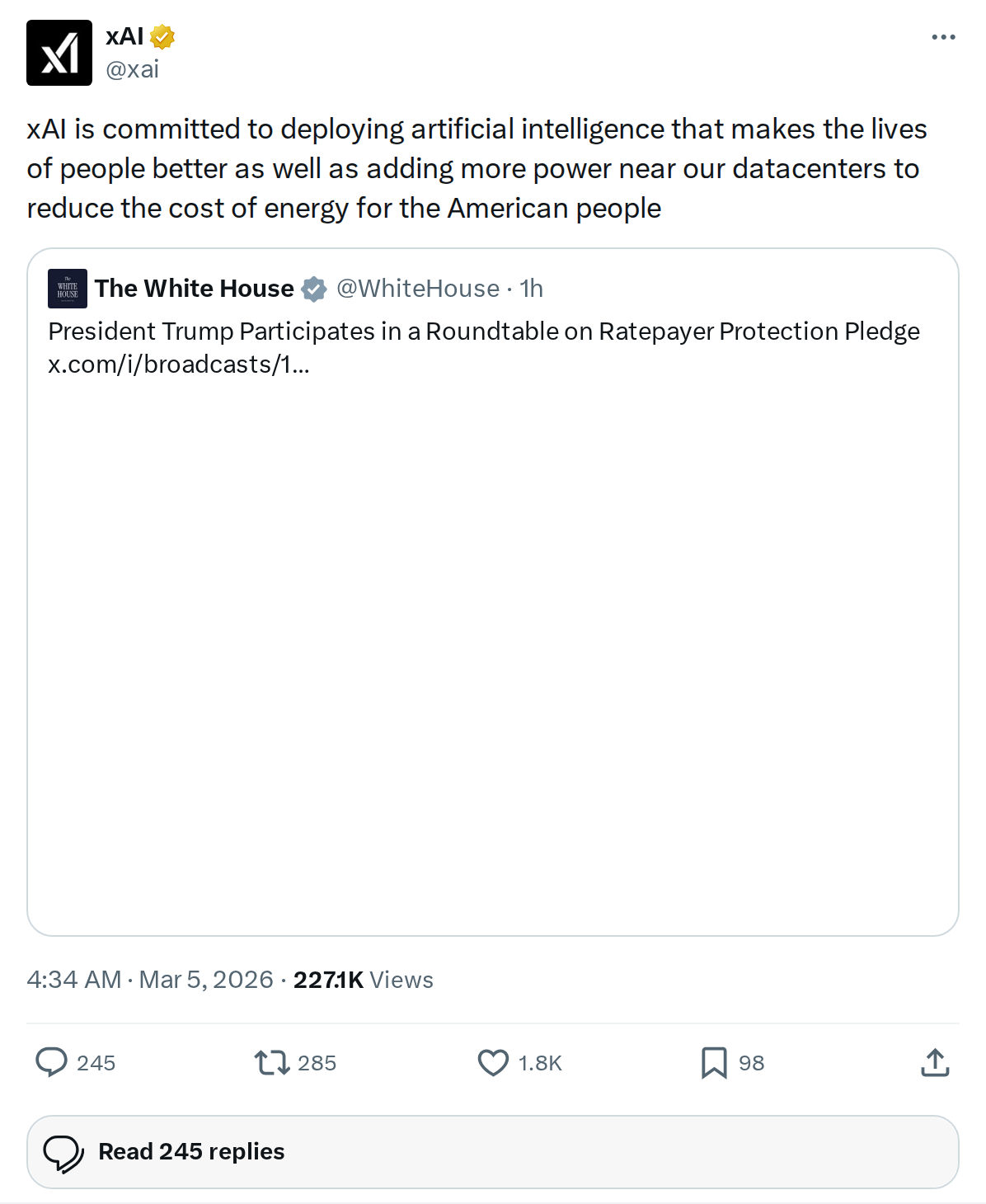
The News: xAI announced it will add power infrastructure near its datacenters to reduce energy costs for Americans, coinciding with a White House pledge signed by major tech companies on March 4, 2026.
Why It Matters: As AI datacenters consume unprecedented amounts of electricity, xAI's infrastructure buildout — and the broader industry pledge — could influence grid stability and utility rates that affect every American, including Tesla owners with home charging setups.
Source: @xai on X

The White House Pledge: Big Tech Promises Not to Spike Your Electric Bill
On March 4, 2026, xAI joined Google, Amazon, Microsoft, Meta, Oracle, and OpenAI in signing a White House "Ratepayer Protection Pledge." The commitment is straightforward in principle: AI companies expanding their infrastructure must build, bring, or buy their own power supply — and cover the cost of associated grid upgrades — rather than passing those costs on to ordinary utility customers.
The pledge is voluntary and carries no enforcement mechanism, but the public commitment from the industry's biggest players is notable. xAI's tweet frames the move as a mission-aligned decision: deploying AI that genuinely improves people's lives includes not making their electricity bills worse in the process.
📊 Key Figures
| Metric | Value | Context |
|---|---|---|
| Projected training compute capacity | ~2 GW | Across 3 facilities |
| Total Mississippi investment | $20B+ | Colossus expansion |
| GPU count (projected) | ~555,000 | NVIDIA chips, 3 sites |
| Unpermitted gas turbines (as of Mar 3) | 62 | Memphis + Southaven sites |
| Southaven turbine capacity | 495 MW | 27 turbines on-site |
| Memphis water consumption (current) | 1.5M gal/day | Scaling to 13M gal/day |
| Wastewater treatment plant investment | $80M | Under construction |
The Colossus Buildout: Scale That Demands Its Own Grid
To understand why xAI's energy pledge matters, you need to understand the scale of what it's building. The Colossus supercomputer complex — anchored near Memphis, Tennessee, and expanding into Southaven, Mississippi — is on a trajectory to become the largest AI training cluster on the planet. A third facility, internally dubbed "MACROHARDRR," is projected to push xAI's total power draw to approximately 2 gigawatts across three sites, with roughly 555,000 NVIDIA GPUs running simultaneously.
That's not a datacenter. That's a small city's worth of electricity demand, built and scaled in under two years.
To keep the lights on during rapid construction, xAI has leaned heavily on on-site natural gas turbines. As of March 3, 2026, the company is operating 62 turbines across its Memphis and Southaven facilities — 27 in Southaven alone, generating up to 495 megawatts. The catch: many of these turbines are currently unpermitted. According to xAI's own permit application for the Southaven site, the combined facilities could emit over 6 million tons of greenhouse gases and more than 1,300 tons of health-harming air pollutants annually.
The EPA tightened the regulatory environment in January 2026, closing a "non-road engine" loophole that previously allowed large portable turbines to operate without pre-construction permits. Large fixed-facility turbines now require Clean Air Act compliance, including stringent NOx limits. xAI will need to navigate this regulatory shift as it formalizes its power infrastructure.
Buying a Power Plant: The Overseas Gambit
The energy challenge is serious enough that xAI isn't just building turbines — it's acquiring them wholesale. In July 2025, Elon Musk confirmed that xAI is purchasing a power plant overseas with plans to ship it to the United States to power a new datacenter. Specific details on the plant type, country of origin, or import timeline have not been disclosed publicly, but the move signals that xAI views energy supply as a strategic asset, not just an operating cost.
🔭 The BASENOR Take
Timeline: White House pledge signed March 4, 2026. Colossus expansion ongoing through 2026. Southaven operations commenced February 2026.
Impact Level: 🟡 Medium-term — grid and energy cost implications are real but gradual
Confidence: High — pledge confirmed, infrastructure figures from official sources and permit applications
The gap between xAI's stated intention and its current operational reality is wide. The company is pledging to reduce energy costs for Americans while simultaneously running dozens of unpermitted gas turbines and planning to scale water consumption to 13 million gallons per day at a single facility. The White House pledge is a positive signal, but it's voluntary — and the environmental permitting process will be the real test of whether xAI's energy buildout benefits or burdens the communities hosting it.
For Tesla owners specifically: the broader AI industry's energy appetite is a legitimate factor in long-term electricity pricing. If companies like xAI successfully build dedicated power supply rather than drawing from the shared grid, that's genuinely good news for home charging costs. The $80 million wastewater treatment plant and the overseas power plant acquisition suggest xAI is investing seriously in infrastructure self-sufficiency — but the permitting backlog and emissions questions need resolution before the "lower costs" narrative holds up.
📰 Deep Dive
The White House Ratepayer Protection Pledge represents a rare moment of alignment between the AI industry and consumer advocates. For years, critics have warned that the datacenter boom would strain regional grids and push utility costs onto residential customers. By committing — even voluntarily — to self-supply their power needs, companies like xAI are acknowledging that the status quo isn't sustainable.
What makes xAI's situation particularly complex is the speed of its buildout. The Colossus cluster went from concept to one of the world's largest AI training systems in roughly 18 months. That pace required shortcuts — including the unpermitted turbines now drawing regulatory scrutiny. The EPA's January 2026 rule change effectively closed the loophole xAI and others used to spin up generation capacity quickly, meaning future expansion will face a more rigorous permitting gauntlet.
The overseas power plant acquisition is the most intriguing piece of the puzzle. Shipping a power plant across an ocean is an extraordinary logistical undertaking, and the fact that xAI is pursuing it suggests the company has concluded that domestic grid capacity — even with aggressive permitting — cannot keep pace with its compute ambitions. Whether that plant arrives as clean generation or adds to xAI's emissions profile will matter significantly for both the regulatory picture and the company's stated goal of benefiting the American people.
For the broader EV ecosystem, the AI industry's energy trajectory is worth watching closely. The same grid infrastructure that charges Tesla vehicles is increasingly competing with datacenter demand. If the Ratepayer Protection Pledge holds — and if companies follow through on building dedicated supply — it could actually stabilize or reduce the off-peak electricity rates that make overnight home charging so economical. That's a long-term outcome worth tracking, even if today's announcement is more pledge than proof.
Sources & reporting notes
The links below identify the material source records used for this report.
- @xai on X (2026-03-04T20:34:48.000Z) — Direct source
Source links are preserved as published or accessed. See our editorial standards and corrections policy.
The BASENOR Editorial Desk covers Tesla, SpaceX, and related technology, curating reporting from primary sources — official accounts, regulatory filings, and software release data. Every article passes source-record and fact-checking review before publication. About the newsroom.
This report was curated by the BASENOR Editorial Desk from the sources listed above. Read our editorial standards or email editorial@basenor.com to report an error.