📌 UPDATE — Feb 27, 2026 🔍
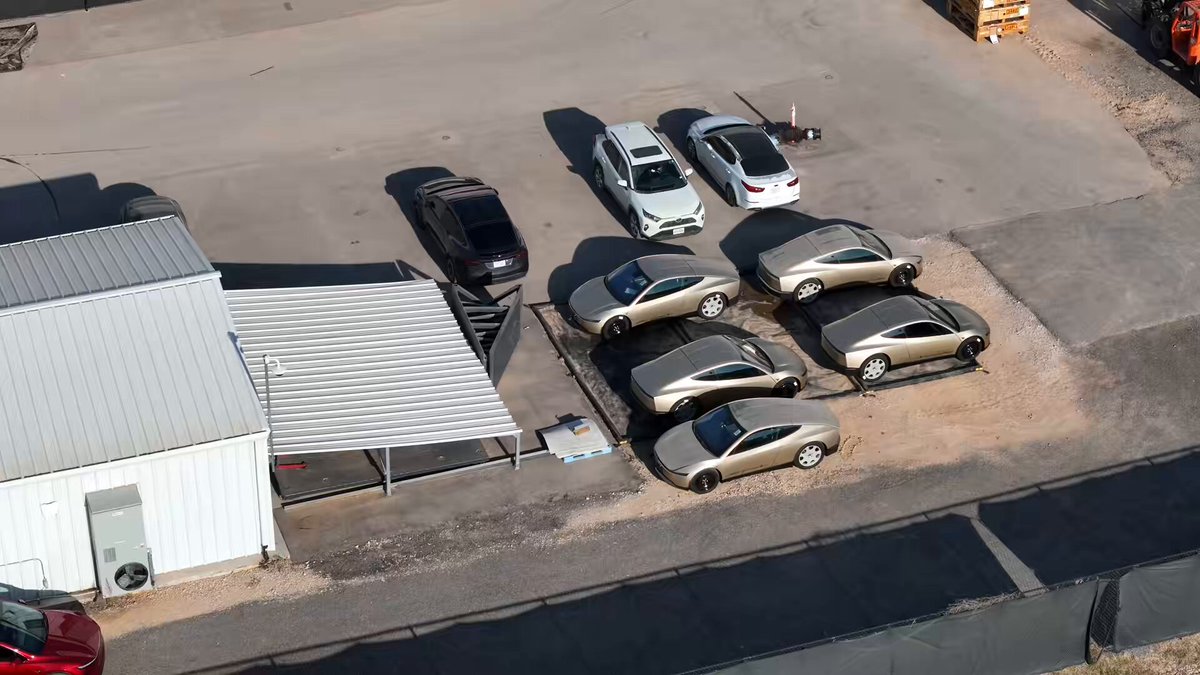
Fresh drone footage from Joe Tegtmeyer reveals checking fixtures (inspection jigs) for Cybercab's large thermoplastic injection-molded exterior body panels have now appeared on-site at Giga Texas — distinct from the injection mold dies previously reported, these gauges are used to verify panel geometry and fit. The discovery signals Tesla's body panel quality-control infrastructure is being staged ahead of volume production ramp.
Separately, significant new earthwork is underway at the North Campus, with a River Road extension permit shedding further light on site construction plans. A far southwest grading area is also emerging, possibly for a new test track and relocation of materials and construction staging. The campus expansion underscores the scale of infrastructure Tesla is laying in parallel with Cybercab production prep.


30-Second Brief
The News: Fresh drone footage from Giga Texas confirms a complete set of thermoplastic injection molds for the Cybercab exterior has arrived at the factory, and multiple steering-wheel-less Cybercab units have been observed exiting the production line.
Why It Matters: Observers with strong track records place the start of volume production just 4–8 weeks out — consistent with Elon Musk's previously stated April 2026 target — making this the clearest on-the-ground signal yet that Tesla's robotaxi era is imminent.
Sources: @JoeTegtmeyer • @SawyerMerritt — February 27, 2026
Cybercab Volume Production Is 4–8 Weeks Away: What the Giga Texas Footage Reveals
The Cybercab's march toward volume production just got a lot more concrete. Drone footage captured at Giga Texas on the morning of February 27, 2026, shows the factory floor humming with robotaxi activity — thermoplastic injection molds for the Cybercab's exterior panels have been delivered to the north end of the plant, and completed units are already rolling off the line without a steering wheel in sight.

📊 Key Figures
| Metric | Value | Context |
|---|---|---|
| Volume production target | April 2026 | Stated by Elon Musk |
| Estimated weeks to launch | 4–8 weeks | @SawyerMerritt estimate |
| First unit off the line | Feb 17, 2026 | Pre-production milestone |
| Target consumer price | <$30,000 | Before end of 2026 |
| Battery range | ~200 miles | 35 kWh pack, inductive charging |
| Parts vs. Model 3 | 50% fewer | Unboxed manufacturing process |
What the Drone Footage Actually Shows
Joe Tegtmeyer — whose Giga Texas overflights have a reliable track record — reported a complete set of thermoplastic injection molds for the Cybercab's exterior delivered to the north end of the factory. Thermoplastic injection molding is the process used to form body panels and trim pieces; receiving a full set of these molds signals that tooling for the exterior is now in place for sustained production, not just prototype runs.
Separately, Tegtmeyer also documented ongoing Giga Texas campus expansion: massive land clearing on the North Campus, the River Road extension beginning to take shape on the east side, and the Cortex 2 cooling system — both temporary and permanent installations — progressing rapidly. A potential large water tank location is also emerging. These are the infrastructure signatures of a factory gearing up for high-volume output, not just pilot production.

No Steering Wheels. Full Stop.
Perhaps the single most striking observation came from Sawyer Merritt, who noted plainly: 'None of these Cybercabs have steering wheels.' This matters because earlier prototype sightings occasionally fueled speculation about whether a steering-wheel variant might be produced to satisfy regulators. What's rolling off the Giga Texas line today is the product as designed — a fully autonomous two-seat vehicle with no manual controls whatsoever.

The first Cybercab rolled off the Giga Texas assembly line on February 17, 2026 — just ten days ago — marking the pre-production milestone. What today's footage confirms is that this was not a one-off event: multiple units are now being produced and observed at the facility, including at the on-site crash testing area where validation work is underway.
🔭 The BASENOR Take
| Timeline | Volume production April 2026 — 4 to 8 weeks from today |
| Impact Level | 🔴 High — First entirely new Tesla vehicle architecture since Cybertruck |
| Confidence | High on production timeline / Medium on near-term consumer availability (regulatory hurdles remain) |
The production side of the Cybercab story is looking increasingly strong. A complete exterior mold set delivered, multiple units in validation testing, and infrastructure expansion that matches what you'd expect from a factory ramping toward high-volume output — these are not vague indicators. They're the tangible, physical evidence of a vehicle entering mass production.
The bigger open question is not whether Tesla can build Cybercabs at scale, but whether the regulatory environment will allow those vehicles to actually operate at scale. Current US federal motor vehicle safety standards are written for human-controlled vehicles. Tesla has not logged active test miles with California regulators for its robotaxi service since 2019 and did not secure state approval in 2025. That gap between manufacturing readiness and legal deployment readiness is the central tension in the Cybercab story heading into spring 2026. For more on the autonomous driving regulatory landscape, see our FSD coverage.
From a pure manufacturing standpoint, the Cybercab is built around Tesla's 'Unboxed' process — a radical rethink of automotive assembly that targets a cycle time of one unit every 10 seconds and uses roughly 50% fewer parts than a Model 3. The thermoplastic injection molds being delivered now are central to that approach: thermoplastics allow faster, lighter panel production compared to traditional stamped steel, supporting both the vehicle's weight targets and the factory's throughput ambitions.
For existing Tesla owners watching from the sidelines: the Cybercab under $30,000 price point (before the end of 2026, according to Tesla's own statements) would make it the most accessible new Tesla ever. If autonomous deployment approvals follow production, the fleet economics of robotaxi operation could eventually reshape how Tesla owners think about vehicle ownership entirely. That's a bigger if — but today's footage makes the production half of that equation look very real.
🚕 Following the Robotaxi rollout? See every operating city, launch date and announced market in our Tesla Robotaxi Tracker.
Related Gear
Gear up your Tesla with tested, custom-fit BASENOR accessories — shop Tesla accessories →
Sources & reporting notes
The links below identify the material source records used for this report.
- @SawyerMerritt on X (2026-02-27T16:32:56.000Z) — Direct source
- @JoeTegtmeyer on X (2026-02-27T16:22:23.000Z) — Direct source
- @JoeTegtmeyer on X (2026-02-27T16:08:23.000Z) — Direct source
- @JoeTegtmeyer on X (2026-02-27T22:17:48.000Z) — Direct source
- @JoeTegtmeyer on X (2026-02-27T22:10:33.000Z) — Direct source
- @JoeTegtmeyer on X (2026-02-27T22:17:57.000Z) — Direct source
Source links are preserved as published or accessed. See our editorial standards and corrections policy.
The BASENOR Editorial Desk covers Tesla, SpaceX, and related technology, curating reporting from primary sources — official accounts, regulatory filings, and software release data. Every article passes source-record and fact-checking review before publication. About the newsroom.
This report was curated by the BASENOR Editorial Desk from the sources listed above. Read our editorial standards or email editorial@basenor.com to report an error.