30-Second Brief
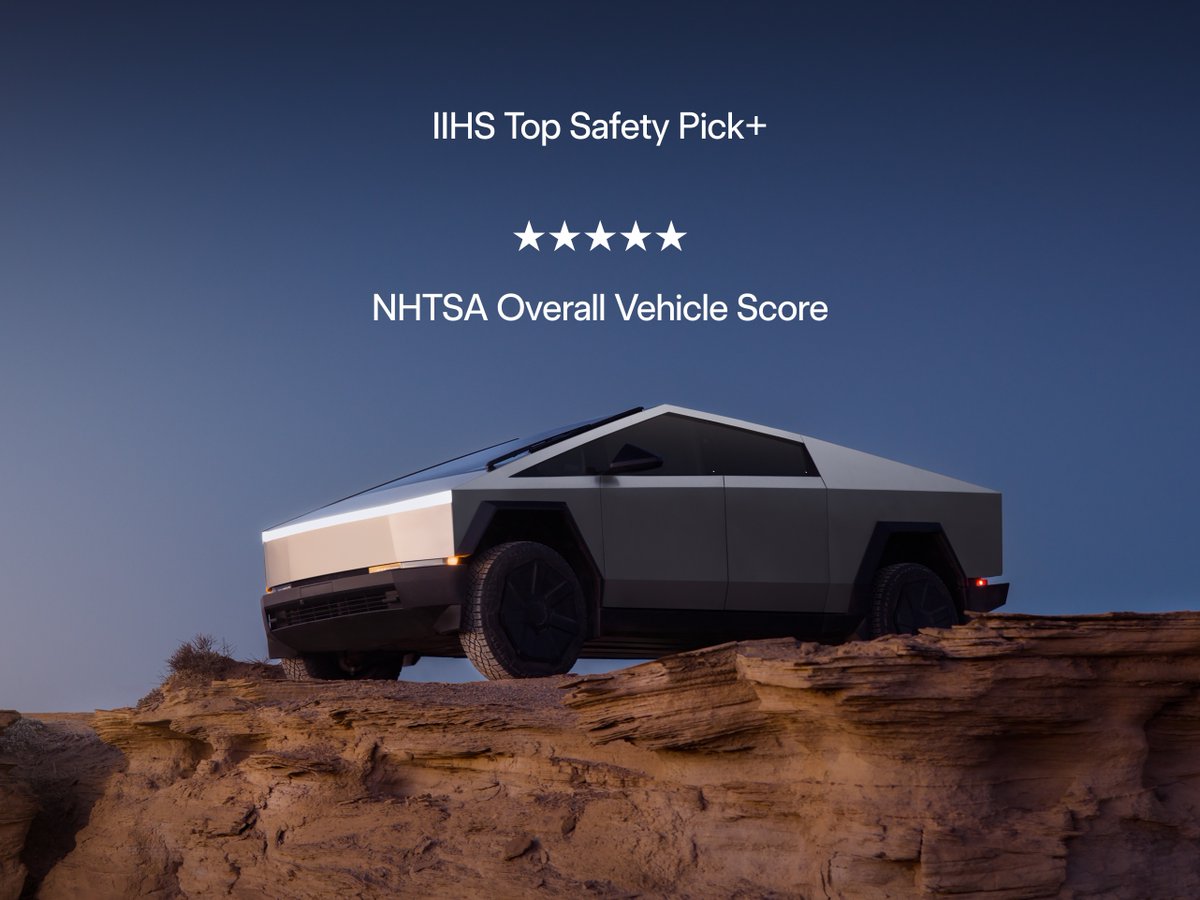
The News: Cybertruck is now the only pickup truck in America to hold both an IIHS Top Safety Pick+ Award and a NHTSA 5-star overall safety rating under the more stringent 2026 testing standards.
Why It Matters: Safety ratings directly affect insurance premiums, resale value, and peace of mind — and this double distinction puts the Cybertruck in a class of its own among trucks.
Sources: @cybertruck · @Tesla — March 24, 2026
Cybertruck Is the Only Pickup with Both IIHS Top Safety Pick+ and NHTSA 5-Star Rating Under 2026's Tougher Standards
Safety benchmarks got harder in 2026 — and the Cybertruck just cleared every bar. Tesla's stainless-steel truck has earned the IIHS Top Safety Pick+ Award, the Insurance Institute for Highway Safety's highest distinction, alongside a NHTSA 5-star overall safety rating. No other pickup truck has managed both under the new, more demanding 2026 criteria.

This isn't a legacy rating carrying over from easier tests. Both agencies updated their standards for 2026, with the IIHS placing new emphasis on pedestrian protection and rear-seat occupant safety — areas where many trucks have historically struggled. The Cybertruck passed both under these elevated requirements.

📊 What This Means: The Two Ratings Explained
| Rating Body | Award | What It Tests | 2026 Change |
|---|---|---|---|
| IIHS | Top Safety Pick+ | Crash tests, headlights, pedestrian detection, rear-seat protection | Stricter pedestrian and rear-occupant criteria added |
| NHTSA | 5-Star Overall | Frontal, side, and rollover crash performance | Updated 2026 testing protocols |
🏆 Exclusive Status: As of March 24, 2026, the Cybertruck is the only pickup truck in the U.S. market to hold both distinctions simultaneously under the 2026 standards.
Why 2026 Standards Are a Higher Bar
Each year, IIHS and NHTSA refine their testing protocols to reflect real-world crash data and emerging safety priorities. The 2026 cycle placed particular scrutiny on two areas that have historically been weak points for large trucks:
- Pedestrian safety: New tests evaluate how a vehicle's front-end geometry and automatic emergency braking perform in pedestrian strike scenarios — a critical metric given the height and mass of modern trucks.
- Rear-seat occupant protection: IIHS expanded its rear-seat testing to better simulate real-world multi-occupant crashes, an area where many full-size trucks have previously fallen short.
Clearing both agencies' updated requirements in the same model year — and being the only truck to do so — is a meaningful engineering achievement, not a marketing footnote.

🚦 Owner's Action Plan
Verdict: RECOMMENDED
No action required to receive these ratings — they apply to your existing Cybertruck. But there are a few smart moves to make right now.
- Contact your insurance provider. IIHS Top Safety Pick+ status is a recognized factor in premium calculations for many insurers. Call or log into your policy portal and ask whether this rating qualifies your Cybertruck for a safety discount. Some carriers apply this automatically; others require you to flag it.
- Update your vehicle records. If you're financing or leasing, some lenders track safety ratings for GAP insurance adjustments. Worth a quick check with your lender.
- Use this when selling or trading in. Dual IIHS/NHTSA recognition under 2026 standards is a concrete, verifiable spec — not a subjective claim. Include it in any private sale listing or bring it up at the dealership. It supports a stronger resale position.
- Verify your active safety features are enabled. These ratings assume your Autopilot-based active safety features (automatic emergency braking, forward collision warning, lane departure) are turned on. Check Controls → Autopilot in your touchscreen to confirm nothing has been inadvertently disabled.
📰 Deep Dive
The dual-rating achievement matters beyond bragging rights. IIHS and NHTSA use fundamentally different methodologies — the IIHS is funded by insurers and focuses heavily on real-world crash avoidance and occupant protection across a wide test matrix, while NHTSA's 5-star program uses government-standardized crash protocols. Satisfying both simultaneously signals that the Cybertruck's safety performance is consistent across testing philosophies, not optimized for one at the expense of the other.
The Cybertruck's exoskeleton construction — its cold-rolled stainless steel body panels and ultra-hard steel frame — has always been central to Tesla's safety pitch for the vehicle. That structural approach, combined with the low center of gravity from its floor-mounted battery pack, appears to be translating directly into top-tier crash test outcomes even as the goalposts moved in 2026. The truck's physical architecture does work that software alone cannot.
For the broader truck market, this is a notable moment. Traditional full-size pickups from legacy automakers have long held strong NHTSA ratings, but the newer, stricter IIHS criteria — especially around pedestrian detection and rear-seat protection — have proven harder to satisfy without modern sensor suites and updated structural designs. The Cybertruck's combination of advanced driver assistance hardware and unconventional construction appears to have given it an edge precisely where 2026's tougher standards applied the most pressure.

Marcus covers Tesla's software releases, FSD rollouts, and OTA changes. Background in automotive engineering. Based in Austin.
Sources verified at publish time. Spotted an inaccuracy? Email editorial@basenor.com.