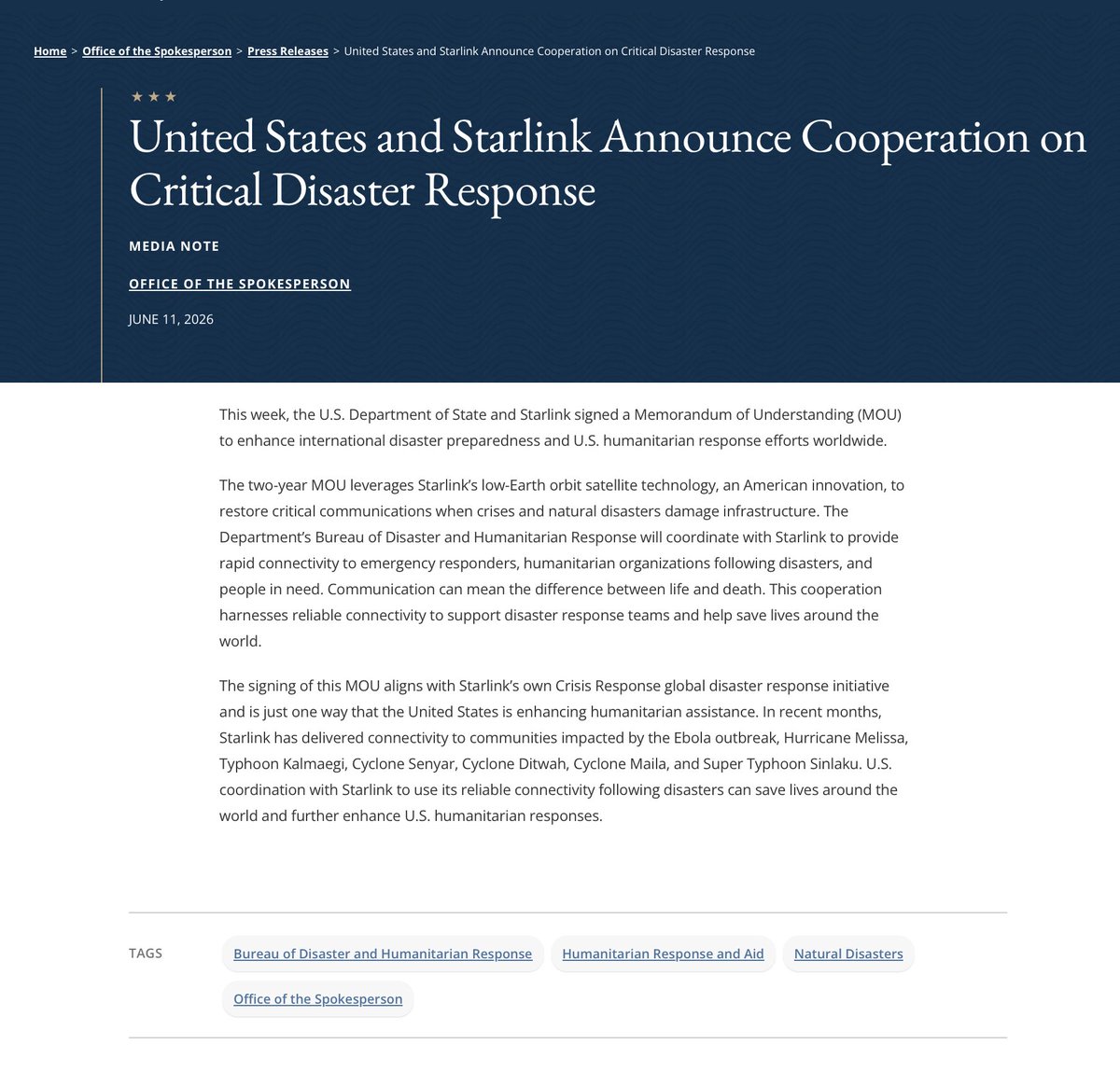
The U.S. State Department has formalized a two-year partnership with SpaceX, signing a Memorandum of Understanding to deploy Starlink satellite connectivity during international disasters and humanitarian crises. The agreement, announced on June 11–12, 2026, puts one of the world's most capable satellite networks directly behind U.S. foreign disaster response operations.

Under the MOU, the State Department's Bureau of Disaster and Humanitarian Response will coordinate directly with Starlink to restore communications in areas hit by natural disasters and crises — getting connectivity to emergency responders, humanitarian organizations, and affected communities as fast as possible. The deal aligns with Starlink's existing Crisis Response initiative, which has already seen the network deployed in Indonesia, the Philippines, Sri Lanka, and across multiple hurricane, typhoon, and cyclone events, including Hurricane Helene in North Carolina in September 2024.
The scale of the network backing this agreement is significant. According to Starlink, the constellation now comprises nearly 8,000 low-Earth orbit satellites serving over 12 million subscribers globally as of June 2026. For disaster zones where terrestrial infrastructure has been destroyed, that kind of coverage is difficult to match. Starlink's hardware lineup for emergency scenarios spans from the compact, power-efficient Starlink Mini to the ruggedized Performance terminal — practical considerations when aid workers are operating in the field with limited power.
This is the kind of government partnership that validates what Starlink has been building toward since its early deployments in Ukraine. Formalizing it with the State Department signals that satellite-based emergency connectivity is no longer a contingency plan — it's becoming standard operating procedure for U.S. humanitarian operations abroad. For more on SpaceX's expanding role, see our SpaceX coverage.
Sources & reporting notes
The links below identify the material source records used for this report.
- @SawyerMerritt on X (2026-06-13T14:29:26.000Z) — Direct source
Source links are preserved as published or accessed. See our editorial standards and corrections policy.
The BASENOR Editorial Desk covers Tesla, SpaceX, and related technology, curating reporting from primary sources — official accounts, regulatory filings, and software release data. Every article passes source-record and fact-checking review before publication. About the newsroom.
This report was curated by the BASENOR Editorial Desk from the sources listed above. Read our editorial standards or email editorial@basenor.com to report an error.