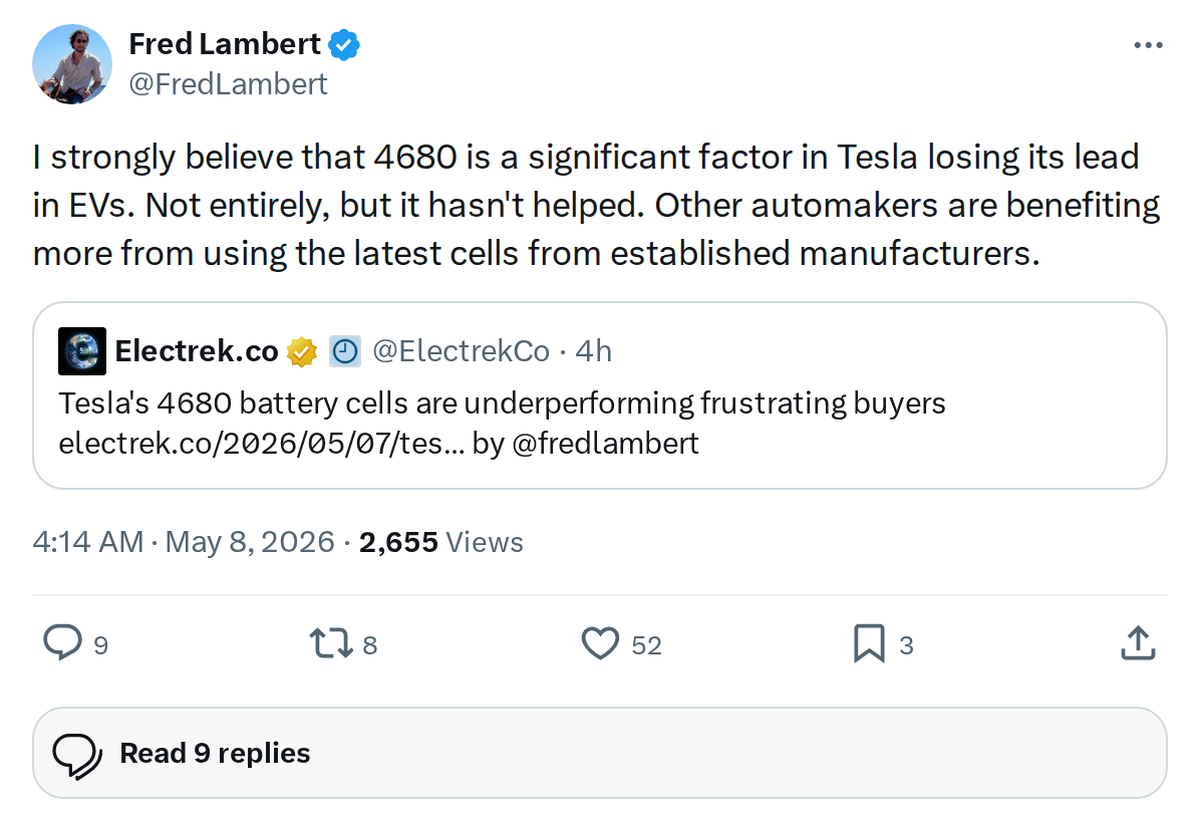
Electrek editor-in-chief Fred Lambert made a pointed claim this week: Tesla's decision to develop and manufacture its own 4680 battery cells in-house may be one of the factors behind the company losing ground in the global EV market. It's a provocative take from one of the most-read EV journalists in the industry — and it deserves a serious look at what the evidence actually shows.

The Argument Against Vertical Integration
Lambert's core claim is straightforward: while Tesla spent years and enormous capital developing a proprietary large-format cell from scratch, rival automakers were free to source the latest and most mature cells from established suppliers — Panasonic, LG Energy Solution, CATL, Samsung SDI — and focus their engineering resources elsewhere. The result, he argues, is that competitors arrived at competitive energy density, range, and cost figures faster than they would have otherwise, while Tesla was fighting manufacturing fires in Austin.
It's not an unreasonable read of the past three years. The 4680 program faced well-documented yield and production ramp challenges. Tesla's Cybertruck launched with 4680 cells that delivered real-world range figures noticeably below EPA estimates — a gap that drew sustained criticism and raised questions about whether the cell's structural battery pack integration was ready for prime time. Meanwhile, automakers using conventional cylindrical and prismatic cells from mature supply chains shipped vehicles with predictable, consistent performance.
What Tesla's Own Data Says
The counterargument is also grounded in real numbers. According to Tesla's Q4 and FY 2025 update letter, the company now produces both the anode and cathode of its 4680 cells using a full dry electrode process at its Austin, Texas facility — a manufacturing breakthrough that had eluded the industry for years. By February 2026, Tesla reported stable yield rates exceeding 90% for both electrodes using this process.
The manufacturing efficiency gains are significant. The dry electrode process is reported to reduce the energy footprint of electrode production lines by an estimated 70–80% and reclaims nearly 50% of factory floor space compared to conventional wet-process lines. More importantly for the cost argument: Tesla's in-house 4680 cells became its lowest-cost cell per kilowatt-hour by the end of 2024, reportedly undercutting prices from Panasonic and LG Energy Solution. The dry electrode process is projected to reduce costs further by over 30%.
Tesla also recommenced building Model Y battery packs with internally produced 4680 cells starting January 28, 2026 — a move framed explicitly around supply chain resilience in the face of trade barriers and tariff exposure. The 2026 Model Y variant using the structural 4680 pack is approximately 10% lighter than its 2170-cell predecessor.
The Honest Tension
Both things can be true simultaneously, and that's what makes Lambert's take worth sitting with rather than dismissing. The 4680 program has, by any honest accounting, taken longer and cost more than Tesla's original timelines suggested. During that window, competitors closed gaps in range, software capability, and charging infrastructure that once seemed insurmountable. Whether the 4680 is the primary cause of that competitive compression — or simply one factor among many including brand perception, pricing strategy, and product cadence — is genuinely debatable.
What's harder to dispute is the long-term logic of Tesla's bet. If the dry electrode process delivers on its cost projections, Tesla will eventually hold a structural manufacturing cost advantage that no supplier-dependent automaker can easily replicate. The question is whether the timing worked out — whether Tesla paid too high an opportunity cost during the ramp years to make the eventual advantage worth it.
For Tesla owners, the more immediate question is practical: the 4680 structural pack in current Model Y variants is a genuine engineering achievement, and the weight reduction and cost trajectory are real. Whether that translates into a durable competitive moat — or whether rivals simply license better cells from CATL and close the gap anyway — is the strategic bet that will define Tesla's next decade.
Related Gear
Gear up your Tesla with tested, custom-fit BASENOR accessories — shop Tesla accessories →
Sources & reporting notes
The links below identify the material source records used for this report.
- @FredLambert on X (2026-05-07T20:14:30.000Z) — Direct source
Source links are preserved as published or accessed. See our editorial standards and corrections policy.
The BASENOR Editorial Desk covers Tesla, SpaceX, and related technology, curating reporting from primary sources — official accounts, regulatory filings, and software release data. Every article passes source-record and fact-checking review before publication. About the newsroom.
This report was curated by the BASENOR Editorial Desk from the sources listed above. Read our editorial standards or email editorial@basenor.com to report an error.