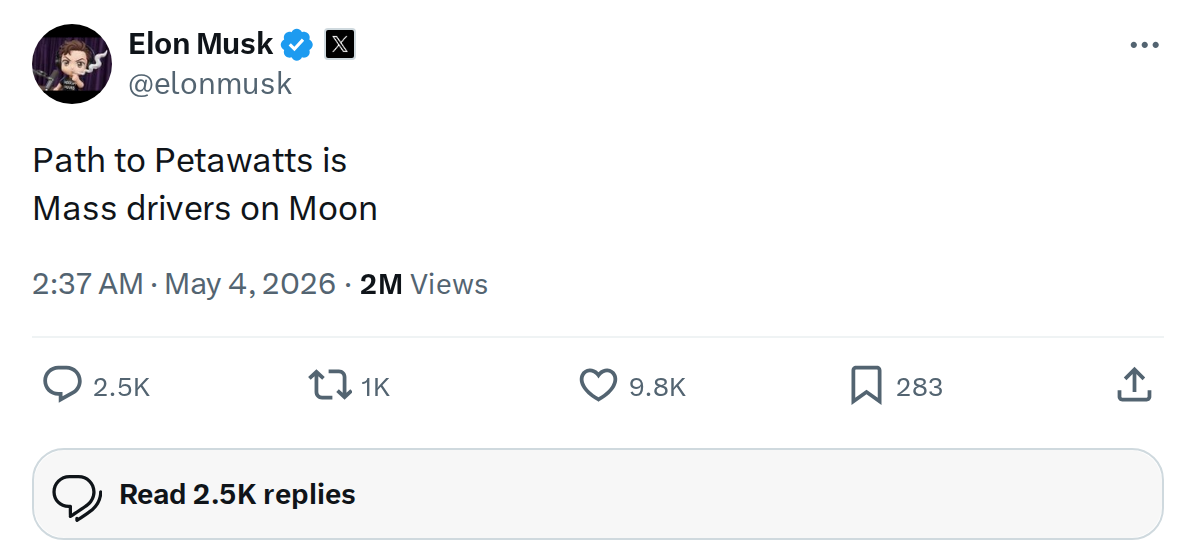
In a characteristically brief post, Elon Musk laid out what he sees as the long-term roadmap to civilization-scale energy: electromagnetic mass drivers built on the Moon. The tweet — just nine words — points toward a far larger strategic vision that SpaceX has been quietly assembling for months, one that would move the most power-hungry computing infrastructure off Earth entirely.

What Is a Lunar Mass Driver?
A mass driver is an electromagnetic launch system — essentially a magnetic catapult — that accelerates payloads along a track and launches them off the lunar surface without any chemical propellant. The Moon's low gravity (one-sixth of Earth's) and complete lack of atmosphere make it an ideal location: there's no drag, and the lunar escape velocity is only about 2.38 km/s, compared to Earth's 11.2 km/s. That physics advantage translates directly into cost.
According to verified technical estimates, a functional lunar mass driver would require a track between roughly 1,600 and 5,350 feet long, capable of operating at accelerations between 30 and 400 times Earth's gravity. Such a system could theoretically launch one payload every 10 to 11 seconds — and the estimated cost reduction for lunar payload launches using this method is approximately 90%, bringing per-kilogram costs down to around $500.
The Bigger Picture: Project TERAFAB
This isn't a new idea for Musk. He first publicly detailed the lunar mass driver concept — describing it as a "cannon-like device using magnetic power" — during an xAI all-hands meeting in February 2026. By March 21, SpaceX had formally integrated electromagnetic mass drivers into its lunar roadmap under what has been referred to as "Project TERAFAB."
The strategic logic is straightforward, if audacious: AI computing is hitting what Musk has called a "terawatt ceiling" on Earth, constrained by available land, power infrastructure, and cooling capacity. The proposed solution is to relocate power-hungry AI data centers to the Moon, where solar energy can be harvested without atmospheric interference and mass drivers can cheaply move materials on and off the surface. The projected output is 500 to 1,000 terawatts per year of AI satellite capacity — petawatt scale. The overarching goal, according to SpaceX's roadmap, is a "self-growing city" on the Moon within less than 10 years.
What Has to Happen First
The lunar mass driver is a declared strategic direction, not yet a funded engineering program. Its feasibility is tightly coupled to several near-term milestones that are still in progress:
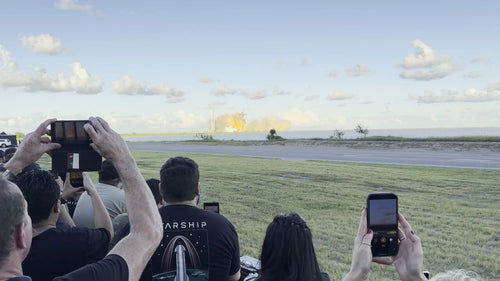
SpaceX's Starship Human Landing System variant — backed by a NASA contract worth up to $4.5 billion — is the primary cargo delivery mechanism, capable of landing over 100 metric tons per mission on the lunar surface. That capacity is what makes construction of large-scale surface infrastructure even theoretically possible. SpaceX is also targeting June 2026 for its first full ship-to-ship orbital propellant transfer demonstration, a critical step for sustained lunar operations.
NASA's Artemis program provides the broader framework: Artemis II and III are scheduled for 2026 and 2027, respectively, and would establish the human presence needed to begin surface construction work. NASA's separate Fission Surface Power program is targeting nuclear reactors on the Moon around 2030, delivering 40 to 100 kilowatts of steady electricity — the kind of baseload power a mass driver construction effort would require in its early phases.
Aspirational, But Grounded in Physics
Musk's timelines are routinely aspirational, and this vision is no exception. There are no engineering contracts, no detailed construction timelines, and no funded development milestones attached to the lunar mass driver program yet. But the underlying physics are sound, the cost math is compelling, and SpaceX's Starship program is the first launch system in history that could plausibly deliver the cargo volumes required to build something like this.
Whether the timeline is five years or twenty-five, the direction Musk is pointing is clear: the next frontier for energy and computing infrastructure isn't in a desert data center. It's 384,000 kilometers away. For more on SpaceX's role in enabling this vision, see our SpaceX coverage.

Sarah focuses on Tesla Energy, SpaceX missions, and the broader Musk AI portfolio. Former data analyst in clean energy. Based in San Francisco.
Sources verified at publish time. Spotted an inaccuracy? Email editorial@basenor.com.