30-Second Brief
The News: Neuralink has introduced Kenneth Shock, an ALS patient diagnosed in 2024, who is using the company's N1 brain-computer interface to regain speech — in his own original voice.
Why It Matters: This is the most human demonstration yet of what brain-computer interface technology can do, and it comes from the same company ecosystem as Tesla and xAI — signaling where Elon Musk's broader technology ambitions are heading.
Source: @neuralink on X
Neuralink Helps ALS Patient Speak Again — In His Own Voice
ALS takes many things from the people it affects. For Kenneth Shock, diagnosed in 2024, one of those things was his voice. Now, Neuralink's brain-computer interface is giving it back — not a synthesized approximation, but his actual voice, reconstructed from recordings made before his diagnosis.
Neuralink shared Kenneth's story on April 23, 2026, offering the clearest public window yet into what the company's VOICE clinical trial is actually achieving.

How the N1 Implant Works for Speech Restoration
Kenneth received Neuralink's N1 brain implant in January 2026, making him the second participant in the VOICE trial to receive an implant specifically targeting speech restoration. The N1 chip is placed in the motor cortex and is equipped with 1,024 electrodes — a density that allows it to capture fine-grained neural signals associated with the intent to speak.
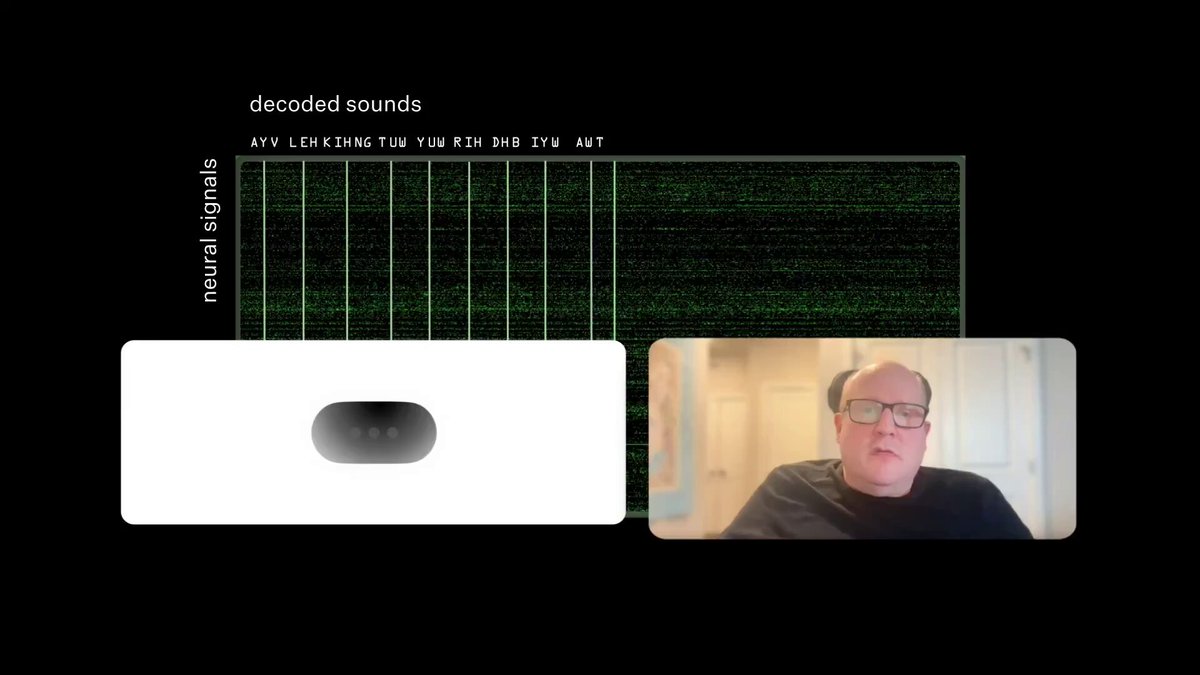
The process works in three stages: the implant captures neural signals, decodes them into phonemes (the building blocks of speech), and then reconstructs full words. What makes Kenneth's case particularly striking is the voice reconstruction layer: Neuralink trained the system on recordings of Kenneth speaking before his ALS diagnosis in 2020, allowing the BCI to reproduce words in what the team calls his "Original Ken" voice.
In other words, Kenneth isn't speaking through a generic text-to-speech engine. He's speaking in his own voice — the one his family and friends recognize.
📊 Key Figures
| Metric | Value | Context |
|---|---|---|
| N1 Electrodes | 1,024 | Placed in motor cortex |
| Implant Date | January 2026 | 2nd VOICE trial participant |
| ALS Diagnosis | 2024 | Voice training data from 2020 |
| PRIME Study Participants | 21 | Enrolled "Neuralnauts" |
| Elon Musk Confirmation | March 31, 2026 | Video shared on X |
What Kenneth Can Do Now
Within weeks of receiving the implant, Kenneth was able to speak, edit videos, and control a computer — all using thought alone. He has described the experience as simply thinking sentences, which the device then vocalizes for him. That's a profound shift from the alternative: silence, or the laborious process of eye-tracking communication boards that many late-stage ALS patients rely on.
The technology is still being refined. Signal processing currently takes minutes rather than being instantaneous, and accuracy is still improving. Neuralink's engineering team is actively working toward real-time brain-to-voice translation — the point at which the lag between thought and spoken word becomes imperceptible.

Where This Stands Regulatorily
Neuralink is explicit that the N1 device is investigational — not commercially available and not yet FDA approved for general use. The company has, however, received Breakthrough Device Designation from the FDA specifically to aid in restoring communication for individuals with severe speech impairment, including those with ALS. That designation is meaningful: it signals that the FDA recognizes the potential and has committed to an expedited review pathway.
The VOICE trial sits within Neuralink's broader PRIME Study, its first-in-human trial program, which currently has 21 enrolled participants with conditions including quadriplegia and ALS.
🔭 The BASENOR Take
Timeline: N1 implant received January 2026 → first speech demonstrated within weeks → Elon Musk confirms VOICE trial success March 31, 2026 → Kenneth's story published publicly April 23, 2026
Impact Level: 🔴 High — This is a genuine clinical milestone, not a lab demonstration
Confidence: ✅ High — Verified by Neuralink directly, corroborated by Elon Musk's public confirmation and multiple independent sources
Kenneth's case matters beyond the human story. It represents a concrete proof point that a brain-computer interface can decode speech intent, reconstruct it as phonemes, and render it in a personalized voice — all in a patient who has lost the physical ability to produce sound. That's not a simulation of speech. That's speech.
For the broader Elon Musk technology ecosystem — which Tesla owners are already part of — Neuralink's progress is a signal worth tracking. The same engineering culture that pushed over-the-air software updates into mainstream vehicles is now iterating on brain implants at a pace that surprised even optimistic observers. Real-time translation is the next milestone, and if Neuralink hits it, the gap between investigational device and commercial product gets significantly shorter.
The regulatory path still requires time. FDA Breakthrough Device Designation accelerates review but doesn't guarantee approval, and the sample size of 21 participants is small by clinical trial standards. What's different now compared to two years ago is that Neuralink has moved from animal studies to human results that are publicly demonstrable — and that's the kind of evidence that changes timelines.
For anyone following the intersection of AI, robotics, and human augmentation — a space that increasingly overlaps with Tesla's own Optimus and FSD ambitions — this is the most important update Neuralink has shared to date. Kenneth Shock wanted his voice back. He's getting it.

Sarah focuses on Tesla Energy, SpaceX missions, and the broader Musk AI portfolio. Former data analyst in clean energy. Based in San Francisco.
Sources verified at publish time. Spotted an inaccuracy? Email editorial@basenor.com.