The News: SpaceX's Falcon Heavy — built from three Falcon 9 first-stage boosters — is launching the ViaSat-3 F3 broadband satellite after weather delays pushed the mission from April 27 to April 29, 2026.
Why It Matters: The simultaneous side-booster landings are one of rocketry's most dramatic spectacles, and this mission underscores SpaceX's relentless launch cadence heading into mid-2026.
Source: @NASASpaceflight on X
SpaceX Falcon Heavy Roars Back: ViaSat-3 F3 Launch Brings Triple-Booster Spectacle After Weather Scrubs
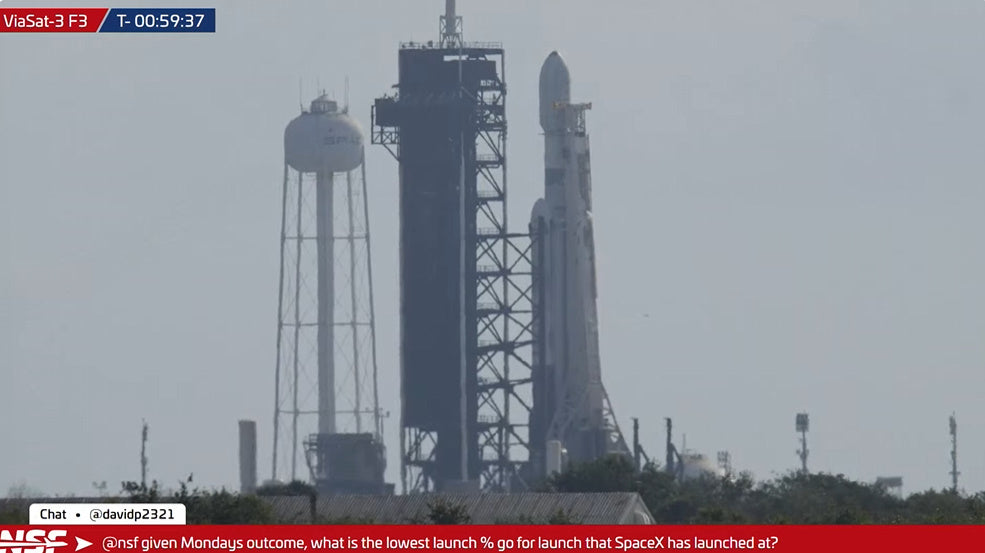
SpaceX's Falcon Heavy is back on the pad — and this time it's going. NASASpaceflight confirmed the countdown was inside one hour for the ViaSat-3 F3 mission on April 29, 2026, following two consecutive scrubs caused by unfavorable weather at Kennedy Space Center. The vehicle sitting on the launch pad is, in practical terms, three Falcon 9 rockets strapped together — and the plan calls for two of them to land simultaneously just minutes after liftoff.

What Is the Falcon Heavy, Exactly?
The framing of "three Falcon 9s launching at the same time" is accurate in a very literal sense. The Falcon Heavy is SpaceX's heavy-lift workhorse, constructed by binding three Falcon 9 first-stage boosters together — one center core flanked by two side boosters. At ignition, all 27 Merlin engines across those three cores fire simultaneously, producing roughly 5 million pounds of thrust at liftoff. A Merlin Vacuum engine on the second stage handles the final push to orbit.
For the ViaSat-3 F3 mission, the target is a geostationary transfer orbit (GTO), where the satellite will eventually park itself 35,786 km above the equator to deliver broadband connectivity. The payload — the ViaSat-3 F3 satellite — tips the scales at approximately 6 metric tons (6,400 kg), firmly in Falcon Heavy territory.
📊 Key Figures
| Metric | Value | Context |
|---|---|---|
| Total first-stage engines | 27 Merlin | 9 per booster |
| Payload mass | ~6,400 kg | ViaSat-3 F3 satellite |
| Side booster A prior flights | 18 | All Starlink missions |
| Side booster B last mission | GOES-U | June 2024 |
| Scrub attempts | 2 | April 27–28 weather |
| Launch window open | 10:13 a.m. EDT | April 29, 2026 |
| Center core fate | Expended | GTO mission profile |
The Double Landing: Why It Still Stops Traffic
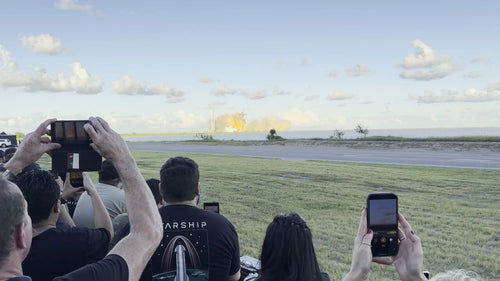
Even after years of SpaceX booster recoveries, the Falcon Heavy side-booster double landing remains one of the most visually arresting moments in modern spaceflight. Both side boosters separate from the core shortly after max-q, flip around, perform boostback and entry burns, and then touch down simultaneously — one at Landing Zone 1 (LZ-1) and one at Landing Zone 2 (LZ-2) at Cape Canaveral Space Force Station — with a sonic double-boom that rattles windows across Brevard County.
The center core, by contrast, is being expended on this mission. The energy demands of sending a 6.4-tonne satellite to GTO leave no margin for a center core recovery burn — so SpaceX accepts the hardware loss in exchange for maximum payload delivery performance.
One of the side boosters flying today has an impressive résumé: 18 prior Starlink missions. The other last flew on the GOES-U weather satellite mission in June 2024. Both will be inspected post-landing and are candidates for future reuse.
Weather Delays and the Road to Launch
This mission was originally scheduled for April 27, 2026, but weather conditions at Kennedy Space Center forced a scrub. A backup window on April 28 also came and went. The April 29 window — opening at 10:13 a.m. EDT — finally gave SpaceX the conditions needed to proceed. NASASpaceflight's countdown tweet, posted just over an hour before launch, confirmed the team was pressing forward.
Weather scrubs are a routine frustration for any launch campaign, but back-to-back holds add pressure on mission teams and complicate scheduling for a company running one of the world's busiest launch manifests. SpaceX has been averaging well over one launch per week in 2025 and 2026, making pad turnaround time a genuine operational constraint.
🔭 The BASENOR Take
Timeline: Launch window opened April 29, 2026 at 10:13 a.m. EDT — following scrubs on April 27 and 28.
Impact Level: Medium-High — commercially significant for ViaSat's broadband network; operationally significant for SpaceX's heavy-lift cadence.
Confidence: High — mission details confirmed by multiple verified sources including NASASpaceflight and Spaceflight Now.
Analysis: The Falcon Heavy doesn't fly as frequently as the standard Falcon 9, but each mission is a demonstration of SpaceX's ability to deliver payloads that no other currently operational Western rocket can match in the heavy-lift class. The ViaSat-3 F3 mission is the third and final satellite in ViaSat's next-generation broadband constellation — completing a network that's been years in the making. For SpaceX, the more interesting story is operational: the company is now routinely flying battle-tested boosters with double-digit flight counts on missions that matter. A side booster with 18 prior flights is no longer a novelty — it's standard practice.
📰 Deep Dive
The Falcon Heavy's architecture is a direct product of SpaceX's modular design philosophy. Rather than engineering an entirely new heavy-lift vehicle from scratch, the company scaled up by clustering proven hardware — the same Falcon 9 booster that has become the world's most frequently flown orbital rocket. This approach compresses development timelines and leverages an already-mature manufacturing and refurbishment pipeline. The tradeoff is structural complexity at the core: the three boosters must be carefully synchronized during ascent to prevent aerodynamic interference, and the side boosters must separate cleanly before executing their recovery sequences.
ViaSat-3 F3 completes a constellation that has faced significant delays. The first satellite in the series suffered a propulsion anomaly after launch that left it unable to reach its intended orbit, a significant setback for the program. F3's successful delivery to GTO would mark a meaningful recovery milestone for ViaSat's broadband ambitions — and a clean mission for SpaceX heading into a packed summer launch schedule.
From a broader industry perspective, the Falcon Heavy occupies a unique position in the current launch market. With the Space Launch System flying infrequently and United Launch Alliance's Vulcan Centaur still in early operational phases, Falcon Heavy remains the only Western rocket currently capable of lifting payloads of this class on a routine commercial basis. That competitive position won't last forever — but for now, missions like ViaSat-3 F3 are a reminder of why SpaceX's heavy-lift capability commands attention. For more on SpaceX's ongoing mission cadence, see our SpaceX coverage.

Sarah focuses on Tesla Energy, SpaceX missions, and the broader Musk AI portfolio. Former data analyst in clean energy. Based in San Francisco.
Sources verified at publish time. Spotted an inaccuracy? Email editorial@basenor.com.