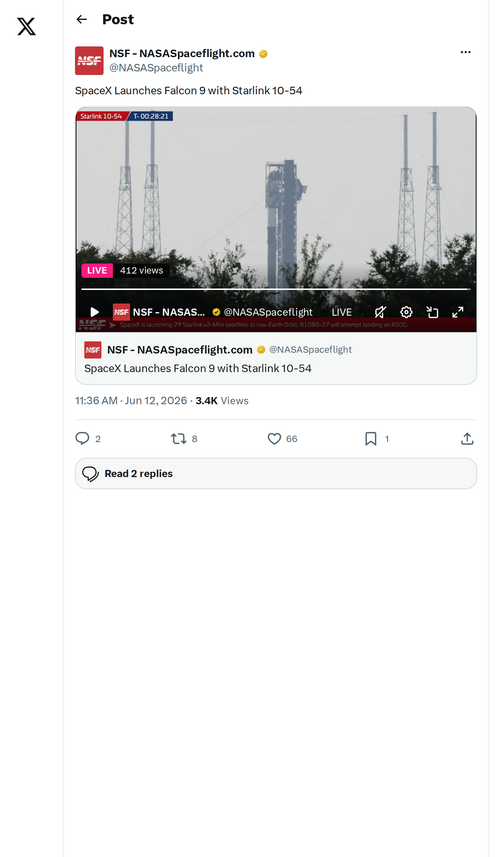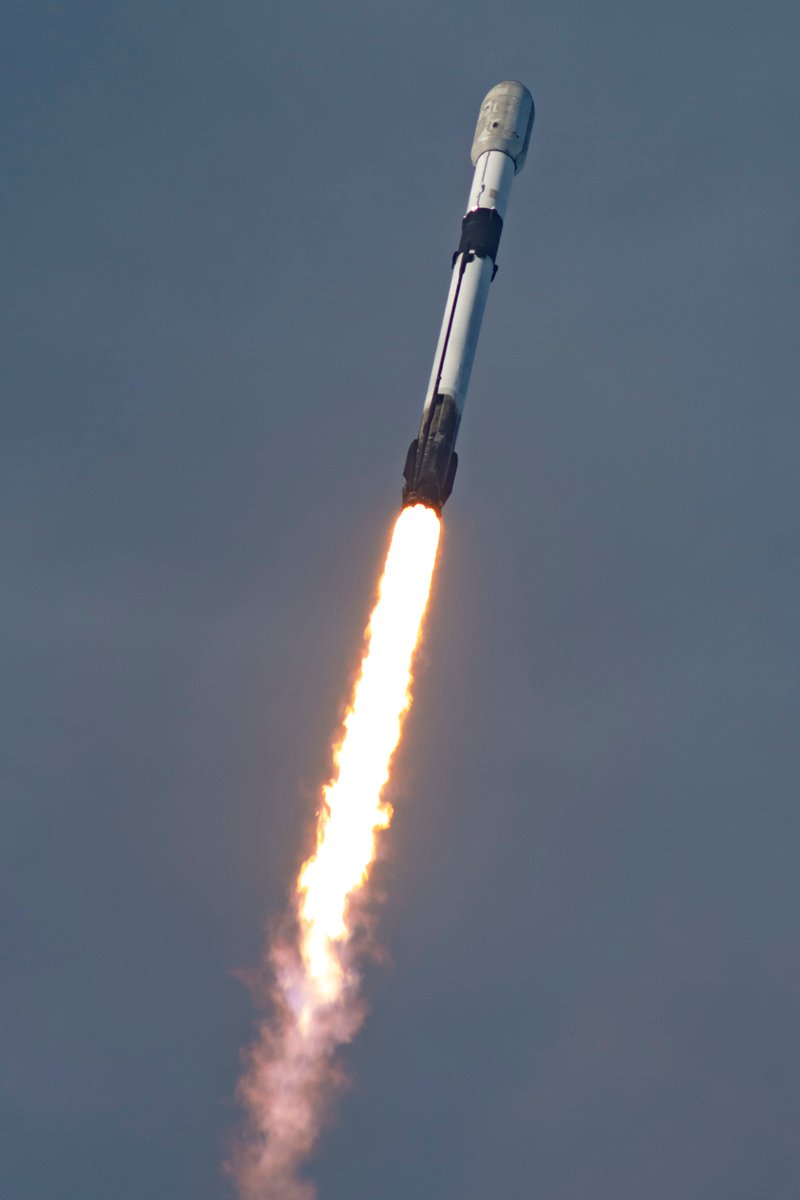
The News: Elon Musk says SpaceX will achieve one rocket launch every hour within 4 to 5 years.
Why It Matters: A launch cadence of this scale would be the single most transformative shift in the history of spaceflight — and it's the backbone of SpaceX's Mars colonization plan.
Source: @elonmusk on X
SpaceX Plans One Launch Per Hour Within 5 Years — What That Actually Means
Elon Musk dropped a single sentence on X this morning that, if it comes true, will redefine what humanity is capable of. In 4 to 5 years, SpaceX aims to launch a rocket every single hour. Not every day. Not every week. Every hour.
To put that in perspective: the entire global space industry — every country, every company combined — currently manages roughly 200-250 orbital launches per year. SpaceX alone is targeting 8,760 launches annually. That's a 30x increase over today's entire world output, from a single company.

📊 Key Figures
| Metric | Value | Context |
|---|---|---|
| Target launch cadence | 1 per hour | ~8,760/year |
| Timeline | 4–5 years | ~2030–2031 |
| Current Falcon 9 cadence | ~13/month | ~156/year |
| Falcon family average interval | Every 2 days | As of Feb 2026 |
| Starship 2025 target | 25 launches | First full year |
| Heavy-class milestone | 2 flights / 10 hrs | March 17, 2026 |
| Starships to be built | 10,000 | Per year, per plan |
| Discussed upper limit | 1 per 2 minutes | Global, per researcher |
Where SpaceX Stands Today
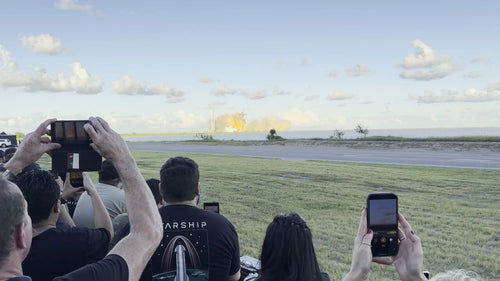
This goal doesn't come out of nowhere — it's the logical endpoint of a trajectory SpaceX has been building for years. As of early 2026, the Falcon family is launching and landing every two days on average. SpaceX was targeting more than 100 launches from Florida alone in 2025, with an overall goal of 170 orbital launches for the year. On March 17, 2026, the company completed two heavy-class rocket flights within a 10-hour window — a quiet but significant proof-of-concept for rapid reuse.
The vehicle that makes the one-per-hour vision possible, however, isn't Falcon. It's Starship.
Why Starship Is the Only Way This Works
Falcon 9 is an extraordinary rocket — but it's not designed for hourly launches. Starship is. The entire architecture of Starship, from its fully reusable Super Heavy booster to its rapid-turnaround propellant loading, is built around the idea of aircraft-like operations. Catch the booster with the launch tower arms, refuel, and go again.
Musk has been refining this timeline publicly. In February 2026, he stated Starship would be capable of launching every hour within three years, then adjusted to 'might take four years but not more than that.' Today's post — 'In 4 or 5 years' — is consistent with that range, and represents the outer bound of his stated confidence.
Starship V3, which is critical for next-generation Starlink and space computing payloads, was originally slated for its maiden flight in March 2026 but has reportedly slipped to around May 2026 due to technical issues during testing. That delay is a reminder that the path to hourly launches runs through a lot of engineering milestones that haven't been cleared yet.
The Mars Math Behind This Number
The one-per-hour target isn't arbitrary. It's driven by the physics of getting to Mars. Earth and Mars align for launch windows roughly every 26 months. To place millions of tons of cargo on Mars — the minimum Musk believes is needed for a self-sustaining city — SpaceX would need to execute thousands of Starship launches concentrated around each window. Researchers analyzing SpaceX's stated plans have noted the company is internally discussing launch rates potentially higher than once per hour, with one planetary physicist citing a scenario of one launch every two minutes globally, based on a plan to manufacture 10,000 Starships per year.
That's not a typo. Ten thousand Starships per year, launching continuously. By comparison, Boeing produces roughly 400 commercial aircraft annually at peak output.
🔭 The BASENOR Take
Timeline: 2030–2031 (4–5 years from March 2026)
Impact Level: 🔴 Civilization-scale — if achieved
Confidence: Medium. The engineering trajectory is real. The timeline is aggressive.
Analysis: The skeptic's case is straightforward: SpaceX has missed ambitious timelines before, Starship V3 is already delayed, and scaling from 156 launches per year to 8,760 requires not just better rockets but entirely new ground infrastructure, regulatory frameworks, airspace management, and manufacturing capacity that doesn't exist yet. The believer's case is equally clear: SpaceX has consistently done things the rest of the industry said were impossible, and the Falcon 9's current cadence — a launch every two days — would have sounded equally delusional in 2010. The honest answer is that nobody outside SpaceX knows whether 2030 is realistic. What is not in question is the direction of travel. SpaceX is building toward this, and every milestone — rapid booster reuse, two heavy-class launches in 10 hours, Starship's growing flight rate — is a step on the same staircase. For owners following SpaceX's trajectory, the story to watch isn't whether hourly launches happen exactly on schedule. It's whether the infrastructure and manufacturing ramp that makes it possible starts becoming visible in 2026 and 2027. That's when we'll know if this timeline is real. Follow our SpaceX coverage for ongoing updates as Starship's flight rate develops.
📰 Deep Dive
What makes Musk's statement worth taking seriously — even if the exact timeline slips — is that it's backed by an engineering system specifically designed to make it true. Starship's fully reusable architecture, the mechanical catch system at Starbase, and the planned fleet of launch towers aren't incremental improvements on existing rockets. They're a ground-up redesign of what a launch system looks like when you optimize for frequency rather than payload mass or cost-per-kilogram alone.
The regulatory dimension is underappreciated. The FAA currently treats each Starship launch as a significant event requiring individual review. Achieving hourly launches would require a fundamental shift in how the agency licenses commercial spaceflight — closer to how the FAA handles commercial aviation than how it currently handles rockets. That's a policy transformation, not just an engineering one, and it will take years to negotiate regardless of how fast the hardware is ready.
The manufacturing challenge is equally daunting. To sustain hourly launches, SpaceX would need to build and maintain a fleet of Starships large enough that individual vehicles can be cycling through refurbishment while others are flying. Based on the 10,000-Starships-per-year figure discussed internally, the company would need to build a Starship roughly every 52 minutes — a production rate that would require factory capacity on par with the automotive industry, not the aerospace industry. SpaceX has shown it can industrialize rocket production faster than anyone expected, but this would be a different order of magnitude entirely.
For now, the milestone to watch is Starship V3's first flight, expected around May 2026. A successful debut — and a rapid cadence of follow-on flights — would be the clearest early signal that the hourly launch vision is on track rather than receding into the future.

Sarah focuses on Tesla Energy, SpaceX missions, and the broader Musk AI portfolio. Former data analyst in clean energy. Based in San Francisco.
Sources verified at publish time. Spotted an inaccuracy? Email editorial@basenor.com.