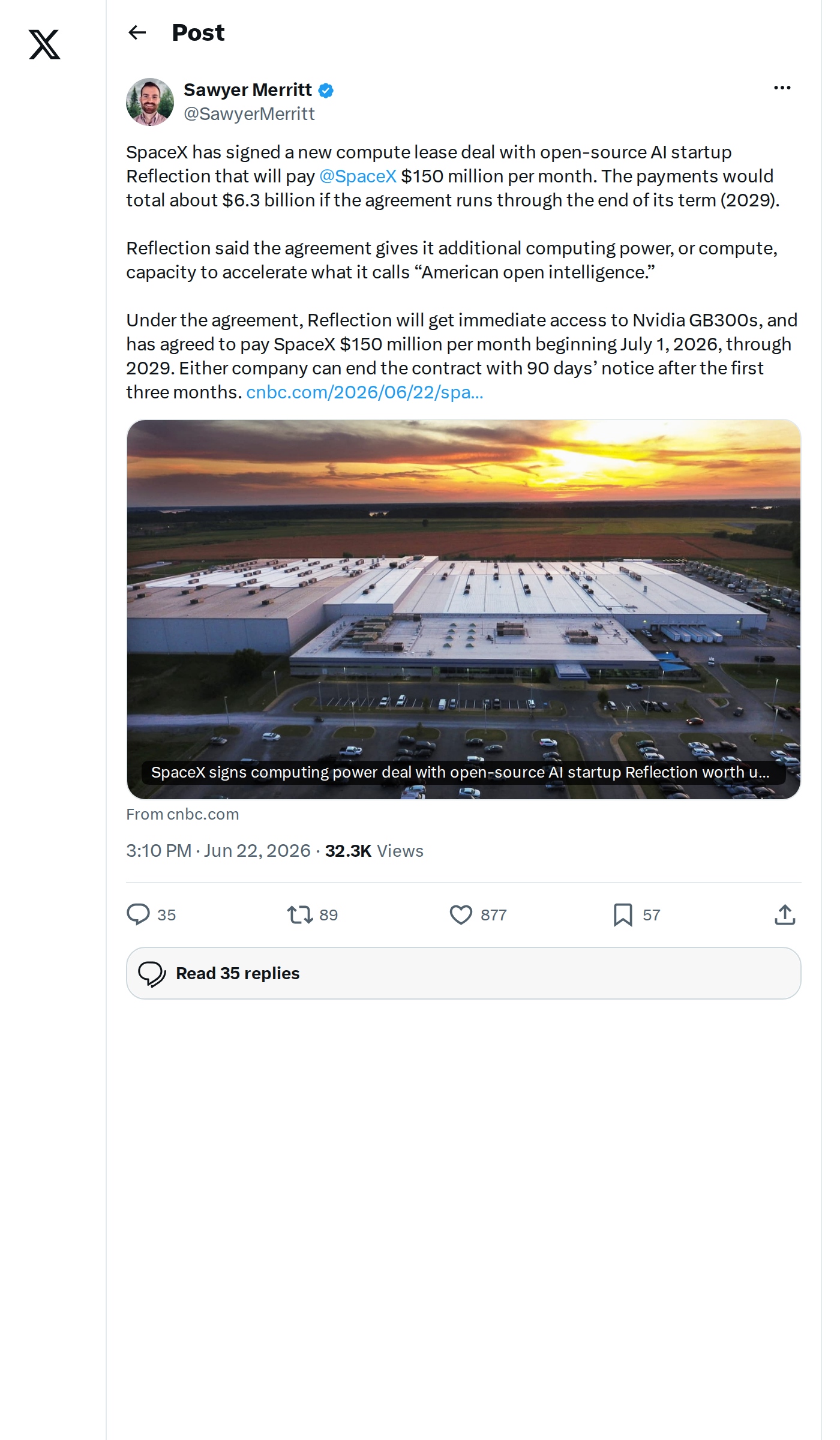
SpaceX is quietly becoming one of the most important AI infrastructure companies in the world. The latest evidence: a freshly signed compute lease with Reflection AI, an open-source startup founded by former Google DeepMind researchers, worth $150 million per month — and potentially $6.3 billion in total if the agreement runs through its full term to the end of 2029.

What SpaceX Is Actually Selling
This isn't a software deal or a launch contract. SpaceX is leasing raw AI compute — specifically Nvidia GB300 chips and related hardware housed at its Colossus 2 facility in Memphis, Tennessee. Reflection AI gets immediate access to that infrastructure starting July 1, 2026, in exchange for the monthly payments.
The structure includes a 90-day exit clause that either party can exercise after the initial three-month period, establishing a minimum commitment of roughly one quarter. That's a meaningful floor: even if Reflection walks away at the earliest opportunity, SpaceX collects at least $450 million.
Who Is Reflection AI?
Reflection AI was co-founded by Misha Laskin and Ioannis Antonoglou, both veterans of Google DeepMind. The company focuses on open-source AI development and has attracted backing from Nvidia — the same chipmaker whose hardware sits at the heart of this deal. According to reports, Reflection was recently valued at $25 billion, making it one of the more significant AI startups to emerge from the current wave of foundation model investment.
SpaceX as AI Infrastructure Provider
The Reflection deal isn't a one-off. According to background reporting, SpaceX has been building a portfolio of compute lease agreements that now includes arrangements with Google (reportedly $920 million per month) and Anthropic (a 180-day lease with a 90-day cancellation notice). The company is also reportedly in the process of acquiring Cursor, the AI coding platform.
Taken together, these moves paint a clear strategic picture: SpaceX is treating its Colossus data center infrastructure as a revenue-generating asset in its own right, not just a tool for internal AI development. For a company that has historically funded itself through launch contracts and Starlink subscriptions, recurring compute revenue at this scale represents a meaningful new income stream — one that's largely independent of rocket cadence or satellite deployment timelines.
The broader implication is that SpaceX's valuation story is increasingly tied to AI infrastructure, not just aerospace. Whether that's a deliberate pivot or an opportunistic response to surging enterprise demand for GPU compute is an open question — but the numbers suggest the company is leaning into it aggressively. For more on SpaceX's expanding business, see our SpaceX coverage.
Sources & reporting notes
The links below identify the material source records used for this report.
- @SawyerMerritt on X (2026-06-22T15:10:07.000Z) — Direct source
Source links are preserved as published or accessed. See our editorial standards and corrections policy.
The BASENOR Editorial Desk covers Tesla, SpaceX, and related technology, curating reporting from primary sources — official accounts, regulatory filings, and software release data. Every article passes source-record and fact-checking review before publication. About the newsroom.
This report was curated by the BASENOR Editorial Desk from the sources listed above. Read our editorial standards or email editorial@basenor.com to report an error.