📌 UPDATE — March 16, 2026
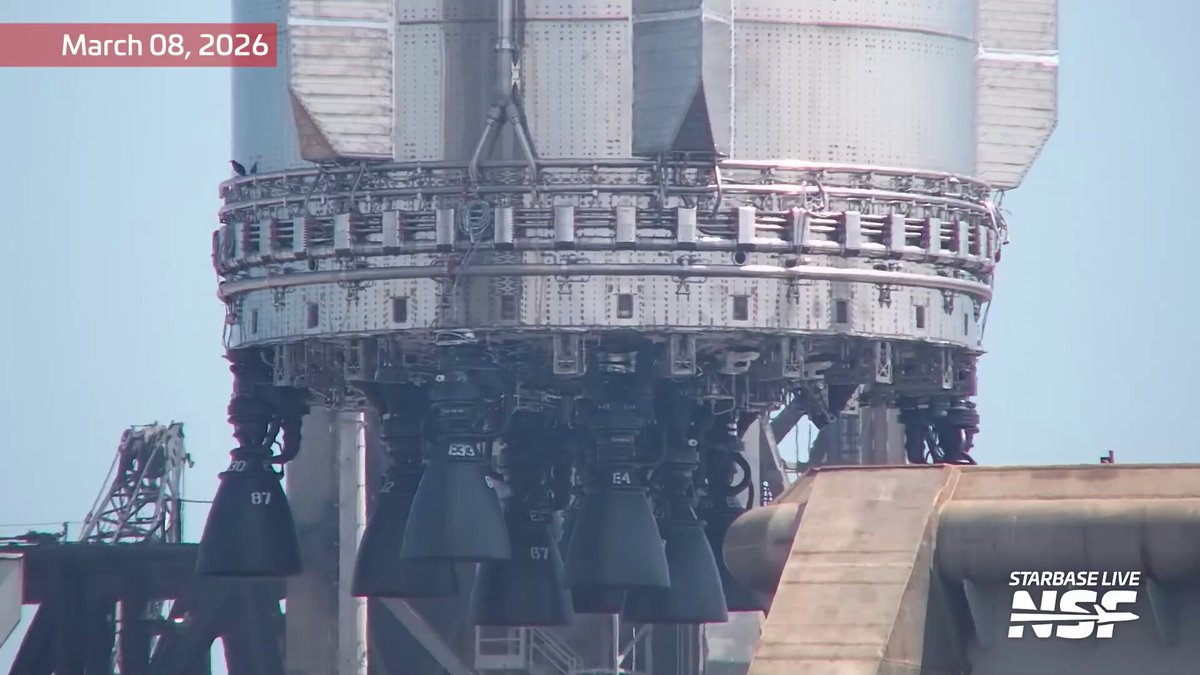
SpaceX has successfully completed the first-ever static fire test of Super Heavy Booster 19 (Booster V3), firing all 33 Raptor V3 engines on Pad 2 at Starbase. This milestone confirms the new Raptor V3 engine configuration has passed its critical ground test, clearing a major hurdle ahead of Flight 12. The first Starship V3 test flight remains on track for sometime in April, consistent with the ~April 9 target window previously reported.

📹 Via @SawyerMerritt on X — Static fire footage from @NASASpaceflight stream
📌 UPDATE — March 16, 2026 🔍
Booster 19 has successfully completed its first static fire test on the new Pad 2 Launch Mount at Starbase — a triple milestone marking the first static fire for Pad 2, the first for V3 hardware, and the first time Raptor 3 engines have fired together. However, observers noted the burn appeared unusually short and may have been aborted early. Analysis from Zack Golden (@CSI_Starbase) suggests at least 3 engines were tested, with plume visible exiting both sides of the trench — indicating at least one engine on each side, with a stronger plume on the east side.
@NASASpaceflight · Mar 16, 2026
"STATIC FIRE: Booster 19 fires up, but feels very short and potentially aborted early. However, first time for Pad 2, the first time for V3, and the first time Raptor 3's have fired up together."
View on X →
Whether the short duration indicates an abort or a planned low-duration test is not yet confirmed. A full 33-engine static fire is still expected before Flight 12 can proceed.
The News: SpaceX's Booster 19 has been installed on Pad 2 at Starbase ahead of a static fire test with its initial 10 Raptor 3 engines, while Ship 39 has cleared its testing campaign at Masseys — the pair are being readied for Starship Flight 12.
Why It Matters: Flight 12 will debut the Block 3 (V3) Starship stack — a generational leap in payload capacity — and mark the first launch from Starbase's new Pad 2. With FAA approval already secured and Elon Musk pointing to ~April 9, the program is moving at serious pace.
Source: @NASASpaceflight on X

📊 Key Figures
| Metric | Value | Context |
|---|---|---|
| Raptor 3 engines (static fire) | 10 (initial set) | Full stack = 33 |
| Raptor 3 thrust per engine | ~280 tonnes | ~22% over Raptor 2 |
| V3 payload to LEO | >100 tonnes | ~3× V2's ~35 tonnes |
| Ship 39 cryo tests completed | 3 consecutive | Feb 28 – Mar 5, 2026 |
| FAA flight approval | Granted | Flight 12 cleared |
| Estimated Flight 12 target | ~April 9, 2026 | ~4 weeks from Mar 7 |
Booster 19: The Most Powerful Rocket Stage Ever Built, On the Pad Now
Booster 19, a Block 3 Super Heavy, rolled to Starbase's Pad 2 on March 7 and was lifted onto the Orbital Launch Mount over the weekend. This week's testing schedule includes a static fire with an initial subset of 10 Raptor 3 engines — a standard qualification step before a full 33-engine firing.
The Raptor 3 engine is a significant upgrade. According to background research, each unit delivers approximately 280 tonnes of thrust — roughly 22% more than the Raptor 2 engines used on earlier flights. With 33 of them firing simultaneously at full power, Booster 19 will generate thrust figures that dwarf anything previously flown.
Booster 19 also completed its cryogenic testing campaign in early February 2026, meaning the structural and thermal validation work is already behind it. The static fire this week is the final major hurdle before the booster is cleared for flight.
Ship 39: The First V3 Starship, Cleared and Ready
Ship 39 is the inaugural Starship Version 3 prototype, and it has now completed its initial testing campaign at Massey's Outpost — SpaceX's secondary test site near Starbase. Between February 28 and March 5, 2026, Ship 39 underwent three consecutive cryogenic pressure-proof tests, including new "squeeze tests" designed to simulate the mechanical loads it will experience when caught by Starbase's Mechazilla tower arms on landing.
Ship 39 arrives at this milestone fully equipped: a complete tiled heat shield and all four flaps are fitted. It has not yet undergone a static fire of its own Raptor engines, but that step is expected to follow at the launch site before Flight 12.
Pad 2: A New Launch Site Enters the Picture
Flight 12 won't just be the debut of the V3 stack — it will also be the first Starship launch from Pad 2. The new pad underwent a full test of its water-cooled top deck on the Orbital Launch Mount in mid-February 2026, followed by a full deluge system test during the week of February 24. Both milestones cleared without issue, according to background research.
Pad 2 is a critical piece of SpaceX's long-term Starship cadence. With two operational pads at Starbase, SpaceX can run overlapping test and launch campaigns — potentially doubling launch frequency once both pads are fully operational.
🔭 The BASENOR Take
Timeline: Static fire expected March 8–10, 2026 → Ship 39 static fire to follow → Flight 12 targeting ~April 9, 2026
Impact Level: 🔴 High — First V3 stack flight, first Pad 2 launch, FAA already approved
Confidence: High — Both vehicles have cleared structural testing; FAA approval is in hand; Elon Musk publicly confirmed the ~4-week timeline on March 7
Key Risk: Static fire results this week. If anomalies surface, the April 9 window could slip. SpaceX has shown willingness to hold launches for engine data.
The V3 Starship stack is a generational leap, not an incremental one. Going from ~35 tonnes to over 100 tonnes to Low Earth Orbit in a single version jump — while simultaneously increasing engine thrust by 22% and introducing a new launch pad — is an extraordinary amount of change to validate at once. The testing cadence SpaceX has run over the past six weeks (Booster 19 cryo in early February, Ship 39 cryo through early March, Pad 2 deluge tests in February) suggests the team is executing to a tight but deliberate schedule.
The squeeze tests on Ship 39 are particularly notable. Mechazilla tower catches are no longer a one-off demonstration — SpaceX is engineering the entire vehicle around the assumption that booster and ship recovery via tower catch is the standard operating procedure. Building that structural validation into the cryo test campaign, rather than treating it as a separate test event, signals how deeply the reusability architecture is now baked into the design process.
For those tracking the broader SpaceX mission manifest — including Starlink V3 satellites, NASA Artemis lunar landers, and commercial payload customers — Flight 12's success is a prerequisite for almost everything that follows. The V3 payload capacity unlocks mission profiles that simply weren't possible with V2. Watch this week's static fire results closely. They'll tell us whether April 9 is real or optimistic. For our full SpaceX coverage, check the tag page.
🚀 Following the Starship program? See every test flight, official outcome and the next launch window in our SpaceX Starship Tracker.
Sources & reporting notes
The links below identify the material source records used for this report.
- @NASASpaceflight on X (2026-03-09T01:12:10.000Z) — Direct source
- @NASASpaceflight on X (2026-03-16T18:44:37.000Z) — Direct source
- @CSI_Starbase on X (2026-03-16T18:48:18.000Z) — Direct source
- @SawyerMerritt on X (2026-03-16T19:08:07.000Z) — Direct source
Source links are preserved as published or accessed. See our editorial standards and corrections policy.
The BASENOR Editorial Desk covers Tesla, SpaceX, and related technology, curating reporting from primary sources — official accounts, regulatory filings, and software release data. Every article passes source-record and fact-checking review before publication. About the newsroom.
This report was curated by the BASENOR Editorial Desk from the sources listed above. Read our editorial standards or email editorial@basenor.com to report an error.