

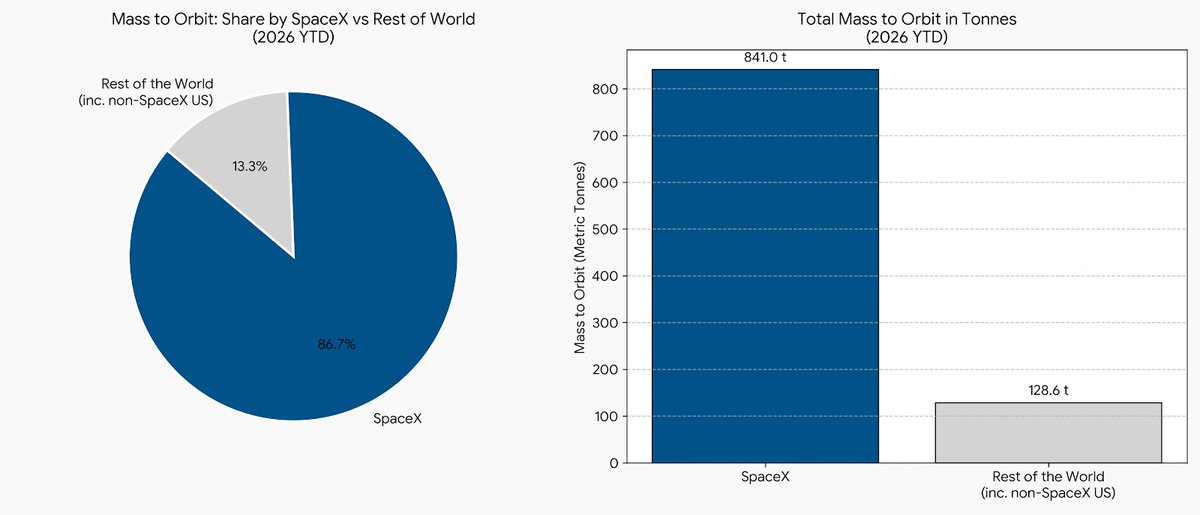
Elon Musk posted a single sentence early Monday that reframes how to think about Starship — not as a rocket, but as infrastructure. The claim: Starship is designed to transport over a megaton of payload to space per year. To put that in perspective, every rocket currently flying combined doesn't come close to that figure. If SpaceX pulls it off, it would represent the most dramatic reduction in the cost of accessing space in history.

The Math Behind a Megaton
A megaton is one million metric tons. Getting there requires both payload capacity per flight and launch cadence to scale simultaneously — and SpaceX's roadmap addresses both levers.
The current Starship (V2) carries approximately 35 metric tons to Low Earth Orbit in a fully reusable configuration. That number jumps significantly with the next generation: Starship V3 is expected to exceed 100 metric tons to LEO in a reusable configuration, with Musk previously expressing confidence in hitting that mark by 2026. An expendable V3 variant is projected to reach 250 metric tons per flight. A further iteration, sometimes referred to as Block 4 and anticipated around 2027, targets 200 metric tons in the reusable configuration.
Even at 100 metric tons per flight, reaching one megaton annually requires 10,000 flights per year — roughly 27 launches per day. That's not a near-term projection; it's the long-horizon design target that justifies the entire manufacturing and reusability architecture SpaceX is building around the vehicle.
Production Scale Is the Real Story
SpaceX's answer to the cadence problem is the Starfactory — its Starship manufacturing facility in South Texas. According to SpaceX's own stated goals, the facility is designed to eventually produce up to 1,000 Starships per year. As of early 2026, the near-term target is around 10 Super Heavy booster and Starship upper stage sets annually, with plans to scale to dozens and eventually hundreds. Musk has discussed thousands of Starship flights per year as the long-term operational tempo needed to support a self-sustaining Mars civilization.
The Raptor 3 engines powering the latest vehicles contribute meaningfully to this ambition: sea-level variants produce 250 metric tons of force, with vacuum engines at 275 tf — improvements that directly translate into payload margin.
What the Megaton Goal Is Actually For
The megaton figure isn't about launching satellites. It's about Mars. Moving enough mass to establish and sustain a city on another planet requires a scale of logistics that has no precedent in the history of spaceflight. Musk has framed Starship's entire design philosophy around this requirement — full and rapid reusability, high production volume, and launch rates that look more like airline operations than traditional rocketry.
Nearer-term milestones give the roadmap some grounding. According to SpaceX's planning documents, Starship cargo flights to the lunar surface are targeted to begin in 2028 at a cost of $100 million per metric ton. Mars cargo flights follow in 2030 at the same rate. NASA is also counting on Starship as the Human Landing System for the Artemis IV lunar mission, giving the program a near-term institutional anchor beyond SpaceX's own ambitions.
The megaton-per-year target is a design specification, not a delivery promise for any particular year. But it explains every architectural decision SpaceX has made with Starship — the scale of the booster, the emphasis on full reusability, the investment in high-volume manufacturing. The rocket is being built to a logistics requirement, and that requirement is civilizational in scope. Whether the timeline compresses or stretches, the direction is set.
🚀 Following the Starship program? See every test flight, official outcome and the next launch window in our SpaceX Starship Tracker.
Sources & reporting notes
The links below identify the material source records used for this report.
- @elonmusk on X (2026-05-18T02:26:18.000Z) — Direct source
Source links are preserved as published or accessed. See our editorial standards and corrections policy.
The BASENOR Editorial Desk covers Tesla, SpaceX, and related technology, curating reporting from primary sources — official accounts, regulatory filings, and software release data. Every article passes source-record and fact-checking review before publication. About the newsroom.
This report was curated by the BASENOR Editorial Desk from the sources listed above. Read our editorial standards or email editorial@basenor.com to report an error.






