30-Second Brief
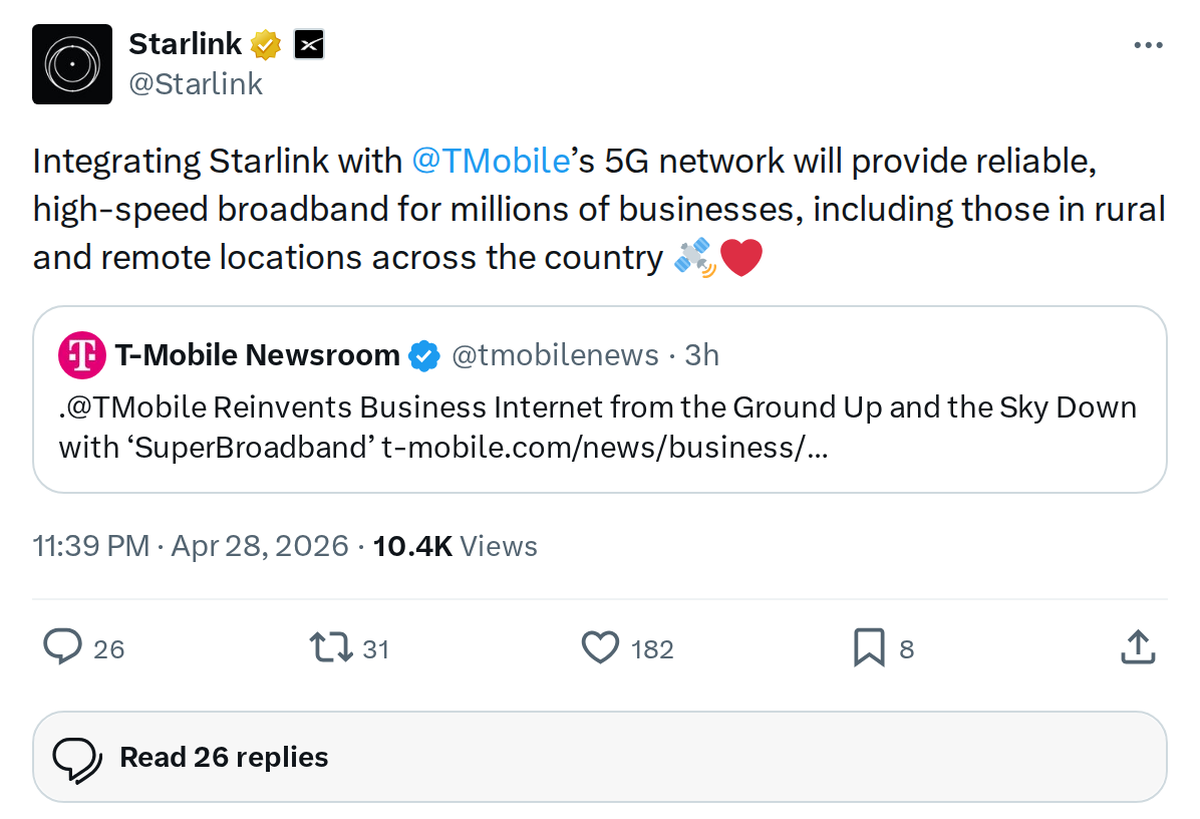
The News: T-Mobile and SpaceX's Starlink have launched "SuperBroadband," a business internet service that combines T-Mobile's 5G network with Starlink satellite connectivity for dual-path, redundant coverage reaching every ZIP code in the U.S.
Why It Matters: For Tesla owners who run businesses — especially in rural or remote areas — this is the most serious enterprise connectivity play yet from the SpaceX ecosystem, with a 99.99% uptime guarantee and no coverage gaps.
Source: @Starlink on X

The Starlink–T-Mobile Partnership Just Got Serious
SpaceX's Starlink and T-Mobile have been building toward this moment for years. What started as a consumer-facing "T-Satellite" service for texting in dead zones has now evolved into a full enterprise-grade product: SuperBroadband, unveiled April 28, 2026.
The premise is straightforward but the execution is ambitious. SuperBroadband routes business internet traffic across two completely independent pathways — T-Mobile's terrestrial 5G network and Starlink's satellite constellation — simultaneously. If one goes down, the other carries the load. That's the architecture behind the headline claim: a 99.99% uptime guarantee.
For context, 99.99% uptime means roughly 52 minutes of downtime per year. That's a standard typically reserved for enterprise data centers, not rural business internet.
📊 Key Figures
| Metric | Value | Context |
|---|---|---|
| Launch Date | April 28, 2026 | Today |
| Starting Price | $250/month | 3-year commitment; includes equipment, install & management |
| Uptime Guarantee | 99.99% | ~52 min downtime/year |
| Coverage | Every U.S. ZIP code | Including rural & remote locations |
| Starlink Satellites Active | 650+ | Orbiting ~200 miles above Earth |
| Consumer T-Satellite Price | $10/month | Add-on for most T-Mobile plans; free on Go5G Next & Experience Beyond |
| V2 Satellite Launch | Mid-2027 | Via Starship; 100x data density vs. current V1 gen |
Two Products, One Partnership
It's worth separating the two distinct offerings that have emerged from the Starlink–T-Mobile relationship, because they serve very different use cases:
T-Satellite (Consumer): Launched officially in July 2025, this service uses Starlink satellites as cell towers in space to deliver SMS, MMS, and increasingly data connectivity to standard smartphones — no special hardware required. Compatible with iPhone 13+, Samsung Galaxy S21+, and Google Pixel 9. It covers over 500,000 square miles of U.S. territory that ground-based networks don't reach. As of October 2025, it supports data for apps like WhatsApp (including voice and video), maps, weather, and social media.
SuperBroadband (Business): Today's announcement. This is a managed enterprise service — outdoor 5G equipment and routers from Ericsson's Cradlepoint unit, professional installation via a partner called Acuative, and ongoing network management, all bundled into the $250/month starting price. T-Mobile plans to expand hardware options to include equipment from Inseego as the product scales.
Jason Fritch, Vice President of Starlink Enterprise Sales at SpaceX, framed the business case directly: "Integrating Starlink with T-Mobile 5G brings reliable, high-performance broadband to businesses with mission-critical operations where downtime costs thousands per hour."
That last phrase is the key. SuperBroadband isn't positioning itself as a cheap rural internet solution — it's targeting businesses where connectivity failure has a real dollar cost per hour.
What's Coming Next: V2 Satellites on Starship
The current product is built on Starlink's V1 satellite generation. The roadmap gets significantly more interesting in mid-2027, when SpaceX plans to launch V2 satellites aboard Starship. According to verified reporting, V2 satellites are expected to deliver 100 times the data density of the current generation — and are designed to provide full 5G speeds from orbit, enabling streaming, video calls, and remote work at quality comparable to terrestrial service.
That's a meaningful upgrade horizon for any business signing a three-year SuperBroadband commitment today. The infrastructure they're buying into now will be the same network that receives the V2 upgrade.
🔭 The BASENOR Take
Timeline: Consumer T-Satellite launched July 2025 → Data expansion October 2025 → SuperBroadband business launch April 28, 2026 → V2 satellites via Starship mid-2027
Impact Level: 🟠 High — for business owners and the broader SpaceX ecosystem
Confidence: ✅ High — announced directly by @Starlink and corroborated by T-Mobile official materials
The Starlink–T-Mobile partnership has followed a disciplined product ladder: prove the satellite-to-phone concept with consumers first, then monetize at the enterprise level where willingness to pay is higher and churn is lower. SuperBroadband is that enterprise step.
For the SpaceX ecosystem broadly, this matters because it validates the dual-path redundancy model as a commercial product — not just a technical capability. The 99.99% uptime guarantee is a contractual commitment, which means SpaceX and T-Mobile are putting money behind the reliability claim.
For Tesla owners who also run businesses, particularly those operating in rural areas — agriculture, construction, energy, logistics — SuperBroadband is the most credible enterprise connectivity option to emerge from the SpaceX orbit. The $250/month all-in price point (equipment, install, management included) is competitive with enterprise-grade fiber alternatives in markets where fiber simply doesn't reach.
The V2 satellite timeline is the longer-term signal to watch. If Starship delivers V2 on schedule in mid-2027, the performance ceiling of this network jumps dramatically — and the businesses that signed up early will be first in line for that upgrade. For our full SpaceX coverage, including Starship development milestones, follow that tag for ongoing updates.
🚀 Following the Starship program? See every test flight, official outcome and the next launch window in our SpaceX Starship Tracker.
Sources & reporting notes
The links below identify the material source records used for this report.
- @Starlink on X (2026-04-28T15:39:42.000Z) — Direct source
Source links are preserved as published or accessed. See our editorial standards and corrections policy.
The BASENOR Editorial Desk covers Tesla, SpaceX, and related technology, curating reporting from primary sources — official accounts, regulatory filings, and software release data. Every article passes source-record and fact-checking review before publication. About the newsroom.
This report was curated by the BASENOR Editorial Desk from the sources listed above. Read our editorial standards or email editorial@basenor.com to report an error.