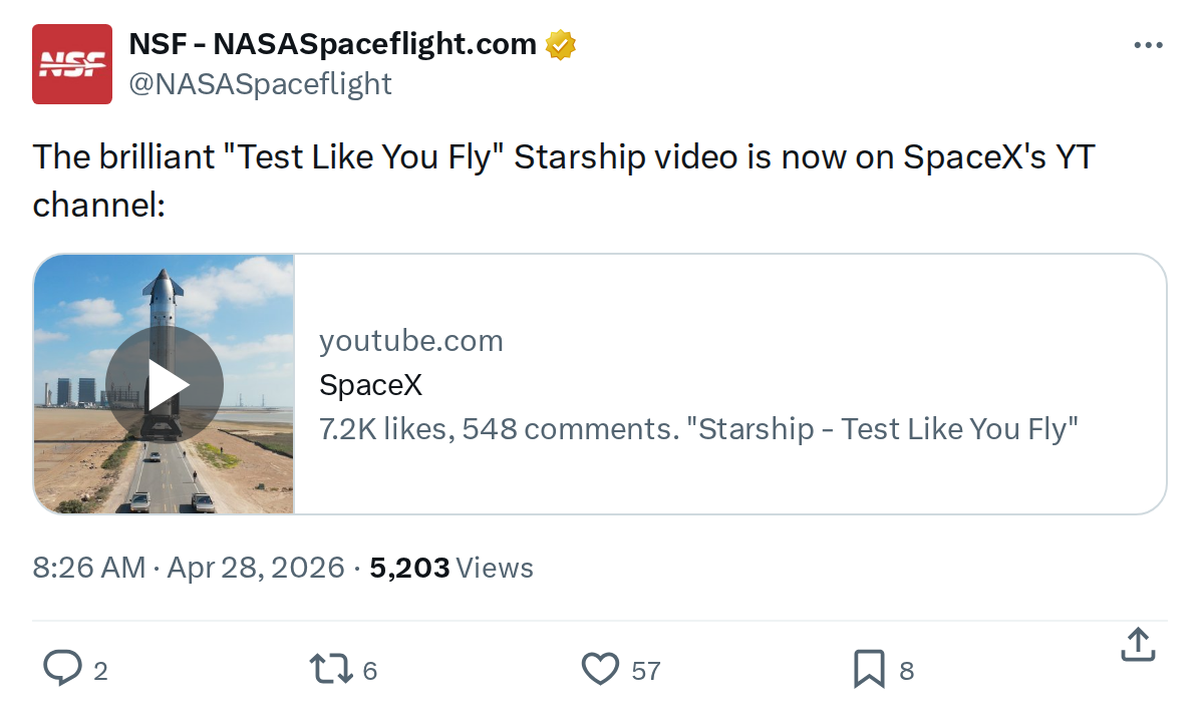
The News: SpaceX released a 25-minute documentary titled Test Like You Fly on April 24, 2026, offering the deepest public look yet at the Starship program's engineering philosophy and the incoming Version 3 hardware.
Why It Matters: The video formally introduces Starship V3 — a clean-sheet redesign with new engines, new booster, new pad, and new test site — and confirms Ship 39 and Booster 19 as the first V3 vehicles. This is the clearest signal yet of where the program is headed.
Source: @NASASpaceflight on X | SpaceX.com
SpaceX's Test Like You Fly Documentary Reveals Starship Version 3 — Everything You Need to Know
SpaceX dropped one of the most information-dense pieces of public content in the Starship program's history on April 24, 2026. The 25-minute documentary Test Like You Fly, now live on SpaceX's YouTube channel, isn't a highlight reel — it's a structured engineering briefing that formally introduces Starship Version 3, details the Raptor V3 engine, and walks through the hard lessons learned from Flights 1 through 5. If you care about where the world's most powerful rocket is going, this video is required watching.

📊 Key Figures
| Metric | Value | Context |
|---|---|---|
| Video Length | ~25 min | Full documentary, not a highlight reel |
| Release Date | April 24, 2026 | 4 days before NSF amplification |
| Booster 19 Engine Tests | 10-engine + 33-engine static fires | First V3 booster for full vehicle ops |
| V3 Orbital Endurance | Up to 48 hours | Enables propellant transfer missions |
| Cryo-Proof Test Temperature | ~80 Kelvin | 70% proof percentage confirmed |
| Flight Test Highlights | Flights 1–5 (V1) | Chopstick catch achieved on Flight 5 |
Starship Version 3: A Clean Sheet, Not an Iteration
The headline reveal in Test Like You Fly is the formal introduction of Starship Version 3. SpaceX isn't calling this an upgrade — they're calling it a clean-sheet design. That's a significant distinction. Where V1 and V2 were built to fly and learn, V3 is built with those lessons already baked in.
According to SpaceX VP of Starship Engineering Bill Riley and Director of Starship Engineering Charlie Cox, who both appear in the video, V3 encompasses five simultaneous redesigns: a new ship, a new booster, new engines, a new pad, and a new test site. Executing all five in parallel is an enormous engineering bet — and exactly the kind of move that defines SpaceX's development philosophy.
Ship 39 is identified as the first V3 Starship. Booster 19 is the first V3 Super Heavy, and the video shows it undergoing both 10-engine and full 33-engine static fire tests. Booster 18, its predecessor, suffered a nitrogen system explosion — a setback the video addresses directly, framing it as a learning input rather than a program failure.
Raptor V3: Reusability as the Primary Goal
The Raptor V3 engine gets dedicated coverage in the documentary. SpaceX's stated objective is aircraft-like reusability — not just surviving multiple flights, but doing so without significant refurbishment between them. The engine has been redesigned for both higher performance and simplification, two goals that are typically in tension. The video doesn't give a specific reuse cycle target, but the commercial aircraft engine benchmark is the clearest public statement of ambition SpaceX has made on this front.
48-Hour Orbital Endurance and Propellant Transfer
One of the most mission-critical capabilities confirmed for V3 Ship is the ability to remain in orbit for up to 48 hours. This isn't just a performance spec — it's a gateway technology. Propellant transfer in orbit is required for missions beyond low Earth orbit: the Moon, Mars, and deeper solar system destinations. The video confirms V3 is designed to perform these transfers, which aligns with NASA's Artemis program requirements for the Human Landing System variant of Starship.
The Starfactory and Cryo-Proof Testing
Beyond the hardware specs, Test Like You Fly offers rare footage inside SpaceX's Starfactory production facility in Boca Chica, Texas. The manufacturing scale visible in the video underscores that SpaceX is no longer treating Starship as a prototype program — production cadence is being built in parallel with flight testing.
The cryo-proof testing sequence is particularly notable for engineers watching the video. Liquid propellant at approximately 80 Kelvin (roughly -193°C) is used to pressure-test tank structures, with a 70% proof percentage confirmed in the footage. This kind of structural validation data is rarely shared publicly at this level of specificity.
🔭 The BASENOR Take
Timeline: V1 flight tests (Flights 1–5) are complete. V3 hardware (Ship 39, Booster 19) is in active testing. No confirmed date for first V3 integrated flight test.
Impact Level: 🔴 High — This is the most detailed public briefing on Starship's next generation to date. It sets expectations for what the program looks like through 2026 and beyond.
Confidence: ✅ High — All technical details sourced directly from the SpaceX-produced video featuring named engineering leadership on camera.
What makes Test Like You Fly different from SpaceX's usual launch livestreams is the deliberate, structured nature of the content. This isn't reactive PR — it's a calculated decision to show the engineering process in detail, likely timed to build public and institutional confidence ahead of V3's first integrated flight test. The simultaneous redesign of five major systems is a risk, but SpaceX's track record with the V1 flight campaign — culminating in a successful chopstick catch on Flight 5 — gives them credibility to make that bet.
For Tesla owners following SpaceX's trajectory: the technologies being validated here — rapid iteration, reusable hardware, high-cadence production — are the same philosophies driving Tesla's own manufacturing evolution. The two companies share more than an owner. They share a development DNA. For our full SpaceX coverage, including previous Starship milestones, see our dedicated tag page.
🚀 Following the Starship program? See every test flight, official outcome and the next launch window in our SpaceX Starship Tracker.
Sources & reporting notes
The links below identify the material source records used for this report.
- @NASASpaceflight on X (2026-04-28T00:26:51.000Z) — Direct source
Source links are preserved as published or accessed. See our editorial standards and corrections policy.
The BASENOR Editorial Desk covers Tesla, SpaceX, and related technology, curating reporting from primary sources — official accounts, regulatory filings, and software release data. Every article passes source-record and fact-checking review before publication. About the newsroom.
This report was curated by the BASENOR Editorial Desk from the sources listed above. Read our editorial standards or email editorial@basenor.com to report an error.