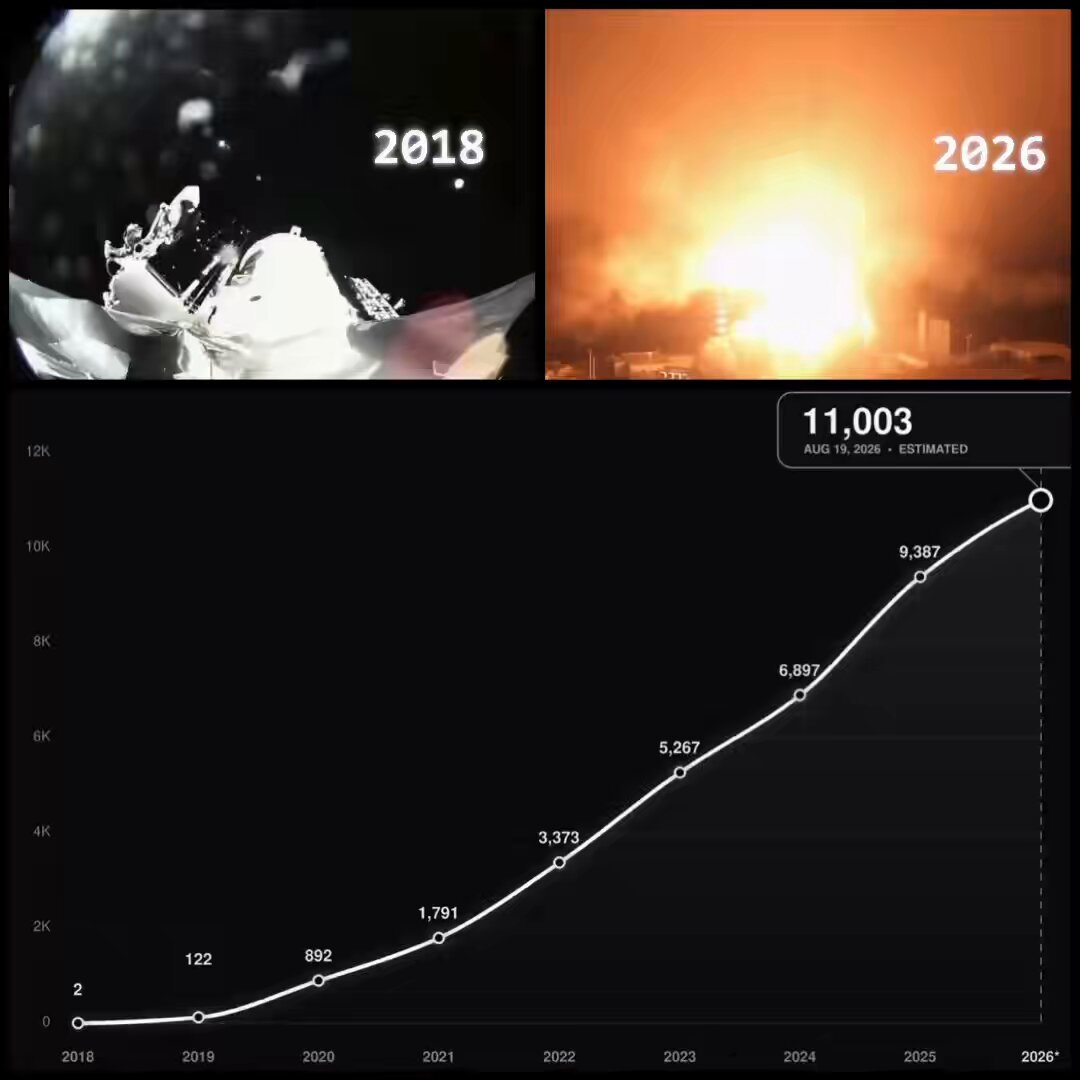
SpaceX has officially crossed 11,000 Starlink satellites in orbit, a milestone that lands just as the company is asking regulators for permission to expand the constellation nearly tenfold. Roughly 1,300 of those satellites were added in 2026 alone, and CEO Elon Musk marked the moment with a characteristically understated line — "one sat at a time" — attached to a montage of Falcon 9 deployments.
The milestone matters less as a round number and more as a signal of what comes next: an FCC filing from early July requesting authority to build a third-generation Starlink network of up to 100,000 satellites, sitting on top of the existing fleet.

Where the Constellation Stands Today
According to tracking data cited by keeptrack.space, the on-orbit Starlink count exceeded 11,000 as of August 18, 2026. That figure includes every satellite SpaceX has ever launched under the Starlink umbrella — operational units, spares, failed hardware, and satellites already queued for controlled deorbit. The active, service-providing fleet is somewhat smaller, but it still represents by a wide margin the largest satellite network ever operated by a single entity.
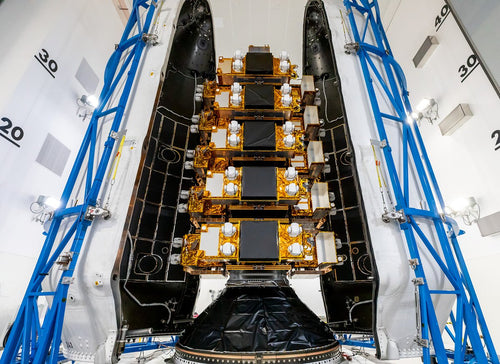
The pace has been the story. SpaceX completed its 100th mission of 2026 on August 18, according to space.com, and 74 of those flights had been dedicated to Starlink deployment. That cadence — roughly one Starlink launch every four days — is what turned Musk's "one sat at a time" quip into a plausible engineering reality. Each Falcon 9 typically carries 20 to 28 V2 Mini satellites depending on orbit and mission profile.

Key Figures
| Metric | Value |
|---|---|
| Total Starlink satellites launched | >11,000 |
| Added in 2026 (YTD) | ~1,300 |
| SpaceX missions in 2026 (through Aug 18) | 100 |
| Missions dedicated to Starlink | 74 |
| Proposed Gen3 constellation size | Up to 100,000 |
The Gen3 Filing Changes the Trajectory
In early July 2026, SpaceX filed with the U.S. Federal Communications Commission for approval to launch and operate a third-generation Starlink network — internally referred to as Gen3 or v3 — of up to 100,000 low-Earth-orbit satellites. According to the filing details reported by fierce-network.com and broadbandbreakfast.com, Gen3 is designed to layer on top of the current constellation rather than replace it, and each Gen3 satellite is intended to deliver roughly an order of magnitude more capacity than today's V2 Mini units.
That capacity leap is the piece worth watching. The current bottleneck for Starlink isn't the number of satellites — it's per-cell throughput, particularly in dense markets where too many subscribers share the same beam. Larger, more powerful Gen3 satellites are the engineering answer, but they require a launch vehicle that can actually carry them: Starship. Falcon 9 is what got Starlink to 11,000. Starship is what SpaceX is counting on to make 100,000 physically and economically feasible.
Regulatory Reality Check
An FCC application for 100,000 satellites is not the same as authorization. SpaceX's existing licenses cover roughly 12,000 first- and second-generation Starlink satellites, with an additional 7,500 conditionally approved. The Gen3 request will draw scrutiny on spectrum coordination, orbital debris mitigation, and interference with astronomy — all issues that have already generated friction between SpaceX, the FCC, and international regulators.
Competitors are watching too. Amazon's Project Kuiper has begun deploying its own LEO constellation, and Chinese state-backed networks are ramping. The 100,000-satellite filing is, among other things, a strategic marker: SpaceX is signaling that it intends to dominate LEO capacity by scale as well as by launch cadence.
What This Means for Tesla Owners
The Starlink story matters to the Tesla ecosystem for two concrete reasons. First, Tesla vehicles equipped with premium connectivity already rely on cellular data, but Starlink is the connective tissue behind Musk's broader vision of ubiquitous data — including the eventual bandwidth demands of a large-scale robotaxi fleet, Optimus units in the field, and cars in regions where terrestrial coverage is thin. Second, Starlink Direct-to-Cell service, which is progressing separately, is the pathway most likely to bring satellite backup connectivity to consumer devices — and, plausibly, to vehicles — over the next few years.
None of that is imminent. But the Gen3 filing is the first concrete regulatory step toward a network whose capacity would make in-vehicle satellite connectivity a real product rather than a slide.
What to Watch Next
- FCC comment period on Gen3: Public filings from competitors and astronomy groups will shape what SpaceX ultimately gets approved.
- Starship cadence: Gen3 economics depend on Starship reaching operational reliability. Every successful test moves the 100,000-satellite plan from paper to pipeline.
- 2026 launch total: At the current pace, SpaceX is on track to blow past 130 orbital missions this year, with Starlink absorbing the majority of that manifest.
- Direct-to-Cell rollout: The consumer-facing service that most directly connects Starlink's growth to everyday users, including Tesla owners.
Eleven thousand satellites was the number that would have sounded absurd five years ago. One hundred thousand is the number that sounds absurd today. The gap between those two, if Gen3 clears the FCC, is essentially a question of how fast Starship can fly.
🚀 Following the Starship program? See every test flight, official outcome and the next launch window in our SpaceX Starship Tracker.
Sources & reporting notes
The links below identify the material source records used for this report.
- @elonmusk on X (2026-08-19T14:52:55.000Z) — Direct source
- @SawyerMerritt on X (2026-08-19T14:54:06.000Z) — Direct source
Source links are preserved as published or accessed. See our editorial standards and corrections policy.
The BASENOR Editorial Desk covers Tesla, SpaceX, and related technology, curating reporting from primary sources — official accounts, regulatory filings, and software release data. Every article passes source-record and fact-checking review before publication. About the newsroom.
This report was curated by the BASENOR Editorial Desk from the sources listed above. Read our editorial standards or email editorial@basenor.com to report an error.