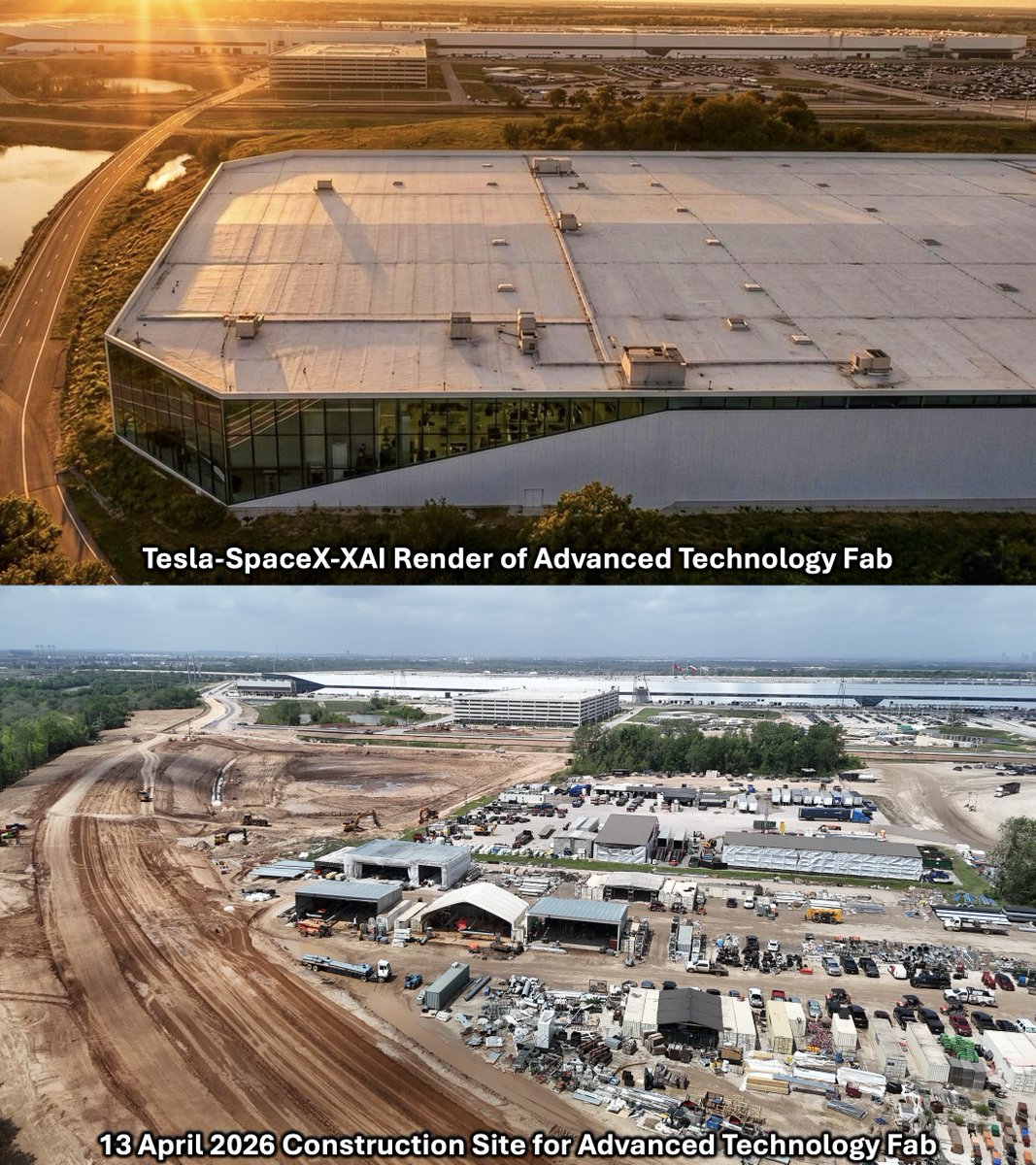
The News: Joe Tegtmeyer has shared a side-by-side comparison of the official Terafab rendering versus current on-site construction progress at the North Campus of Gigafactory Texas in Austin.
Why It Matters: Terafab is the $20–25B joint chip fabrication facility backed by Tesla, SpaceX, xAI, and Intel — designed to produce AI chips for FSD, Cybercab, Optimus, and beyond. Seeing dirt move is the first real proof the project is off paper and into the ground.
Source: @JoeTegtmeyer on X
Rendering vs. Reality: What Tegtmeyer's Photos Show
Construction observers have been watching the North Campus of Gigafactory Texas closely since Elon Musk announced the Terafab venture on March 21, 2026. Now, site watcher Joe Tegtmeyer has delivered the clearest visual update yet — a direct comparison between the official architectural rendering and what the site looks like on the ground today.

According to Tegtmeyer, the bulk of current activity is focused on three infrastructure priorities: extending River Road to serve the new campus, installing water retention and drainage systems, and relocating existing workshops and trailers to clear the construction footprint. These are classic early-phase moves — the kind of groundwork that has to happen before a single wall goes up.
Separately, verified site reports from earlier in April noted that the diamond-shaped foundation outline — matching the distinctive geometry of the official rendering — is beginning to emerge from the ground, with crews installing piers to support the footings. The site is moving fast by any standard for a project of this scale.
📊 Key Figures
| Metric | Value | Context |
|---|---|---|
| Estimated Project Cost (Phase 1) | $20–25B | Initial fabrication campus |
| Target AI Compute Output | 1 terawatt / year | ~50× current global AI chip output |
| Initial Wafer Starts | 100,000 / month | Scaling to 1M / month at full capacity |
| Process Node Target | 2nm | Intel 18A node with GAA transistors |
| First Chip (AI5) Small-Batch | 2026 | Volume production expected 2027 |
| Intel Joined as Partner | April 7, 2026 | Contributing 18A process + 3D packaging |
What Is Terafab, and Why Does It Matter to Tesla Owners?
Announced just weeks ago at Austin's historic Seaholm Power Plant, Terafab is not a typical chip contract arrangement. The facility is designed to vertically integrate the entire chip production pipeline — design, lithography, fabrication, memory, advanced packaging, and testing — all under one roof, adjacent to Gigafactory Texas. Intel joined the project on April 7, 2026, bringing its cutting-edge 18A process node, which features gate-all-around transistor architecture, backside power delivery, and advanced 3D stacking via EMIB and Foveros technologies.
For Tesla owners, the direct downstream impact is significant. Chips manufactured at Terafab are slated to power Tesla's AI5 processor — the next-generation silicon behind Full Self-Driving — as well as the Cybercab robotaxi platform and Optimus humanoid robots. In short, the faster Terafab reaches volume production, the faster Tesla's autonomous capabilities can scale.
The long-term vision extends well beyond Austin. The permanent Terafab campus is expected to require thousands of acres at a yet-to-be-determined location, with the current Gigafactory Texas site serving as the initial prototype fabrication hub before that larger buildout begins.
🔭 The BASENOR Take
Timeline: Announced March 21, 2026 → Intel partnership April 7, 2026 → Active earthwork and foundation prep confirmed April 13, 2026. That is less than four weeks from announcement to visible ground movement on a multi-billion-dollar semiconductor fab.
Impact Level: 🔴 High — This is the supply chain backbone for Tesla's next decade of AI hardware.
Confidence: High — Site photos corroborate the official rendering geometry and the infrastructure work described is consistent with early-phase fab construction.
The pace here is worth emphasizing. Traditional semiconductor fabs take five to seven years from groundbreaking to volume production. Terafab's stated timeline — small-batch AI5 chip output in 2026, volume in 2027 — is extraordinarily aggressive by industry standards. Whether that holds will depend heavily on how quickly the foundation and cleanroom shell can be completed, and whether Intel's 18A process node delivers at yield in a new facility environment.
What Tegtmeyer's comparison photo confirms is that the site is not sitting idle. The River Road extension, water retention infrastructure, and trailer relocation are all prerequisite work that has to clear before heavy construction equipment can operate freely across the full footprint. Seeing this progress less than a month after the public announcement suggests the project had significant pre-announcement planning behind it — which is consistent with how Musk-led ventures typically operate.
📰 Deep Dive
The choice to site Terafab's initial phase directly adjacent to Gigafactory Texas is strategically deliberate. Giga Texas already handles Model Y and Cybertruck production, and the proximity means the AI5 chips coming off the Terafab line can be integrated into vehicle hardware with minimal logistics friction. It also allows Tesla's engineering teams to iterate on chip-to-vehicle integration in real time — a feedback loop that TSMC or Samsung contract manufacturing simply cannot replicate.
Intel's involvement deserves more attention than it has received. The 18A node is Intel's most advanced process technology, and Terafab would represent one of its highest-profile external deployments. Intel's Foveros 3D stacking and EMIB interconnect technologies are specifically designed for the kind of chiplet-based architectures that maximize AI compute density — exactly what Tesla needs for FSD inference at scale in both vehicles and data centers.
The target of one terawatt of annual AI compute capacity is a number that demands context. Current global AI chip output — dominated by NVIDIA — is estimated at roughly 20 gigawatts annually. Terafab's stated goal is approximately 50 times that figure. Even if the actual ramp falls well short of that ceiling, the facility would represent a seismic shift in who controls AI silicon supply. For Tesla owners, that translates directly into faster FSD iterations, more capable Optimus robots, and a Cybercab fleet that is not constrained by third-party chip availability.
Watch the River Road extension closely in the coming weeks. That infrastructure milestone is the clearest leading indicator of when heavy construction equipment will be able to access the full site — and when the foundation pour timeline will become clearer. Tegtmeyer's ongoing documentation is currently the best ground-level visibility available on a project that will shape Tesla's hardware roadmap for years to come. For more on how AI silicon connects to Tesla's self-driving ambitions, see our FSD coverage.

Sarah focuses on Tesla Energy, SpaceX missions, and the broader Musk AI portfolio. Former data analyst in clean energy. Based in San Francisco.
Sources verified at publish time. Spotted an inaccuracy? Email editorial@basenor.com.