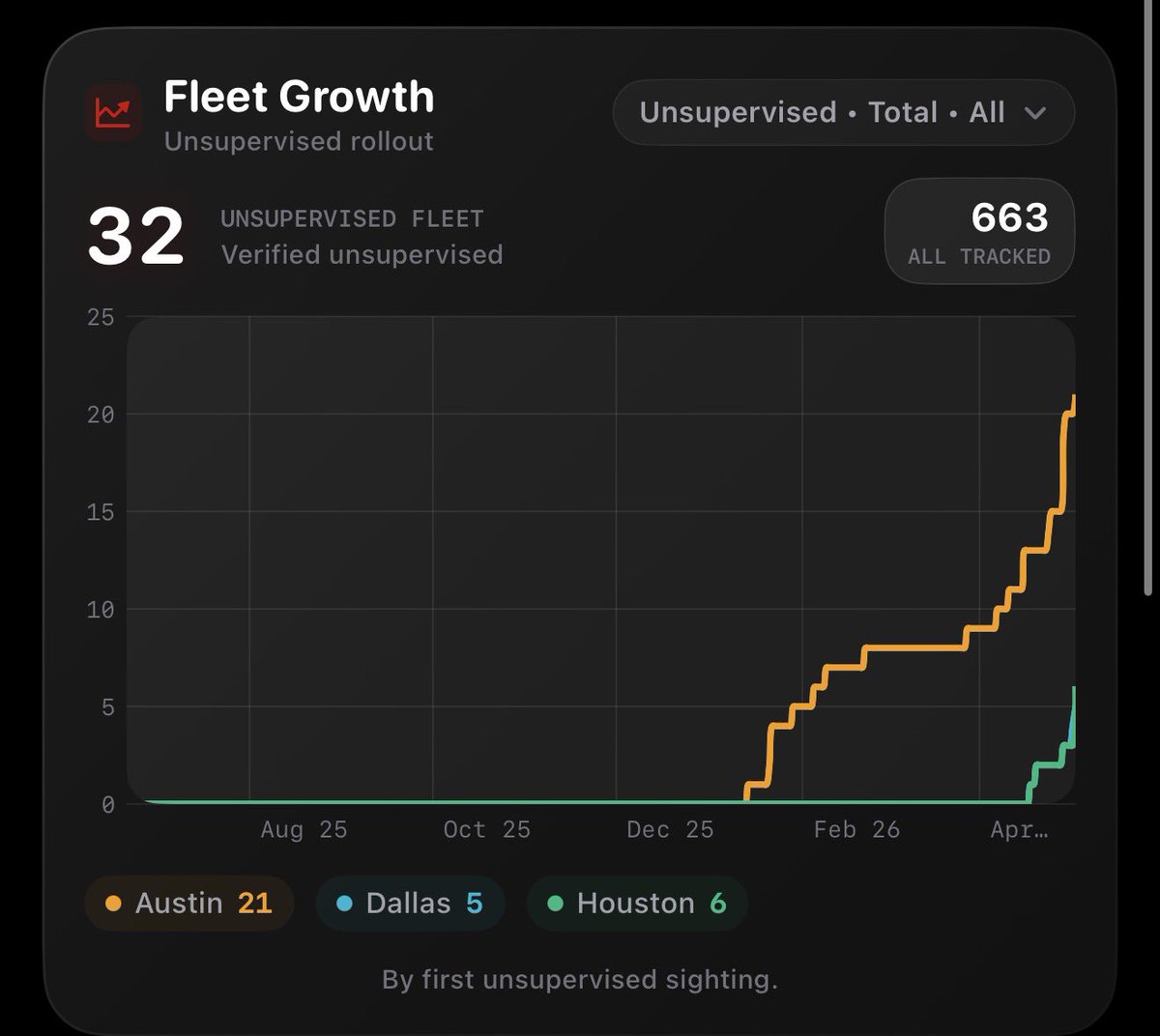
It doesn't look explosive from the outside — but according to fleet tracking platform Teslascope, Tesla's rollout of unsupervised Full Self-Driving vehicles is already the fastest autonomous vehicle expansion in North American history. And if current growth curves hold, Tesla is on track to leave every other AV operator behind within five to six months.

Gradual, Until It Isn't
Teslascope's framing — "Gradually, then all at once" — is borrowed from Hemingway's description of bankruptcy, but it applies just as cleanly to exponential technology adoption. The early stages of an exponential curve are nearly indistinguishable from flat. Critics point to the modest vehicle counts and declare the rollout stalled. Then the curve bends upward and the numbers become impossible to ignore.
That inflection point appears to be approaching. Teslascope, which tracks Tesla fleet data and software deployment, notes that even at what feels like a measured pace, Tesla's unsupervised FSD deployment has already outrun every comparable autonomous vehicle program that has operated in North America. That's a meaningful benchmark — the continent has hosted Waymo, Cruise, Zoox, Aurora, and a roster of other well-funded AV programs over the past decade, each with its own expansion timeline.
Why the Comparison Matters
Most AV competitors operate purpose-built fleets — vehicles manufactured specifically for autonomous operation, deployed in controlled geofenced zones, and scaled city by city through lengthy regulatory approval processes. Each new market requires fresh permitting, mapping runs, safety driver training, and infrastructure investment. Growth is linear by design.
Tesla's model is structurally different. The vehicles already exist on public roads, owned by customers. The hardware — cameras, compute, neural network inference — ships with every new Tesla. Enabling unsupervised operation is, at the infrastructure level, a software deployment. That distinction is what makes exponential scaling plausible in a way it simply isn't for a traditional robotaxi operator building out a dedicated fleet from scratch.
When Teslascope projects that Tesla will surpass "other popular AVs" within five to six months, the comparison is almost certainly to total miles operated autonomously without human supervision, or to the number of vehicles capable of unsupervised operation — metrics where Tesla's installed base gives it a structural ceiling that no competitor can match on a similar timeline.
What Exponential Growth Actually Looks Like
The challenge with exponential growth is that it requires patience before it demands attention. A program doubling every few weeks looks unremarkable in month one. By month five or six, the same doubling rate produces numbers that dwarf anything that came before it. If Teslascope's five-to-six-month projection is accurate, the AV industry's competitive landscape could look materially different before the end of Q3 2026 — not because competitors lost ground, but because Tesla's curve finally bent into territory where the gap becomes visually undeniable.
For Tesla owners, the practical implication is straightforward: the unsupervised FSD capability that is currently available to a subset of the fleet is expanding, and expanding faster than the public narrative suggests. Eligibility criteria, geographic availability, and the specific conditions under which unsupervised operation is permitted will continue to evolve as the rollout widens. Owners interested in our FSD coverage can track those developments as they happen.
Editor's View
The "gradual, then all at once" framing is doing a lot of work here, and it's worth taking seriously rather than dismissing as hype. The companies that lost ground to Tesla in the EV market largely made the same mistake: they watched the early adoption numbers, concluded the threat was manageable, and recalibrated too late. The AV space may be running the same playbook. Five to six months is a short window to close an exponential gap.
Related Gear
Gear up your Tesla with tested, custom-fit BASENOR accessories — shop Tesla accessories →
Sources & reporting notes
The links below identify the material source records used for this report.
- @teslascope on X (2026-05-03T20:06:53.000Z) — Direct source
Source links are preserved as published or accessed. See our editorial standards and corrections policy.
The BASENOR Editorial Desk covers Tesla, SpaceX, and related technology, curating reporting from primary sources — official accounts, regulatory filings, and software release data. Every article passes source-record and fact-checking review before publication. About the newsroom.
This report was curated by the BASENOR Editorial Desk from the sources listed above. Read our editorial standards or email editorial@basenor.com to report an error.