📱 30-Second Brief
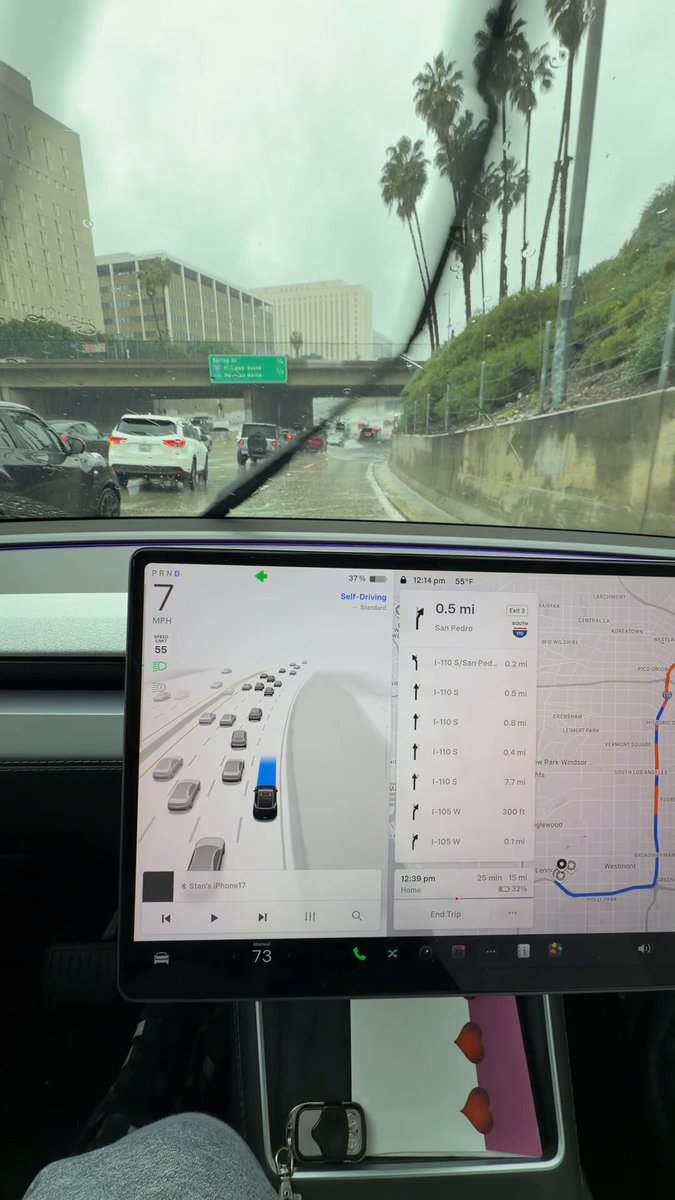
The News: Tesla AI has released official footage demonstrating FSD Supervised successfully navigating through heavy rain and flooded road conditions.
Why It Matters: This marks the first time Tesla has publicly showcased FSD's extreme weather capabilities using official channels, addressing one of the most critical safety questions owners have about autonomous driving reliability.
Source: @Tesla_AI on X — Feb 17, 2026
🌧️ The Official Reveal
Tesla's AI team broke their typical silence tonight with a single tweet that's already generating buzz across the Tesla community: 'FSD Supervised knows how to handle heavy rain & flooding.' The accompanying video shows a Tesla navigating through conditions that would make most drivers slow to a crawl—standing water on roadways, reduced visibility from torrential rain, and the kind of weather that typically triggers degraded performance warnings.

What makes this announcement significant is the source. While Tesla owners have been posting their own heavy rain FSD experiences throughout late 2025 and early 2026, this is Tesla's official AI team putting their stamp on extreme weather performance. The timing is notable—coming just weeks before Tesla's expected Q1 2026 European FSD authorization, where regulatory scrutiny on safety performance is at its peak.
🔭 The BASENOR Take
Analysis: This release serves multiple strategic purposes. First, it directly addresses one of the most common criticisms of vision-only autonomous driving—that cameras can't match human performance in low-visibility conditions. Second, it provides regulatory evidence as Tesla pushes for European approval. Third, it counters recent NHTSA probe findings from late 2025 that cited 'occasional failures in reduced visibility.'
The backdrop makes this particularly interesting: FSD v14, which incorporates learnings from Tesla's Robotaxi program, began rolling out in late 2025. Hardware 4 vehicles with upgraded 5-megapixel Sony IMX sensors offer improved dynamic range specifically for challenging conditions. The 2026 Model Y Juniper even includes a self-cleaning lip on side repeater cameras—design choices that only make sense if Tesla is confident about tackling weather extremes.
📊 What This Means for Tesla Owners
Current FSD Users: If you've been hesitant to engage FSD during heavy rain, this official endorsement suggests the system is ready for real-world weather challenges. User reports from late 2025 through early 2026 align with this—drivers on FSD v13.2.9 and v14 have documented successful navigation in heavy rain and snow, with the system adapting speed appropriately.
European Buyers: This announcement arrives strategically before Tesla's expected Q1 2026 European regulatory approval. The Dutch vehicle authority RDW confirmed a February 2026 target for compliance demonstrations. Extreme weather performance is a critical checkbox for European regulators given the continent's diverse climate conditions.
Prospective FSD Subscribers: With Tesla transitioning to subscription-only FSD after February 14, 2026, this demonstration adds value to the subscription proposition. Weather reliability directly impacts usability—if FSD can't handle rain, it's not a daily driver tool.
🔍 The Technical Context
Tesla's vision-only approach has always been the company's most controversial architectural decision. While competitors add lidar and radar for redundancy, Tesla maintains that artificial intelligence interpreting camera data is the correct path. Heavy rain tests this philosophy to its limits—water droplets on lenses, reduced contrast, obscured lane lines, and unpredictable surface conditions.
The improvements likely come from several sources:
- Neural network training: FSD v14 incorporates data from the Robotaxi program, which means exposure to millions of miles in diverse weather conditions
- Hardware upgrades: Hardware 4's 5-megapixel sensors with improved dynamic range help cameras distinguish features in low contrast situations
- Path planning refinement: The system appears to identify standing water and adjust trajectory accordingly, suggesting improved surface analysis
However, owner experiences reveal nuance. While many report successful operation in heavy rain, some note that 'extremely heavy' downpours still trigger weaving behavior due to lane line detection challenges. The system may display 'FSD supervised may be degraded' warnings but continues driving—a compromise between capability and conservative alerts.
⚠️ The Regulatory Backdrop
Tesla's timing isn't accidental. NHTSA investigations in late 2025 and early 2026 flagged 'lingering issues like occasional failures in reduced visibility' for FSD. By releasing official footage of successful heavy rain navigation, Tesla provides counter-evidence. This is particularly important as the company scales toward wider FSD deployment and regulatory approval in new markets.
The European approval process demands rigorous safety validation. By demonstrating extreme weather capability publicly, Tesla signals to regulators that vision-only architecture can meet safety standards even in challenging conditions. The February 2026 timing aligns perfectly with RDW's demonstration timeline.
📰 Deep Dive
The evolution of FSD's weather capability tells the story of Tesla's AI-first development philosophy. Early versions struggled with even moderate rain, triggering frequent disengagements and requiring driver intervention. The progression from v12 through v13 to the current v14 generation shows systematic improvement in perception under degraded conditions. Each iteration trained on exponentially more data, with Tesla's fleet learning from millions of real-world miles in every weather condition imaginable.
What makes Tesla's approach unique is the rejection of sensor redundancy as a crutch. While competitors argue that lidar provides weather-independent distance measurement, Tesla maintains that humans drive with vision alone, therefore properly trained AI should match that capability. This video serves as evidence for that thesis—if the neural network can identify flooded sections, maintain lane position, and navigate safely through heavy rain, it validates the vision-only architecture.
The commercial implications extend beyond current owners. Tesla's full self-driving ambitions—including the planned Robotaxi network—depend entirely on all-weather reliability. A robotaxi service that shuts down during rain isn't viable. By demonstrating extreme weather capability at this stage, Tesla signals that the technology is maturing toward true autonomy, not just fair-weather assistance.
For the 500,000+ Tesla owners in the BASENOR community, this announcement provides both reassurance and a glimpse of the development roadmap. The gap between 'works most of the time' and 'works reliably in extreme conditions' is the difference between a convenience feature and a transformative technology. Based on this demonstration and supporting field reports, FSD Supervised appears to be crossing that threshold. As Tesla continues investing heavily in AI solutions through 2026, expect weather performance to become a standard selling point rather than a cautious footnote.
📋 Tracking Tesla software? See every firmware, FSD and app version in one place in our Tesla Software Update Tracker.
🚕 Following the Robotaxi rollout? See every operating city, launch date and announced market in our Tesla Robotaxi Tracker.
Related Gear
Gear up your Tesla with tested, custom-fit BASENOR accessories — shop Tesla accessories →
Sources & reporting notes
The links below identify the material source records used for this report.
- @Tesla_AI on X (2026-02-17T23:02:07.000Z) — Direct source
Source links are preserved as published or accessed. See our editorial standards and corrections policy.
The BASENOR Editorial Desk covers Tesla, SpaceX, and related technology, curating reporting from primary sources — official accounts, regulatory filings, and software release data. Every article passes source-record and fact-checking review before publication. About the newsroom.
This report was curated by the BASENOR Editorial Desk from the sources listed above. Read our editorial standards or email editorial@basenor.com to report an error.