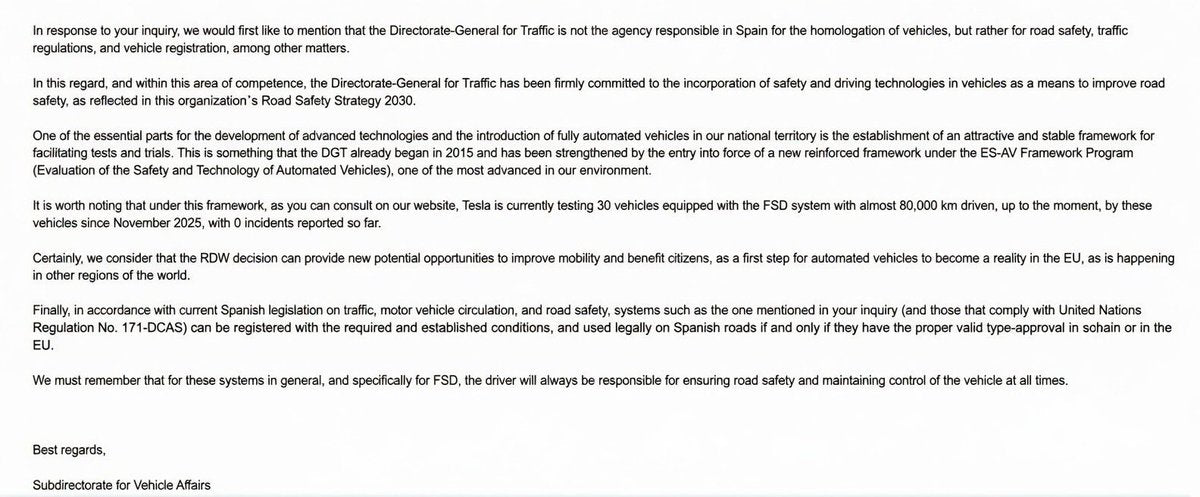
The News: Tesla is actively testing FSD (Supervised) in Spain, with 30 vehicles having logged nearly 80,000 km since November 2025 — with zero reported incidents, according to Spain's national traffic authority.
Why It Matters: This is the clearest official confirmation yet that Tesla's FSD international expansion is underway in Europe, with a government body on record validating the program's safety record.
Source: @TeslaNewswire on X
Tesla FSD (Supervised) Is Now Being Tested in Spain — 80,000 km and Zero Incidents
Tesla's Full Self-Driving expansion into Europe just got its most significant official endorsement to date. Spain's national traffic authority has confirmed that Tesla is actively running a sanctioned FSD (Supervised) testing program on Spanish roads — and the early numbers are hard to argue with.

What Spain's Traffic Authority Actually Said
The statement from Spain's national traffic authority is unusually direct for a government body: 30 Tesla vehicles equipped with FSD have collectively driven nearly 80,000 km since November 2025, with zero reported incidents. That's not a Tesla press release — that's an independent regulatory body putting its name on the safety record of FSD on European roads.
For context, 80,000 km across 30 vehicles over roughly five months represents a meaningful real-world dataset. These aren't closed-course test laps. Spanish roads include dense urban environments, high-speed motorways, roundabouts (a fixture of European infrastructure that has historically challenged driver-assistance systems), and mixed-traffic rural roads.
📊 Key Figures
| Metric | Value | Context |
|---|---|---|
| Vehicles in program | 30 | Official testing fleet |
| Total km driven | ~80,000 km | ~2,667 km per vehicle |
| Program start date | November 2025 | ~5 months of data |
| Reported incidents | 0 | Per traffic authority |
Why Spain, and Why Now?
Spain isn't a random choice. It's one of Europe's largest automotive markets and sits within the EU regulatory framework that Tesla will need to navigate for any broad European FSD rollout. Getting a clean safety record on file with a national traffic authority — and having that authority speak publicly about it — is exactly the kind of groundwork needed before a commercial launch can happen.
The timing also aligns with Tesla's broader international FSD push. The company has been methodically expanding FSD testing beyond North America, and a government-confirmed, incident-free program in a major EU member state strengthens the regulatory case significantly.
🔭 The BASENOR Take
Timeline: Testing active since November 2025 — approximately 5 months of documented operation
Impact Level: High — first government-confirmed FSD testing program in continental Europe
Confidence: High — statement attributed directly to Spain's national traffic authority
What to watch: Whether Spain's data triggers parallel approvals in France, Germany, or at the EU level
The zero-incident figure deserves scrutiny in the right direction: it's genuinely impressive, not just as a marketing number. Spain's traffic authority has no incentive to underreport incidents — if anything, regulators are typically conservative about validating autonomous systems. A clean record after 80,000 km on public roads, logged with a government body, is a meaningful data point.
What this doesn't tell us is the intervention rate — how often a human driver had to take over. FSD (Supervised) still requires an attentive driver, and the "zero incidents" metric reflects crashes or reportable events, not disengagements. That distinction matters for understanding where the technology actually stands versus where it needs to go for a fully unsupervised European deployment.
For European Tesla owners following our FSD coverage, this is the clearest signal yet that a broader rollout is being built on a foundation of regulatory trust, not just technical capability. The path from "testing in Spain" to "available across the EU" still involves multiple regulatory bodies, homologation requirements, and likely further testing milestones — but the direction is unambiguous.
📰 Deep Dive
What makes this announcement structurally different from Tesla's own FSD milestone claims is the source. When a national traffic authority — the body responsible for road safety regulation — issues a statement confirming an active testing program and its safety record, it carries a different weight than a company press release. Spain's DGT (Dirección General de Tráfico) is the equivalent of the NHTSA in terms of regulatory authority over road safety, and their willingness to publicly confirm this program suggests a cooperative relationship with Tesla that goes beyond a simple permit filing.
The scale of the program — 30 vehicles, nearly 80,000 km — also suggests this isn't a token gesture. Tesla appears to be running a structured data-collection effort designed to produce the kind of safety record that satisfies European regulators. Five months of real-world operation across what is presumably a diverse set of Spanish road conditions gives regulators something concrete to evaluate.
For owners in other European markets, the question is sequencing. Spain's program likely feeds into a broader EU regulatory conversation. Germany, France, and the Netherlands are the other major markets where FSD availability would have the most immediate impact, and each has its own regulatory pathway. But a clean government-confirmed record in one EU member state creates useful precedent. Watch for similar announcements from other national authorities — that's the signal that the European rollout is accelerating from pilot to pre-launch.

Marcus covers Tesla's software releases, FSD rollouts, and OTA changes. Background in automotive engineering. Based in Austin.
Sources verified at publish time. Spotted an inaccuracy? Email editorial@basenor.com.