30-Second Brief
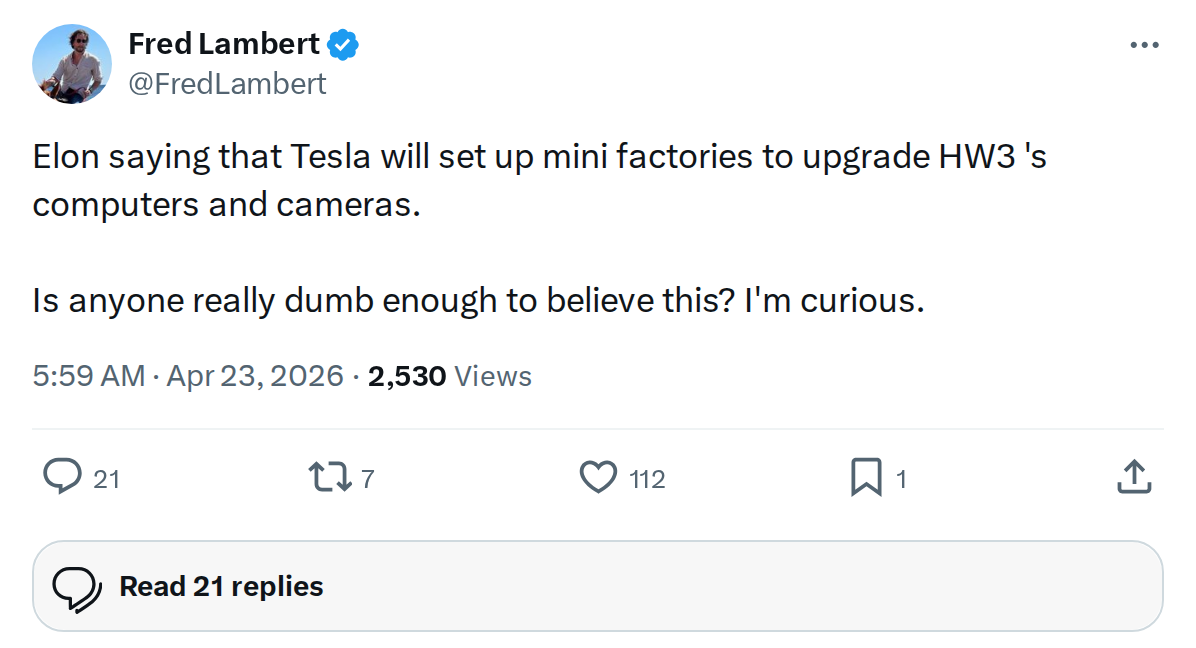
The News: Elon Musk has stated that Tesla plans to establish dedicated mini-factories to upgrade Hardware 3 (HW3) computers and cameras in existing vehicles.
Why It Matters: Approximately 4 million HW3 vehicles globally cannot achieve unsupervised Full Self-Driving — this upgrade path is Tesla's answer to that obligation, and it affects a massive portion of the existing fleet.
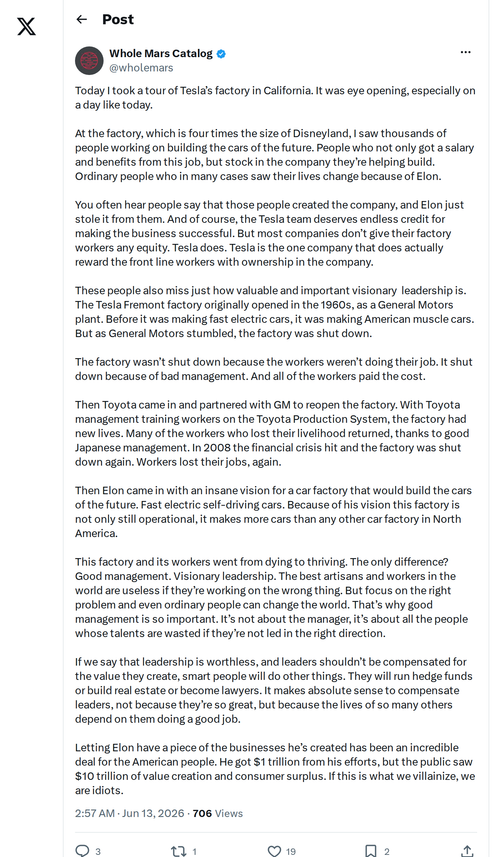
Source: @FredLambert on X
Tesla Plans Mini-Factories to Upgrade HW3 Computers and Cameras in 4 Million Vehicles
If you own a Tesla with Hardware 3 and paid for Full Self-Driving Capability, this is the news you've been waiting — and wondering — about. Elon Musk has indicated that Tesla intends to set up dedicated mini-factories specifically to handle the physical upgrade of HW3 computers and cameras across its existing fleet. The scale of the challenge is enormous: roughly 4 million HW3 vehicles worldwide are affected.

Fred Lambert's skepticism, captured above, reflects a sentiment shared by many in the Tesla community. The logistics of physically upgrading millions of vehicles at scale — each requiring new compute hardware and cameras — is genuinely unprecedented for an automaker. But understanding why Tesla is committed to this path requires understanding what's actually at stake.
Why HW3 Can't Just Get a Software Fix
On April 22, 2026, Elon Musk confirmed what had been rumored since early 2025: Hardware 3 will not achieve unsupervised Full Self-Driving. This isn't a software limitation that can be patched over-the-air. HW3 was built around a different compute architecture, and the neural network demands of unsupervised FSD — the kind that powers the Cybercab and Tesla's robotaxi ambitions — simply exceed what HW3 can deliver.
This creates a real obligation for Tesla. Millions of customers paid anywhere from $8,000 to $15,000 for FSD Capability on the promise that their vehicle would eventually achieve full autonomy. With HW3 now officially ruled out for unsupervised operation, Tesla needs a credible solution — and the mini-factory upgrade program is that solution.
What the Upgrade Actually Involves
According to verified information, HW3 owners with FSD Capability will be offered two paths:
- Free hardware upgrade — replacing the Autopilot computer and cameras with AI4-generation hardware. Due to form-factor, power, and architecture differences between HW3 and full HW4, the replacement is expected to be a trimmed-down AI4 variant — sometimes referred to as HW3.5 or a reduced HW4 — rather than the identical chip found in new vehicles rolling off the line today.
- Discounted trade-in — trading in the HW3 vehicle for a newer model with native AI4 hardware. Specific discount structures have not yet been disclosed.
The camera upgrade is equally significant. HW3 vehicles shipped with lower-resolution cameras than current production cars. Unsupervised FSD relies heavily on camera quality for perception, so a compute swap alone wouldn't be sufficient — the cameras need to come along for the ride.
The Mini-Factory Concept: Why It Makes Sense (and Why It's Hard)
A traditional service center model isn't built for this kind of throughput. Replacing a vehicle's central compute stack and all cameras is a multi-hour job requiring trained technicians, specialized tooling, and a controlled environment for calibration. Multiplied across 4 million vehicles, that's not a service queue — it's a manufacturing challenge.
The mini-factory approach — dedicated facilities optimized specifically for this upgrade workflow — is Tesla's answer to that throughput problem. Think of it less like a dealership service bay and more like a specialized retrofit line: vehicles come in, get upgraded on a streamlined process, and leave with next-generation hardware. Tesla has demonstrated this kind of operational creativity before, including its use of temporary production tents during Model 3 ramp. The concept is plausible. The execution timeline and geographic distribution of these facilities, however, remain unconfirmed.
The Interim Bridge: FSD v14 Lite
While the hardware upgrade program is being stood up, Tesla is preparing a stopgap for HW3 owners: a stripped-down version of FSD v14, reportedly called "v14 Lite," expected by the end of June 2026. This version is optimized for older hardware but will have reduced capabilities compared to the full v14.x releases running on AI4 vehicles. It keeps HW3 owners in the FSD ecosystem while the physical upgrade path is built out — a pragmatic bridge, even if it's not the destination.
📊 HW3 Upgrade Snapshot
| Vehicles Affected | ~4 million globally |
| HW3 Unsupervised FSD Capable? | No — confirmed by Elon Musk |
| Upgrade Hardware Target | AI4 variant (trimmed HW4 or HW3.5) |
| Cost to FSD Owners | Free (hardware upgrade option) |
| Interim Software | FSD v14 Lite — expected by end of June 2026 |
| Mini-Factory Timeline | Not yet confirmed |
🔭 The BASENOR Take
Timeline: Announcement confirmed April 22, 2026. Execution timeline for mini-factories: TBD. FSD v14 Lite interim: end of June 2026.
Impact Level: 🔴 High — affects millions of existing Tesla owners with FSD Capability purchases
Confidence: Medium. The commitment is real and the obligation is clear. The mini-factory execution at the scale required is the open question.
Fred Lambert's skepticism isn't unfounded — Tesla has a history of ambitious timelines that slip. But the business logic here is unusually clear. Tesla sold FSD Capability to millions of customers on a specific promise. HW3 cannot fulfill that promise. The legal, reputational, and customer-relationship stakes of not delivering an upgrade path are significant. That pressure makes the mini-factory program more credible than a typical Musk timeline announcement.
The harder question is execution. Upgrading 4 million vehicles requires not just the facilities, but the supply chain for AI4 compute hardware and new cameras at scale — while simultaneously supplying new production vehicles. These are competing demands on the same manufacturing capacity. How Tesla prioritizes and sequences this will tell us a lot about how seriously the upgrade commitment is being resourced.
For HW3 owners, the near-term advice is straightforward: watch for FSD v14 Lite this summer as your interim upgrade, and keep an eye on official Tesla communications for when the hardware upgrade program opens in your region. The mini-factory model, if executed, could actually be faster and more consistent than routing millions of appointments through existing service centers — but that's a big if that deserves healthy scrutiny. For more context on Tesla's self-driving roadmap, see our FSD coverage.

Marcus covers Tesla's software releases, FSD rollouts, and OTA changes. Background in automotive engineering. Based in Austin.
Sources verified at publish time. Spotted an inaccuracy? Email editorial@basenor.com.