📌 UPDATE — March 24, 2026
New factory footage from inside Tesla's Semi production facility reveals the production-ready truck has been significantly refined beyond the prototype showcased in Jay Leno's Garage deep-dive. Tesla engineers managed to slash over 1,000 lbs from the prototype's weight, a major win for payload capacity and efficiency. The production Semi is also described as more energy-efficient and notably easier to service and repair — addressing a key concern for fleet operators focused on uptime and total cost of ownership. These improvements suggest Tesla has iterated aggressively between the prototype stage and full production readiness.
@TeslaNewswire · March 24, 2026Check out this video from inside the Tesla Semi factory!
Tesla has made the production-ready Tesla Semi:
✅ More mass-efficient
✅ More energy-efficient
✅ More service- and repair-efficient
Tesla has cut more than 1,000 lbs from the Semi prototype.
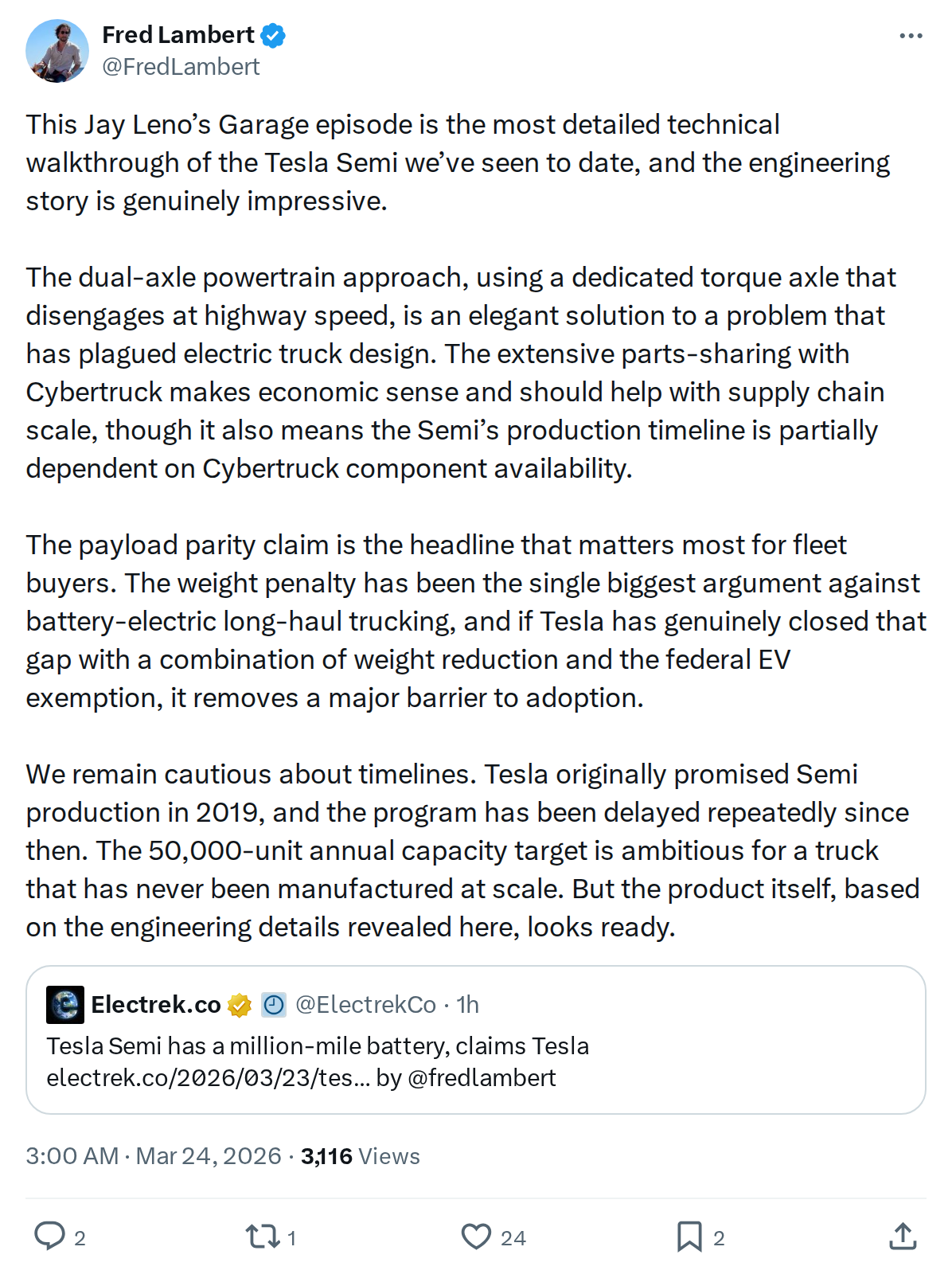
The News: A Jay Leno's Garage episode featuring Tesla Semi program lead Dan Priestley delivered the most detailed technical walkthrough of the Semi's powertrain to date.
Why It Matters: The engineering details — from a disengaging torque axle to 1.2 MW charging — reveal a truck that's genuinely competitive with diesel Class 8 rigs on payload, range, and efficiency.
Source: @FredLambert on X

Tesla has always been cagey about the Semi's inner workings. That changed today. A new Jay Leno's Garage episode featuring Tesla Semi program lead Dan Priestley pulled back the curtain on one of the most sophisticated electric powertrain architectures in commercial trucking — and the details are worth unpacking carefully.
📊 Key Figures
| Metric | Value | Context |
|---|---|---|
| Combined Drive Power | 800 kW (~1,073 hp) | 3 independent motors |
| Energy Consumption | 1.7 kWh/mile | At full 82,000 lb GCW |
| Peak Charging Speed | 1.2 MW | Long Range via MCS 3.2 |
| Range Added in 30 Min | ~300 miles | Long Range variant (~60% SoC) |
| Drag Coefficient (Cd) | ~0.4 | 7% improvement over prior demos |
| Weight Savings vs. Earlier Versions | ~1,000 lbs | Plus 2,000 lb federal EV exemption |
| ePTO Output | Up to 25 kW | Electric Power Take Off |
| Battery Design Life | 1 million miles | Original duty cycle |
| Reno Factory Target Capacity | 50,000 units/year | Dedicated Semi facility |
The Dual-Axle Trick Nobody Talks About
The headline engineering story is the Semi's two-axle approach — and it's smarter than it sounds. Tesla uses three independent electric motors split across two rear axles, but they don't all work together all the time.
One axle is the torque axle: geared specifically for heavy acceleration, hill climbs, and low-speed hauling. It's the muscle. The other is the efficiency axle: optimized for steady-state highway cruising. Here's the clever part — the torque axle completely disengages internally once the truck reaches highway speeds. No drag, no parasitic loss from gears spinning unnecessarily. The efficiency axle takes over entirely.
This is Tesla's answer to the multi-speed transmission that diesel trucks rely on. Instead of complex gear-shifting hardware, Tesla uses two purpose-built axles with different gear ratios and lets electronics handle the transition seamlessly. It's an elegant solution that eliminates a major mechanical failure point while optimizing for both peak torque and highway efficiency simultaneously.
The result: 1.7 kWh per mile at a full 82,000 lb gross combination weight. For context, that's a figure that holds whether you're running the Standard Range (325 miles) or Long Range (500 miles) variant.
Cybertruck DNA in a Class 8 Body
One of the more surprising revelations is how much the Semi shares with the Cybertruck. According to the episode, the two vehicles share battery cell type, stator and inverter designs, and critically, a 48-volt low-voltage architecture. That last point matters more than it sounds — the switch from a traditional 12V system dramatically reduces wiring mass throughout the vehicle, which contributes directly to the ~1,000 lbs of weight Tesla has stripped out compared to earlier iterations.
That weight reduction, combined with a 2,000 lb federal weight exemption for electric vehicles, means the Long Range Semi can now achieve effective payload parity with conventional diesel Class 8 trucks. That was the payload argument critics used against the Semi for years. It's now largely resolved.
Charging That Actually Works for Trucking
The Semi supports peak charging at 1.2 MW via the Megawatt Charging System (MCS 3.2) standard. In practical terms: 30 minutes of charging recovers approximately 300 miles of range on the Long Range variant — roughly 60% of its battery capacity. For a truck operating on regulated HOS (Hours of Service) rest requirements, that charging window fits naturally into a mandatory 30-minute break.
The battery pack itself is structurally integrated low into the chassis — a design choice that lowers the center of gravity and contributes to the Semi's aerodynamic profile. Tesla claims the pack is designed to last one million miles in its original duty cycle, which, if it holds in real-world fleet operation, would be a compelling total cost of ownership argument against diesel.
🔭 The BASENOR Take
Timeline: Jay Leno's Garage episode published March 23, 2026. Reno factory ramp targeting 50,000 units/year.
Impact Level: 🔴 High — First comprehensive technical confirmation of production-intent Semi specs.
Confidence: ⭐⭐⭐⭐⭐ — Directly from Tesla Semi program lead Dan Priestley on camera.
Analysis: This episode matters because it's the first time Tesla has put a named engineering lead on camera to explain the Semi's architecture in detail. The dual-axle disengagement system is genuinely novel for Class 8 trucking — it achieves what a 10-speed automated manual transmission does in diesel trucks, but with fewer moving parts and no clutch wear. The Cybertruck component-sharing strategy also signals Tesla is treating the Semi as a scaled platform, not a one-off experiment. With the Reno factory targeting 50,000 units annually and payload parity now achievable, the commercial case for fleet operators is becoming harder to dismiss.
📰 Deep Dive
What makes this Jay Leno's Garage episode significant isn't just the numbers — it's the engineering philosophy behind them. Tesla's decision to use three motors instead of the four from the 2017 prototype reflects a maturation in their approach: fewer motors, better-optimized, with purpose-specific axle roles. The torque axle/efficiency axle split is the kind of systems-level thinking that's easy to miss in a spec sheet but makes a real difference in total cost of operation over a truck's working life.
The aerodynamics figure is also worth noting. A Cd of approximately 0.4 — achieved after a 7% improvement over earlier demonstrations — is remarkable for a vehicle with the frontal area of a Class 8 truck. For comparison, that's in territory typically associated with sports cars, not freight haulers. At highway speeds, aerodynamic drag is the dominant energy cost for any large vehicle, so every point of Cd reduction translates directly into extended range and lower energy costs per mile.
For fleet operators evaluating the Semi, the combination of payload parity (thanks to weight cuts and the federal EV exemption), 1.7 kWh/mile efficiency at max GCW, and 30-minute charging windows that align with HOS regulations removes three of the four major objections to EV adoption in long-haul trucking. The fourth — charging infrastructure density along freight corridors — remains the open question as Tesla builds out its Megawatt Charging network. But the truck itself, technically, is no longer the weak link in that argument.
The 48V architecture shared with Cybertruck also hints at Tesla's longer-term platform strategy. By standardizing low-voltage systems, battery cell formats, and inverter designs across consumer and commercial vehicles, Tesla gains manufacturing scale advantages that are difficult for traditional OEMs to replicate quickly. It's the same playbook that made their passenger car business work — and it appears to be transferring to commercial trucking.

Sarah focuses on Tesla Energy, SpaceX missions, and the broader Musk AI portfolio. Former data analyst in clean energy. Based in San Francisco.
Sources verified at publish time. Spotted an inaccuracy? Email editorial@basenor.com.