📌 UPDATE — May 11, 2026
New evidence suggests Tesla's China FSD rollout will arrive under a localized rebrand: Tesla Assisted Driving (TAD). An updated version of Tesla's Owner's Manual references the TAD name, indicating the rebranding is already being formalized in official documentation — likely to satisfy Chinese regulatory language requirements or to better resonate with local consumers. This is the first concrete indication of what the product will actually be called at launch, moving beyond the internal beta reports covered below. The name change mirrors how other foreign automakers have adapted ADAS branding for the Chinese market.

Source: @TeslaNewswire via X · May 11, 2026
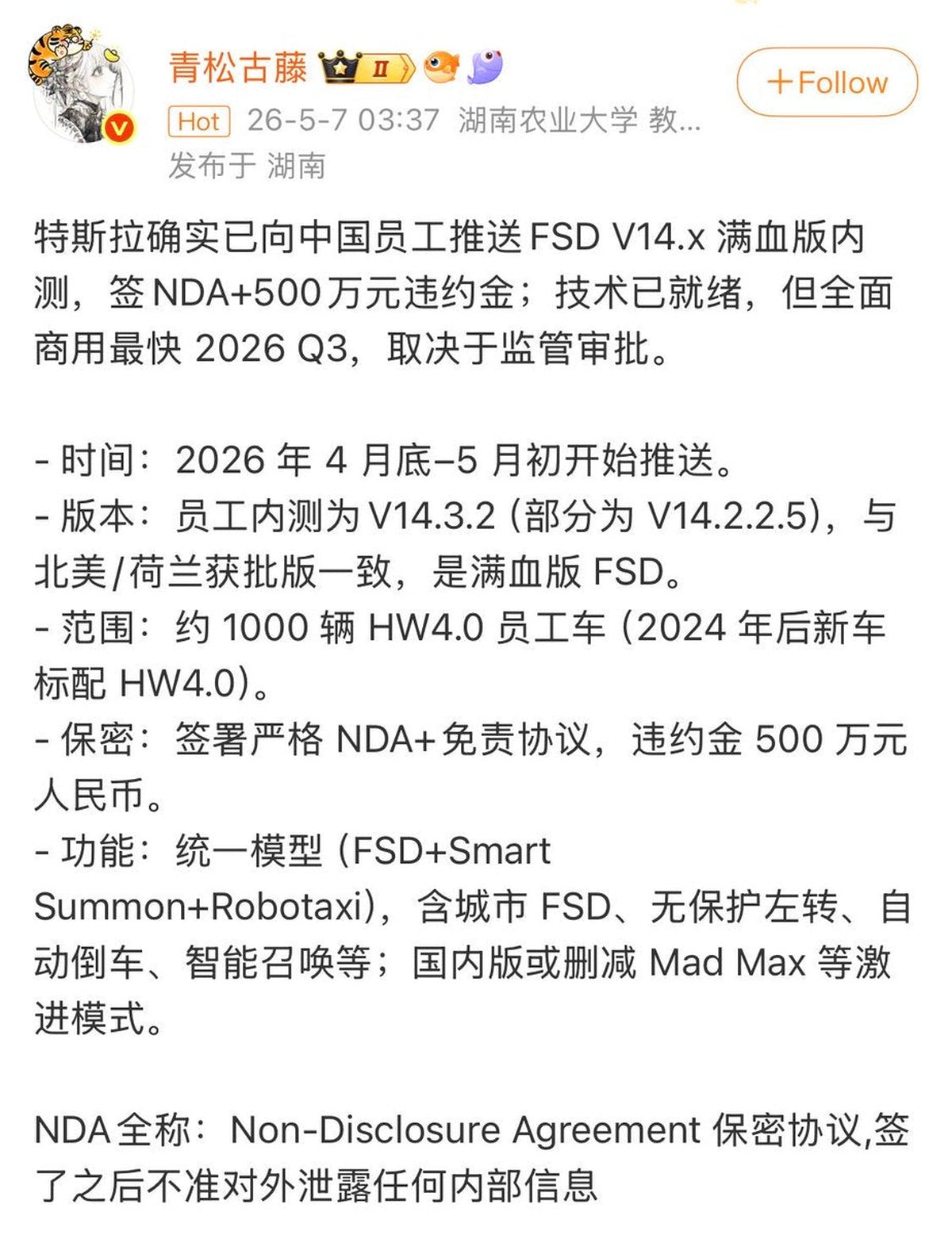
Tesla may be closer to a full FSD rollout in China than the official timeline suggests. Unconfirmed reports circulating on X claim that Tesla has begun pushing an internal beta of its full-featured FSD V14.x software to employees in China — a meaningful step forward in a market where regulatory approval has proven elusive.

The report, shared by well-known Tesla watcher Ray (@ray4tesla), carries an important caveat: credibility is uncertain. The alleged details, however, are specific enough to warrant attention. According to the claim, participants in the internal beta are required to sign a Non-Disclosure Agreement with a penalty of 5 million RMB (roughly $690,000 USD) for violations — a figure that signals Tesla is treating this as a serious, controlled test rather than a casual rollout.
Where the Official Timeline Stands
The internal beta report arrives against a backdrop of concrete regulatory progress — and some slippage. Tesla CFO Vaibhav Taneja stated in April 2026 that the company now expects to secure full FSD approval in China by Q3 2026. That's a delay from Elon Musk's earlier projections of February or March 2026, but it remains Tesla's official public target.
If the internal beta reports are accurate, the timing makes sense. Companies typically run employee testing several months ahead of a commercial launch to gather real-world data, refine edge cases, and satisfy regulators with documented performance records. An employee beta starting now would fit neatly within a Q3 approval window.
The Infrastructure Tesla Has Built
Deploying FSD in China isn't simply a matter of flipping a software switch. Chinese regulations require that driving data be processed locally, and mapping must rely on domestically approved providers. Tesla has spent years building the necessary foundation:
- Shanghai data center — operational since 2021, handling local data processing and storage in compliance with Chinese law
- Baidu mapping partnership — required for any navigation or autonomous driving feature operating on Chinese roads
- Local AI training center — began operations in early 2026, enabling Tesla to train its neural networks on China-specific road conditions and driving behaviors
This infrastructure is what makes an employee beta plausible right now. The technical prerequisites are in place; what remains is regulatory sign-off.
A Market With Unique Complications
China's FSD journey has been anything but straightforward. In April 2025, under regulatory pressure, Tesla rebranded its FSD software in China as "Intelligent Assisted Driving" (智能辅助驾驶), removing explicit FSD references from the user interface entirely. The feature set remained largely the same, but the branding shift reflected how carefully Tesla has had to navigate Beijing's scrutiny of autonomous driving claims.
For Chinese Tesla owners who have been waiting, the current situation looks like this: a free one-month trial of FSD version 13.2.6 (for Hardware 4.0 vehicles) ran from March 17 to April 16, 2026. The full FSD package is available for outright purchase at 64,000 RMB (approximately $8,850 USD), but a subscription option has not yet launched in the market. Broader commercial availability of the full-featured system is still contingent on regulatory approval.
What to Make of Unconfirmed Reports
Ray's post is explicit about the uncertainty — "not sure how credible the info is" — and that honesty matters. The specific details (the version designation, the NDA penalty amount) give the report texture, but without official confirmation from Tesla, it should be treated as a strong signal rather than settled fact.
What is settled: Tesla has the infrastructure, the regulatory timeline, and the commercial incentive to be running exactly this kind of internal test right now. China is Tesla's second-largest market, and FSD monetization there represents a significant revenue opportunity. If Q3 2026 approval is the goal, the clock is already running. Whether V14.x is the version that crosses the finish line in China — or whether it takes another iteration — will likely become clearer as summer approaches.
📋 Tracking Tesla software? See every firmware, FSD and app version in one place in our Tesla Software Update Tracker.
Related Gear
Gear up your Tesla with tested, custom-fit BASENOR accessories — shop Tesla accessories →
Sources & reporting notes
The links below identify the material source records used for this report.
- @ray4tesla on X (2026-05-08T16:11:05.000Z) — Direct source
- @TeslaNewswire on X (2026-05-11T21:31:17.000Z) — Direct source
Source links are preserved as published or accessed. See our editorial standards and corrections policy.
The BASENOR Editorial Desk covers Tesla, SpaceX, and related technology, curating reporting from primary sources — official accounts, regulatory filings, and software release data. Every article passes source-record and fact-checking review before publication. About the newsroom.
This report was curated by the BASENOR Editorial Desk from the sources listed above. Read our editorial standards or email editorial@basenor.com to report an error.