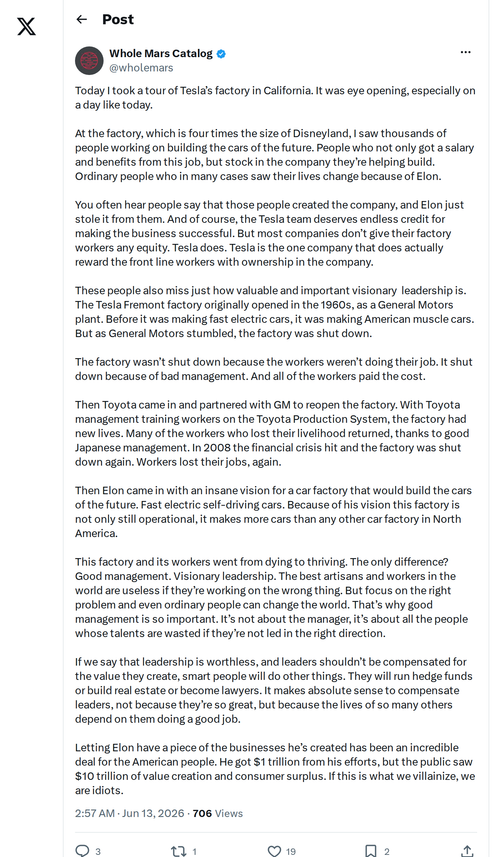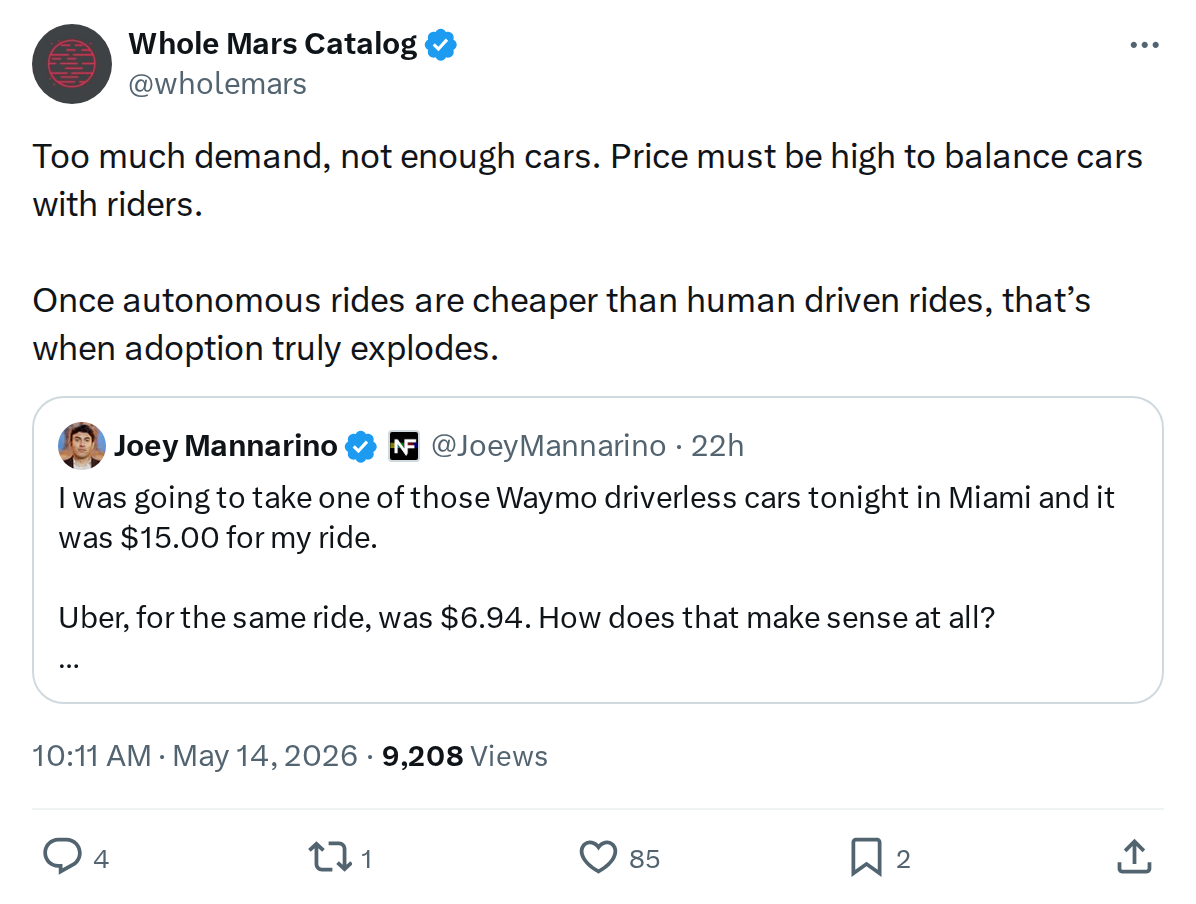
Right now, getting into a robotaxi costs more than hailing a human driver. That's not a bug — it's basic economics. But the moment that flips, everything changes. A widely-shared observation from Tesla watcher Whole Mars Catalog cuts to the heart of where the autonomous ride market stands today, and why the real adoption wave hasn't started yet.

Supply and Demand, Robotaxi Edition
The logic here is straightforward, but worth spelling out. When demand for a new service outstrips supply, prices rise to ration access. That's exactly where autonomous ride services sit today. There aren't enough vehicles on the road to serve everyone who wants a ride, so pricing stays elevated to keep the system from being overwhelmed.
This isn't unique to robotaxis — it's how every new transportation technology enters the market. Early commercial flights were luxury products. Ride-hailing apps launched with surge pricing that made taxis look cheap. In both cases, scale eventually drove costs down until the new option became the obvious default for most people.
Robotaxis are at that early, constrained stage right now. The fleet is small, the technology is still proving itself in more cities, and the cost structure hasn't yet benefited from the economies of scale that mass production enables.
The Cybercab Factor
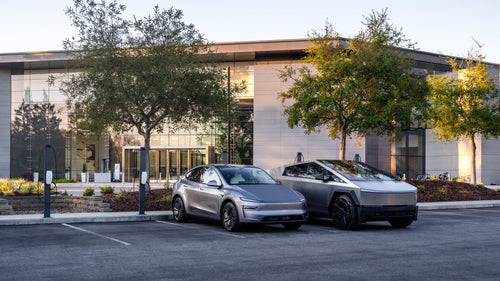
Tesla's answer to the supply problem is the Cybercab. According to verified production reports, Tesla officially commenced Cybercab production at its Giga Texas facility in April 2026, following pilot production that began in February. Getting vehicles onto the road at scale is the prerequisite for everything else — you can't lower per-ride prices without first having enough cars to spread fixed costs across millions of trips.
The economic case for autonomous rides becoming cheaper than human-driven ones is well-established in principle. Remove the driver — historically the single largest cost in any ride-hailing service — and the unit economics shift dramatically. No wages, no benefits, no shift limits. The vehicle runs as long as maintenance and charging allow. That cost structure, at sufficient scale, makes sub-$1-per-mile pricing plausible in a way that's simply impossible with a human behind the wheel.
Why the Tipping Point Matters More Than the Launch
What Whole Mars Catalog is pointing at isn't just a pricing observation — it's a description of a threshold event. Adoption curves for transformative technologies rarely move linearly. They compress. When autonomous rides cross below the cost of a human-driven alternative in a given market, the incentive structure for riders inverts completely. Price-sensitive commuters, who currently can't justify the premium, suddenly have a financial reason to switch. That's when the S-curve goes vertical.
Tesla has consistently framed the Cybercab not as a premium product but as a mass-market service. Elon Musk has previously cited target pricing in the range of $0.20-$0.30 per mile at scale — a figure that would undercut not just Uber and Lyft, but personal car ownership costs in dense urban markets. Whether those specific numbers prove achievable is an open question, but the directional logic is sound: the business model only works if it's cheaper, and it only becomes cheaper through scale.
The current high-price phase is a necessary passage, not a destination. Fleet expansion is the variable that closes the gap — and with Giga Texas now producing Cybercabs, that process is underway. How fast it moves will determine whether the adoption inflection point arrives in 2027 or 2030.

David covers the EV industry, regulatory developments, and accessory ecosystem. 15+ years writing about consumer tech. Based in London.
Sources verified at publish time. Spotted an inaccuracy? Email editorial@basenor.com.