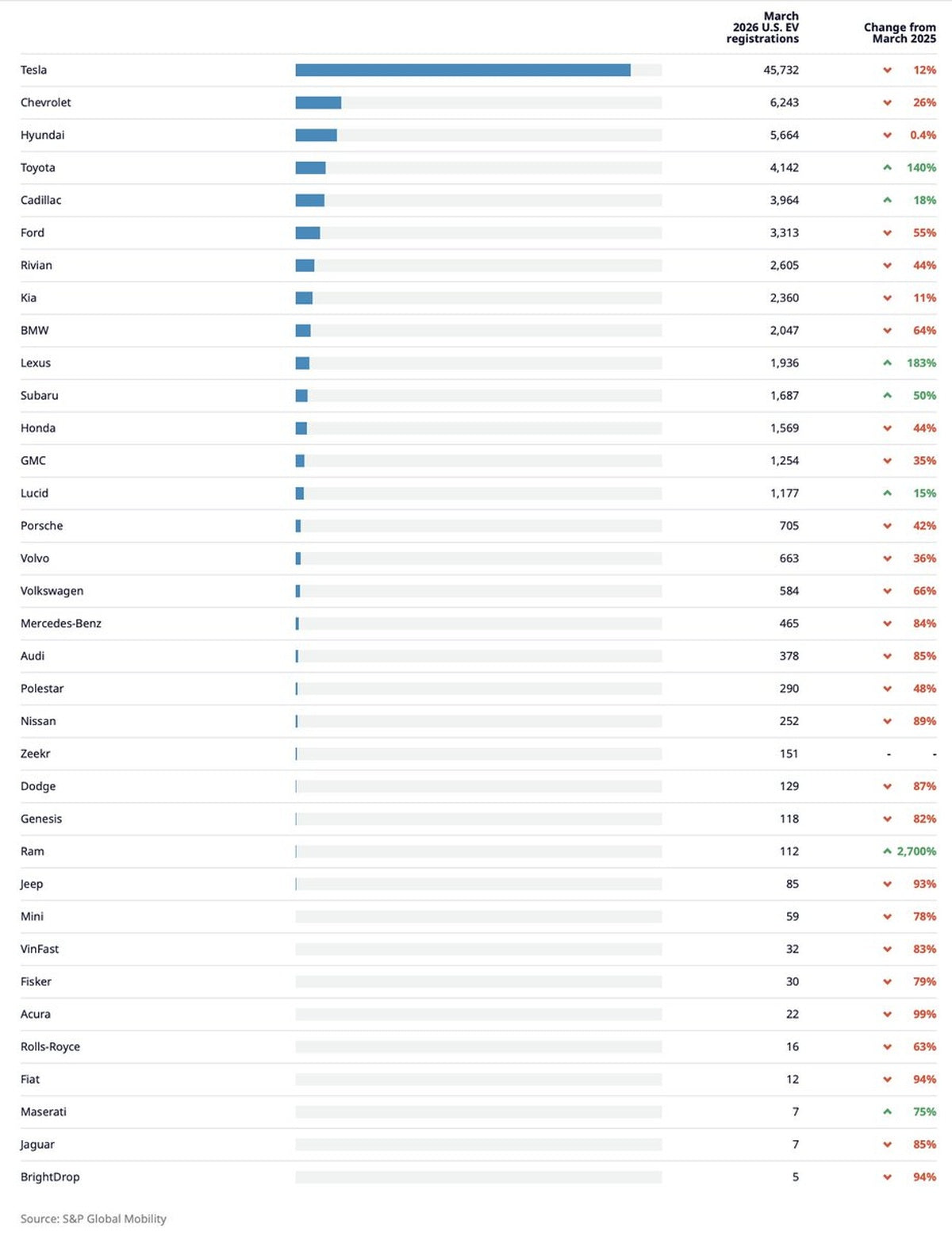
The U.S. electric vehicle market posted its strongest monthly volume of early 2025 in March, with registrations climbing to 107,594 new EVs — an 18.5% jump from February. The headline number looks healthy, but a closer read of the data reveals a market in transition: Tesla's dominance is narrowing, inventory is tightening, and prices are creeping back up.

The Numbers at a Glance
| Metric | March 2025 | Change |
|---|---|---|
| New EV Sales Volume | 107,594 units | +18.5% MoM / +8.2% YoY |
| EV Market Share | 6.8% | of new vehicle sales |
| Avg. Transaction Price | $59,205 | +3.8% MoM / +4.4% YoY |
| Days' Supply | 93 days | −12.5% MoM |
| Tesla EV Market Share | 42% | −5 pts MoM |
Data via Cox Automotive / @wholemars.
Tesla Still Leads — But the Gap Is Closing
Tesla's 42% share of U.S. new EV registrations means it still outsells every other EV brand combined by a wide margin. The Model Y and Model 3 held the top two spots in the sales rankings for the month. That said, a five-percentage-point drop in a single month is not a rounding error — it reflects real competitive pressure from a maturing field.
The top five models by volume, according to Cox Automotive data, were:
- Tesla Model Y
- Tesla Model 3
- Ford Mustang Mach-E
- Chevrolet Equinox EV
- Hyundai Ioniq 5
The Chevy Equinox EV's presence in the top five is notable. Priced well below the segment average, it represents exactly the kind of volume play that can erode Tesla's share without necessarily threatening its revenue or margins. Ford and Hyundai continuing to appear reflects sustained — if still modest — traction from the legacy automakers.
Inventory Tightening Is the Underreported Story
Days' supply falling 12.5% month-over-month to 93 days signals that EV inventory is moving faster than dealers are restocking it. For buyers, that means less negotiating leverage and fewer incentive deals on the lot. For the industry, it's a positive signal that demand is absorbing supply more efficiently than it was in late 2024, when bloated EV inventory was a persistent concern across multiple brands.
The average transaction price rising to $59,205 — up year-over-year despite months of price cuts across the segment — suggests the mix is shifting toward higher-trim and longer-range variants. It also means the "affordable EV" narrative is still largely aspirational at the market-wide level, even as entry-level options from GM and Hyundai expand.
What the 6.8% Share Figure Actually Means
Six-point-eight percent of new vehicle sales being electric is meaningful context. The U.S. market has historically lagged Europe and China on EV penetration, and while 6.8% is not a transformational number, the year-over-year volume growth of 8.2% shows the trajectory is intact. The question heading into Q2 2025 is whether tariff uncertainty, interest rates, and federal incentive changes will sustain or interrupt that momentum.
For Tesla specifically, the data presents a familiar tension: the company remains the undisputed volume leader in U.S. EVs, but its share ceiling appears to be compressing as more competitive models reach meaningful production scale. How Tesla responds — whether through further price adjustments, new model introductions, or FSD-driven differentiation — will shape the second half of 2025 more than any single monthly registration report.
Related Gear
Gear up your Tesla with tested, custom-fit BASENOR accessories — shop Tesla accessories →
Sources & reporting notes
The links below identify the material source records used for this report.
- @wholemars on X (2026-05-14T21:25:20.000Z) — Direct source
Source links are preserved as published or accessed. See our editorial standards and corrections policy.
The BASENOR Editorial Desk covers Tesla, SpaceX, and related technology, curating reporting from primary sources — official accounts, regulatory filings, and software release data. Every article passes source-record and fact-checking review before publication. About the newsroom.
This report was curated by the BASENOR Editorial Desk from the sources listed above. Read our editorial standards or email editorial@basenor.com to report an error.