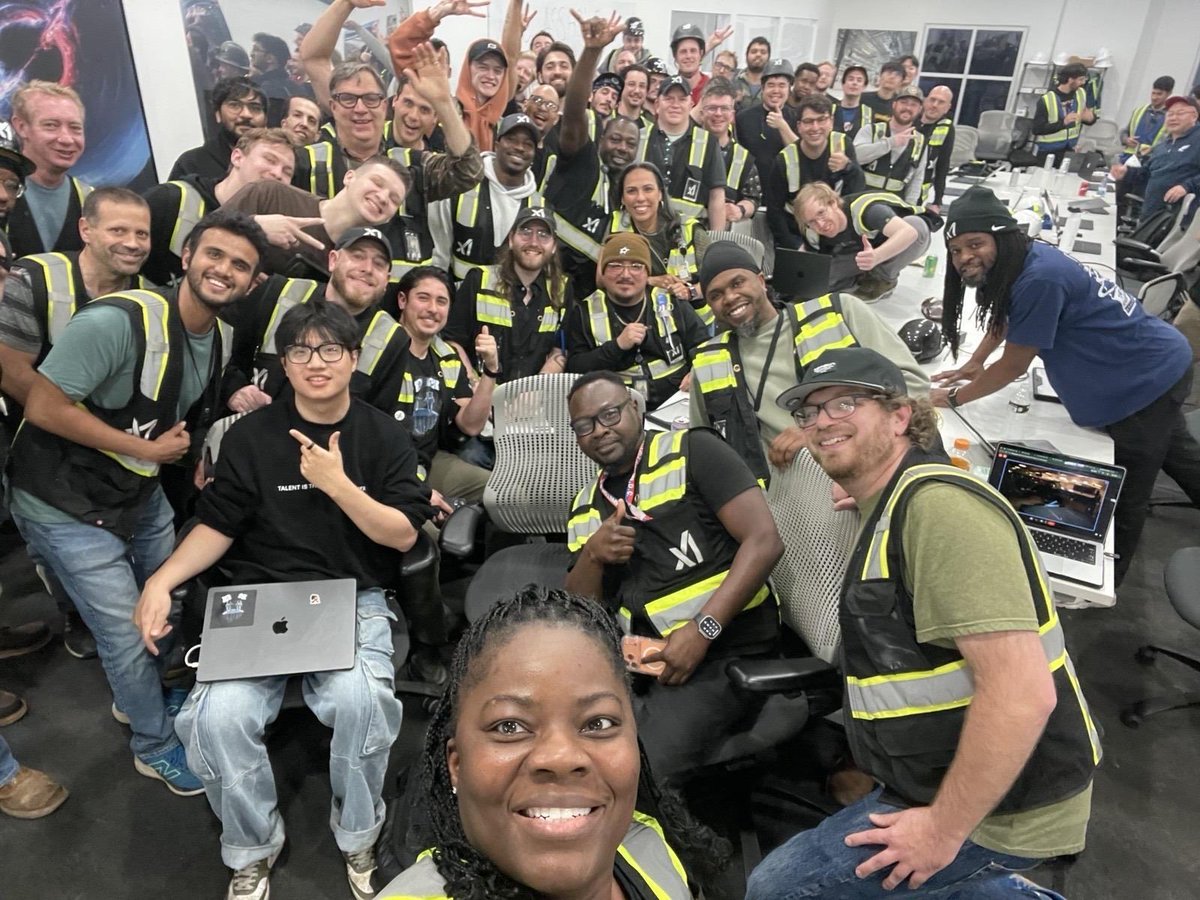
xAI Memphis Supercomputer Nears 555,000 GPUs in 2GW AI Arms Race
⚡ 30-Second Brief
The News: Elon Musk shared an update on the xAI Memphis facility, home to the Colossus supercomputer — one of the world's most powerful AI training clusters.
Why It Matters: The AI infrastructure powering Grok directly enhances Tesla's Full Self-Driving capabilities, Optimus robot development, and the entire autonomous vehicle roadmap. What happens in Memphis affects what arrives in your Tesla.
Source: @elonmusk on X — February 17, 2026

📊 Key Figures
| Metric | Value | Context |
|---|---|---|
| Total GPUs | ~555,000 Nvidia GPUs | Acquired for approximately $18 billion as of Feb 2026 |
| Site Capacity | Approaching 2 GW | Enough to power ~1.5 million homes |
| Build Speed | 122 days (initial) | 100K GPUs operational by July 2024 |
| Expansion Time | 92 days | Doubled to 200K GPUs in Q3 2024 |
| Target Scale | 1 million GPUs | Third building acquired Dec 2025 for Q2-Q3 2026 deployment |
| Cooling Water | 13 million gal/day | Supplied by world's largest ceramic membrane bioreactor |
🔭 The BASENOR Take
Timeline: Active deployment — third building conversion begins Q1 2026, additional GPU deployment Q2-Q3 2026
Impact Level: 🔴 Critical — This infrastructure directly accelerates Tesla's AI roadmap
Confidence: ✅ Confirmed — Based on Musk's update and verified facility data
Elon Musk's brief update on the xAI Memphis facility signals a critical milestone in the AI arms race — and Tesla owners should pay attention. Since SpaceX acquired xAI in an all-stock transaction on February 2, 2026, the computational resources being built in Memphis now directly support Tesla's Full Self-Driving development, Optimus humanoid robot training, and the broader autonomous vehicle mission.
The Colossus supercomputer facility represents one of the fastest infrastructure buildouts in tech history. According to verified reports, the initial 100,000 Nvidia H100 GPU cluster was operational within 122 days of breaking ground in 2024. The system was then doubled to 200,000 GPUs in just 92 additional days — a pace that industry observers called "unprecedented" for AI infrastructure of this scale.
As of February 15, 2026, the Memphis complex houses approximately 555,000 Nvidia GPUs across multiple generations: H100s, H200s, and GB200s. This $18 billion investment in silicon is approaching a total site capacity of 2 gigawatts — enough electrical capacity to power roughly 1.5 million average American homes.
Why This Matters for Your Tesla: The Grok AI model trained on Colossus doesn't exist in isolation. With the SpaceX-xAI integration, these computational resources now feed directly into Tesla's neural network training pipelines. Every improvement in Grok's reasoning capabilities, vision processing, and real-time decision-making translates into faster FSD development cycles.
The third building — dubbed "MACROHARDRR" — was acquired on December 30, 2025, near the existing Colossus 2 data center. Conversion into a data center is scheduled to begin this quarter (Q1 2026), with further GPU deployment planned for Q2-Q3 2026. This expansion will push the facility toward its stated goal of 1 million GPUs, cementing Memphis as the world's largest AI training cluster.
Infrastructure development is keeping pace with the compute expansion. In July 2025, xAI began construction of what's described as "the world's largest ceramic membrane bioreactor" to supply 13 million gallons per day of cooling water using untreated wastewater. A dedicated gas power plant is expected to be completed in 2026 to support the facility's massive energy requirements.
The Tesla Connection: For Tesla owners tracking FSD progress, the Memphis buildout is the physical manifestation of the "training compute" bottleneck Musk has repeatedly cited. More GPUs mean faster iteration cycles on neural network architectures, quicker validation of edge cases, and accelerated rollout of new FSD capabilities.
Grok 5 training is currently underway on Colossus, and the model improvements will likely flow into Tesla's vision processing stack. The facility also provides computing support for X and SpaceX operations, creating a shared AI infrastructure across Musk's ecosystem of companies.
The speed of this buildout is worth emphasizing: from concept to 555,000 GPUs in under two years. For context, most hyperscale data centers take 18-36 months just to complete permitting and site preparation. Memphis went from zero to the world's largest AI training cluster in that timeframe.
📰 Deep Dive
The xAI Memphis facility represents a strategic bet that the AI infrastructure arms race will be won through raw computational scale and deployment speed. While competitors like OpenAI, Google DeepMind, and Anthropic focus on algorithmic efficiency and model architecture, xAI is pursuing a brute-force approach: amass more GPUs than anyone else and iterate faster.
This strategy has direct implications for Tesla's competitive positioning in autonomous vehicles. Waymo's advantage has historically been data volume and real-world testing miles. Tesla's counter-strategy relies on fleet learning from millions of customer vehicles combined with massive compute to process that data. Colossus is the engine that makes that strategy viable.
The infrastructure also signals confidence in the current trajectory of large language models and multimodal AI. A $18 billion investment in GPUs assumes that scaling laws will continue to hold — that bigger models trained on more data with more compute will yield meaningful capability improvements. If that assumption proves correct, Tesla's FSD could see step-function improvements in 2026-2027 as Grok-derived models process the company's proprietary driving data.
For Tesla owners, the practical impact may manifest in several ways: faster FSD update cycles (potentially monthly instead of quarterly), improved handling of rare edge cases through better simulation and training, enhanced Autopilot visualization and decision explanations, and potentially new features like predictive route optimization based on real-time traffic AI analysis.
The Memphis facility is also a hedge against regulatory uncertainty around AI development. By building vertically integrated infrastructure under direct control, xAI (now part of SpaceX) avoids dependence on third-party cloud providers who may face future restrictions on AI training workloads. This could prove strategically valuable as governments worldwide debate AI regulation frameworks.

Sarah focuses on Tesla Energy, SpaceX missions, and the broader Musk AI portfolio. Former data analyst in clean energy. Based in San Francisco.
Sources verified at publish time. Spotted an inaccuracy? Email editorial@basenor.com.