An Under-Screen Box That Doesn't Break the HVAC
Most under-screen storage boxes seal off the cavity where Tesla's cabin temperature sensor lives. The HVAC system can't read ambient, the heat pump throws errors, and you get a warning message on the touchscreen. We scanned the sensor location and cut a specific opening for it.
The Problem
The Under-Screen Box That Costs You Working Climate Control
The dead space under the Tesla Model 3 Highland and Model Y Juniper touchscreen is an obvious candidate for storage. You see it every time you get in the car. It's wide, empty, and has an obvious lid geometry already hinted at by the factory trim. The aftermarket caught on immediately — within a year of the Highland launch, a dozen "concealed mode" under-screen boxes appeared on Amazon.
They share a problem. Tesla placed the cabin temperature sensor inside that cavity, on the vertical face behind the screen. The HVAC system uses that sensor to regulate the heat pump — if the sensor can't read the actual cabin air temperature, the system guesses, runs the compressor harder than it should, and eventually throws a heat-pump error on the touchscreen. Seal the cavity with a concealed box, and within two weeks of warm-weather driving you're seeing "climate control unavailable" warnings.
We noticed this failure mode because our own QA team saw it first — we bought five competitor boxes for benchmarking. Three of the five caused HVAC errors on our Highland test vehicle within the first week. The problem isn't that those boxes are poorly made — it's that the designers never scanned the sensor location.
So the brief for this product started with a constraint nobody else was writing down: the box has to preserve airflow to the cabin temperature sensor. Whatever storage volume we could fit around that sensor, we'd ship. Anything that blocked it wouldn't be acceptable.
Precision First
We Scanned the Sensor Before We Scanned the Box
Before touching CAD, we brought a Scantech handheld structured-light scanner into a 2024 Model 3 Highland and captured the full under-screen cavity at 0.02mm resolution. The scan covered the left and right walls, the speaker grille on the driver side, the surfaces behind the screen, and — critically — the exact location, orientation, and intake geometry of the cabin temperature sensor.
The sensor sits on the rear wall of the cavity, angled slightly upward to pull air from the ambient cabin volume. It has a 12mm × 8mm grille pattern on its intake face. Any storage box that overlaps that grille blocks the sensor. Our box's rear wall had to stop 18mm before reaching that grille, and the geometry around it had to permit natural airflow from the cabin.


The scan gave us two numbers that defined the product: 46.4mm of usable depth at the center of the cavity, and an 18mm keep-out zone around the temperature sensor. The box we shipped uses all of the first number while respecting all of the second.
The Concept
Open Mode, With a Cutout That's Not Cosmetic
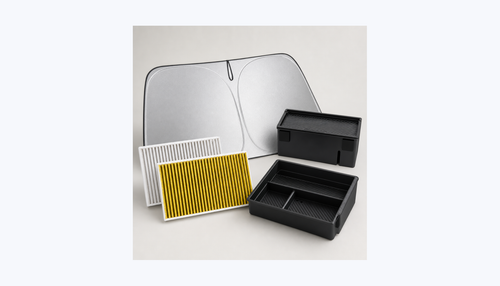
The box is an "open mode" design — no closing lid, no concealed-compartment mode. The front face sits flush with the factory dashboard line so it reads as integrated trim, and the storage cavity is accessible top-down. Critically, the rear wall has a specific cutout that aligns with the factory cabin temperature sensor. Air flows from the cabin past the cutout and into the sensor intake exactly as Tesla designed.
Dedicated Temperature Sensor Cutout
Rear wall has a profiled opening sized to the factory sensor grille. Ambient cabin air reaches the sensor; HVAC system reads accurate temperature; no heat-pump errors.
Open-Mode Access
Top-down storage without a lid. Grab your sunglasses, wallet, or phone without reaching past a mechanism. Faster daily access than concealed designs.
46.4mm Maximum Depth
Scan-derived usable volume. Every millimeter of available space that doesn't overlap the sensor, the speaker grille, or the factory trim.
Soft TPE Interior with Raised Edges
Rigid ABS outside, full soft-flex TPE lining inside. Raised interior edges form a retaining lip so phones, keys, and coins don't migrate out when you accelerate or corner hard.
Trial & Error
Four Iterations on the Sensor Cutout
The outer box geometry was set by the scan — match the cavity, done. The sensor cutout was the hard part. Too small and the sensor reading stays sluggish (HVAC still misbehaves, just less obviously). Too large and the cutout weakens the rear wall structurally. We instrumented a test Highland with a diagnostic cable on the HVAC ECU to watch the sensor output while we test-fitted each iteration.

Gen 1 — ABS-Only, No Cutout
Built the box as a single-material ABS shell with a sealed cavity to establish baseline. Left the HVAC diagnostic running. 11 minutes into a 22°C morning drive, the cabin temp sensor reading drifted 4°C below ambient. Heat pump error logged. Confirmed the problem is real.
Gen 2 — 8mm Circular Cutout
Drilled a small opening centered on the sensor. Drift dropped to 1.5°C after 30 minutes. Still too much — the sensor needs airflow, not a peephole. Geometry, not area, was the constraint.
Gen 3 — Profiled Cutout Matching Sensor Grille
Replaced the circle with a profiled opening that matches the sensor's 12×8mm grille pattern, plus a 6mm airflow channel leading from the cabin. Drift dropped to 0.3°C. Heat pump error stopped appearing.
Gen 4 — Production Geometry + TPE Liner
Added a subtle rear-wall chamfer that increases airflow volume without visibly changing the exterior. Also added the full soft-flex TPE interior liner with raised retaining edges — keys and coins stopped rattling, items stopped migrating out under hard cornering. Final HVAC diagnostic test: sensor reading within 0.2°C of ambient through a 60-minute drive cycle. This is the production shell.
Verification
Caliper-Verified, HVAC-Diagnostic-Verified
A regular storage box passes when it fits and doesn't fall out. This one had a second test: the Tesla's own HVAC system had to not notice it existed. Every prototype ran through a 60-minute drive cycle with the AC on full, the touchscreen climate display monitored continuously, and the HVAC ECU sensor data logged at 1Hz. Pass criteria: zero error messages, and sensor reading within 0.5°C of cabin ambient for the full cycle.


The real test happened on the third week of the Gen 4 prototype. Summer conditions, 32°C ambient, AC on max. The Highland's HVAC system held cabin temperature within 1°C of setpoint the whole drive. No errors, no warnings, no degraded performance. That's when we knew the product was done.
Materials
Rigid ABS Outside, Soft TPE Inside
| Component | Material | Why |
|---|---|---|
| Outer shell | Injection-molded ABS | Rigid enough to hold the scan-derived geometry and the sensor cutout geometry for the life of the part. Doesn't flex under daily reach-in use. |
| Inner lining | Soft-flex TPE | A full interior liner cushions whatever you drop in. Phones don't scratch. Keys don't clack. Coins don't rattle over every road seam. |
| Raised interior edges | Integrated TPE lip | The lining extends upward at every interior edge to form a shallow retaining wall. Items don't migrate out of the box when you accelerate, corner, or brake hard. |
| Surface finish | Matte black, low-gloss | Matches the factory dashboard trim. Doesn't reflect light back into the windshield during daytime driving. |
| Sensor cutout walls | Chamfered ABS with anti-dust rib | Protects the sensor from debris (coins, crumbs) while preserving airflow. The rib redirects loose material away from the sensor opening. |
| Mount hooks | Integrated ABS tabs | Grip the factory trim ribs by geometry. No adhesive, no tools, no modifications to the factory dashboard. |
The dual-material construction solves two problems at once. ABS on the outside gives us the dimensional stability to hold the sensor cutout precisely — flex there over time would occlude the opening and the HVAC errors would come back. TPE on the inside gives us what ABS alone can't: a soft landing for whatever you put in, silent contact instead of clacking plastic, and raised edges that hold items in place when the car moves.
The Result
What You Actually Get
| Feature | What It Means for You |
|---|---|
| Temperature sensor cutout | HVAC climate control works the way Tesla designed. No error messages, no heat-pump warnings, no degraded AC performance. |
| 3D-scan-derived cavity fit | Slots into the under-screen space by geometry. No adhesive, no modifications, no gaps against the factory trim. |
| Open-mode access | Top-down storage without a lid. Faster daily use than concealed-mode boxes. |
| 46.4mm usable depth | Every millimeter of available space that doesn't overlap the sensor, speaker, or factory trim. |
| Matte factory-match finish | Reads as OEM when installed — doesn't broadcast "aftermarket" from the driver's seat. |
| Soft TPE liner with raised edges | Cushioned interior silences keys and coins. Raised retaining edges keep items in the box when you brake or corner hard. |
| Hook-mount install | Grips factory trim ribs. Drop in, done. Remove any time without residue. |
| Factory HVAC verified | Tested on a Highland with HVAC diagnostic logging — sensor reading within 0.2°C of ambient through 60-minute drive cycles. |
| Fits 2024+ Model 3 Highland and 2025+ Model Y Juniper | Shared under-screen geometry between the two vehicles. Same box fits both. |
Common Questions
Frequently Asked Questions
Will this actually cause problems with my HVAC like other under-screen boxes?
Does it fit both the Model 3 Highland and the Model Y Juniper?
Why is it open mode instead of concealed mode with a lid?
How is it held in place?
Will it scratch the factory dashboard?
What can actually fit in 46.4mm of depth?
How does it compare to the "hidden" or "concealed mode" designs?
Will HVAC diagnostic errors ever go away if I've already been running a concealed box?
Ready for Storage That Doesn't Break Your Climate Control?
The Under-Screen Box That Keeps the HVAC Happy
Scan-derived cavity fit. Dedicated temperature sensor cutout. Open-mode access. Verified with live HVAC diagnostic on a Model 3 Highland — zero errors, zero degradation.
Shop NowFits 2024+ Tesla Model 3 Highland & 2025+ Model Y Juniper · Free US Shipping