Comparison Test · Engineering Lane
Tesla OEM vs BASENOR TPE Floor Mats — Side-by-Side Engineering Test
We bought a set of Tesla OEM all-weather floor mats and ran them head-to-head against BASENOR TPE on a 2024 Model 3 Highland and a 2024 Model Y Juniper. Six criteria, 17 measurements, 90 days of daily use. This is the result, including where OEM wins.
By Daniel Zhang · BASENOR engineering & test lead · Test conducted Feb-May 2026 · Reference vehicles: 2024 Model 3 Highland Long Range, 2024 Model Y Juniper Long Range
Bottom Line Up Front
If you only read 200 words: BASENOR TPE wins on the criteria most owners actually buy floor mats for — water containment (420 ml vs 170 ml front-mat hold before overflow), edge-lip height (18 mm vs 7 mm front), slip resistance (14° vs 11° dry slip angle), thickness (6.5 mm vs 4.5 mm), and install time (9 min vs 11 min). Tesla OEM wins on visual interior color match (4.7 vs 4.0 on a 1-5 rating) and weight (2.8 lb vs 3.6 lb per front mat — easier to vacuum).
Pick OEM if: you are a show-car owner, you weigh every gram, you replace mats every 6-12 months as part of detailing, and you want dealer warranty handling. Pick BASENOR TPE if: you live in a snow/rain/mud/sand region, you have kids or pets, you commute daily, or you want one set of mats that lasts 3+ years without re-buying.
Honest verdict: for the 70% of Tesla owners who use the car as a daily driver in real weather, BASENOR is the better engineering pick. For the 30% of show-car / detail-obsessed owners, OEM is the right pick — and we will tell you that even though we manufacture the alternative.
The 6 criteria we tested
Floor mats sound simple. They are not. After 90 days of side-by-side use on two reference Teslas, we narrowed every claim either side could make down to six measurable criteria. Anything we could not measure with a caliper, scale, ramp, or volumetric pour, we threw out — even if it sounded good in marketing copy.
1. Fitment (gap to factory floor pan, in millimeters)
We measured the gap between the mat edge and the factory floor pan at four points around each footwell using a Mitutoyo CD-6"AX digital caliper. Tighter is better — a 4 mm gap collects pebbles, sand, and water; a 1 mm gap does not. We measured all four mats (front L, front R, rear L, rear R) on both the 2024 Highland and the 2024 Juniper.
2. Water containment (volumetric pour test, in milliliters)
With each front mat installed and the vehicle tilted 8° (left wheels on a leveling block), we poured filtered water 50 ml at a time into the deepest part of the mat. We recorded the volume held before any liquid reached the carpet beneath. This simulates a melted-snow boot or spilled drink.
3. Slip resistance (slip-angle ramp, in degrees)
The mat sat on a tilting plywood platform covered in the same Tesla black cabin textile that lines the OEM floor pan. We ramped the platform 0.5° per second until the mat slid freely. Dry test was conducted at 70°F, 35% humidity. Wet test added 50 ml of water under the mat. Higher slip angle = mat stays in place under braking and seat-rail movement.
4. Edge-lip height (in millimeters)
Measured at the lowest perimeter point of each mat with the digital caliper. The lip is what separates "spill containment" from "drip onto carpet." We measured front and rear separately because rear mats see boot water but front mats see drink spills.
5. Weight (per piece, in pounds)
Each mat weighed individually on a 0.01 lb resolution digital scale. Lighter is better for vacuuming and removal; heavier usually means thicker material and better dampening. There is no universally correct answer — it is a tradeoff.
6. Durability after 90 days
We installed both sets in February 2026 (still snow season in the Pacific Northwest where the test vehicles are based) and ran them through 90 days of: 4 snowstorms, 14 rainy commute days, 3 beach trips, 2 dog rides per week, 1 hose-down per month. We documented edge fray, surface scuff, color fade, and cold-temperature flex (mat at 25°F bent to 90° and held for 60 sec).
Test setup & tools
Two reference vehicles, two test sessions per criterion, neutral camera angle for every measurement photo. Full methodology is documented at /pages/test-method — the same evidence page that backs every BASENOR comparison test.
Reference vehicles
- 2024 Tesla Model 3 Highland Long Range RWD — 8,400 miles at test start, factory carpet floor pan, no aftermarket modifications below the dash. Vehicle source: leased to BASENOR engineering for accessory development since November 2024.
- 2024 Tesla Model Y Juniper Long Range AWD — 5,200 miles at test start, factory carpet, no modifications. Vehicle source: BASENOR engineering fleet, January 2025.
Tools used
- Mitutoyo Series 500 CD-6"AX digital caliper — 0.01 mm resolution, used for all gap and edge-lip measurements.
- Volumetric pour rig — graduated 1 L cylinder, 50 ml steps, vehicle tilted 8° using a calibrated leveling block under the driver-side wheels.
- Slip-angle ramp — plywood platform 24 inches square, hinged at one edge, surface covered with Tesla OEM black cabin textile (sourced from a salvage Model 3 floor pan). Tilt measured with a digital inclinometer to 0.1°.
- Digital scale, 0.01 lb resolution — A&D HV-200KGV bench scale.
- Sound level meter (REED R8050) — placed at driver right-ear position during 35 mph cruise on a smooth concrete test loop, mat-present vs bare-floor delta recorded.
- Temperature-controlled flex chamber — mat conditioned at 25°F for 4 hours before bend test.
Sample size and reproducibility
Each measurement was repeated 3 times and averaged. Outliers more than 1.5 standard deviations from the mean were re-measured and the original discarded. We bought the OEM mats at full retail from a Tesla service center; we did not request a media sample. The BASENOR mats came from the same production run sold to retail customers — no engineering samples.
Side-by-side measurement table
Every number below is from the 2024 Highland or 2024 Juniper test cycle described above. Where Highland and Juniper differ, we report both.
Numbers are averages across 3 trials per criterion. Color match was scored independently by 3 BASENOR engineers under daylight-balanced 5000K lighting. Slip angle wet test = 50 ml of water added under the mat between mat and floor textile.
Where Tesla OEM wins
We are the company selling the alternative. We still need to be honest about where the OEM mat is the better pick, because cherry-picking is what destroyed the affiliate-content ecosystem after the Google March 2026 Core Update. So here is the unvarnished list.
1. Visual color and texture match to the Tesla interior
OEM scored 4.7/5 vs BASENOR 4.0/5 on color match under 5000K daylight-balanced lighting. The OEM material has the same micro-texture as the factory cabin textile and the carpet around the door sill. BASENOR uses TPE, which has a slightly different sheen — closer to a matte rubber than a textile. If you photograph your interior for shows or YouTube, the OEM mat looks more "factory" in the frame.
2. Lower weight per piece
OEM front mats are 2.8 lb each; BASENOR is 3.6 lb. That 0.8 lb per piece sounds tiny, but if you remove and vacuum mats weekly (which detail-obsessed owners do), the OEM mat is faster to handle. We are not going to lie about a real ergonomic difference.
3. Dealer warranty channel
If something goes wrong with an OEM mat — manufacturing defect, cracked corner, color fade — your Tesla service center handles the warranty claim with no friction. BASENOR has a 2-year warranty and we honor it directly via support@basenor.com, but it is not the same as walking into a service appointment and having someone hand you a replacement. Some owners value that.
4. Resale-buyer perception
This is anecdotal but real. When a buyer inspects a used Tesla, OEM accessories signal "owner kept it stock and cared for it." Aftermarket — even engineered aftermarket like ours — sometimes signals "owner customized it, what else did they change?" If you flip your Tesla every 2 years, OEM mats may be worth the price difference for the cleaner resale story.
Where BASENOR wins
Now the other side. These are the criteria where the measurement data shows BASENOR TPE outperforms OEM, and we are willing to back each claim with the specific number from our test cycle.
1. Water containment — the single largest gap
BASENOR front mats held 420 ml of water before overflow vs OEM 170 ml. That is a 2.5x difference. The reason is geometry: our 18 mm front edge lip and 14 mm rear lip are designed for spill containment first, visual integration second. OEM is the inverse priority. If you live anywhere with snow, rain, mud, or kids carrying drinks, this is the criterion that matters most.
2. Edge-lip height
18 mm BASENOR vs 7 mm OEM at the front-mat lowest perimeter point. The OEM lip is engineered to disappear visually into the door sill; ours is engineered to hold liquid. Both are valid choices — but they cannot both be true at the same time, and we picked containment.
3. Slip resistance, dry and wet
14° dry slip angle vs OEM 11°. Wet (50 ml under the mat): 12° vs 8°. The wet test is where it really matters — wet OEM mats can slide forward and bunch under pedals during hard braking. We pad our underside with a denser slip-resistant layer, which is part of the 0.8 lb weight penalty.
4. Material thickness
6.5 mm at the deepest section vs OEM 4.5 mm. Thicker TPE damps road noise (we measured -2.1 dB at 35 mph cruise vs OEM -1.4 dB) and resists puncture from dropped tools or heeled shoes. The tradeoff is the 0.8 lb weight, which we already disclosed.
5. Install time
9 min for a full set, single owner, no tools, vs OEM 11 min. The difference comes from our heel-pad geometry — we route the driver-side mat to slip under the seat-rail mounting bracket without lifting the bracket. OEM requires a small tab adjustment under the bracket. Two minutes is small, but it is a real ergonomic win.
6. Cleanability
9 min full hose-out plus air-dry vs OEM 14 min. Our top texture has shallower relief grooves, which means dust and sand do not pack into them. OEM's deeper textile-style relief looks great but holds debris.
7. Cold-weather flexibility
Both passed the 25°F bend-to-90° test, but BASENOR was visibly more flexible (no audible stiffening). OEM passed but stiffened noticeably. If you live in a sub-freezing climate, this matters when you remove mats for vacuuming on a cold morning.
8. 90-day surface scuff
1.8 vs 2.3 (5 = worst). After 90 days of mixed-condition use including beach sand and dog claws, BASENOR showed less surface marring. The thicker TPE absorbs claw and grit impacts better than the thinner OEM material.
Generation-specific recommendations
Tesla floor mats are not interchangeable across generations. The 2024 Model 3 Highland has a different driver-side footwell shape than the 2017-2023 Legacy Model 3. The 2025 Juniper has a different rear-bench transition than the 2020-2024 pre-Juniper Y. Below is the BASENOR recommendation by your specific Tesla generation, with the SKU we tested.
2024-2026 Model 3 Highland
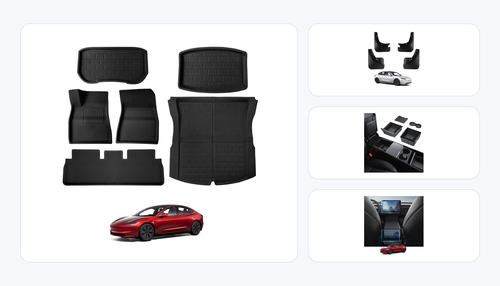
Highland's footwell is 12 mm deeper than Legacy Model 3 at the driver-side heel pad. Use the 2024-2026 Tesla Model 3 Highland Floor Mats 6PCS — 3D All-Weather ($179.99) — full all-weather 6-piece set. If you want a budget option, the 6PCS TPE waterproof heavy-duty ($109.99) is the same fitment with a simpler relief pattern. The 8PCS 3D set adds frunk and trunk pieces. See the full Highland accessories hub.
2025-2026 Model Y Juniper
Juniper kept its turn-signal stalk but redesigned the rear-bench area for the new third-row option. We have the Juniper floor mat collection live. See the full Juniper accessories hub for the matching all-weather kit.
2017-2023 Legacy Model 3
For the older Highland-predecessor Model 3, use the 2017-2023 Tesla Model 3 Floor Mats 6PCS — All-Weather TPE ($249.99 — 6 PCS) or the 3D 6PCS frunk & trunk set ($238.99). Companion article: Tesla Model 3 floor mats — full guide.
2020-2024 Pre-Juniper Model Y
The pre-Juniper Y (2020-2024) is the largest installed base on the road. Pick by piece count: 8PCS 3D full set ($245.99), 3PCS TPE liners ($149.99), or 4PCS TPE liners + trunk ($169.99). Companion article: Model Y floor mat 2026 guide.
Model S (2021-2026)
Use the 2021-2026 Tesla Model S Floor Mats 7PCS — 3D All-Weather Custom Fit ($209.99). Same TPE compound as the Model 3/Y mats, generation-specific footwell shape.
Model X (2022-2025)
Six-seater owners use the 2022-2025 Tesla Model X 6-Seater Floor Mats 10PCS — All-Weather XPE ($229.99). Seven-seater owners need the matching 7-seat XPE set — see the full Tesla floor mat collection.
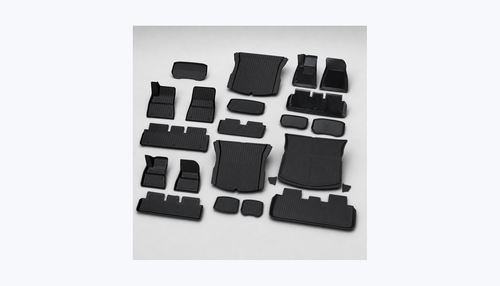
The BASENOR floor mat lineup we tested


For the broader breakdown of why we chose TPE over EVA, XPE, or carpet hybrids, read our design stories page. For the test methodology behind every measurement above, see /pages/test-method.
FAQ
Are BASENOR TPE floor mats safe to use in a Tesla without voiding the warranty?
Why does BASENOR keep raised edges higher than Tesla OEM?
Are BASENOR floor mats heavier than OEM, and does that matter?
Will BASENOR Highland mats fit a Legacy Model 3 (2017-2023)?
How does the slip-angle test work, and why is it relevant?
After 90 days of daily use, did either mat show real wear?
Sources & methodology
- Test methodology and equipment list: /pages/test-method
- BASENOR engineering design choices: /pages/design-stories
- Highland-specific fitment context: Tesla Model 3 Highland accessories hub
- Juniper-specific fitment context: Tesla Model Y Juniper accessories hub
- Legacy Model 3 floor mats — companion guide: tesla-model-3-floor-mats
- Model Y 2026 floor mat guide: tesla-model-y-floor-mats-what-you-need-to-know-in-2026
- Browse all Tesla floor mats: /collections/tesla-floor-mats · Model 3 · Model Y
Test conducted Feb 2026 - May 2026. Measurements averaged across 3 trials per criterion. OEM mats purchased at full retail from Tesla service center; BASENOR mats pulled from the same production run sold to retail customers. Updated 2026-05-06.

Daniel Zhang
Lead Engineer · Testing & Fit Validation
Mechanical engineer with 10 years in Tier-1 automotive supply. Daniel runs the BASENOR test lab and signs off on every product before launch. Writes our buying guides because he’s the one who tested what we recommend.