Model 3 Highland fitment guide
How to Verify 2024 Model 3 Highland Accessory Fitment Before You Buy
A 2024+ Model 3 Highland may still be called simply Model 3 on product pages, but the interior, screen setup, bumper details, and molded cargo/floor surfaces are different enough that fits Model 3 is not a safe buying test.
Bottom Line Up Front
Use generation first, then year. For molded parts, choose listings that explicitly say 2024-2026 Model 3 Highland, not just Model 3.
Highest return-risk categories: floor mats, mud flaps, screen protectors, console organizers, roof shades, rear-seat/kick covers, and anything with wiring or clips.
Safer BASENOR path: start with Highland-specific products and avoid older 2017-2023 Model 3 listings unless the product is universal and does not depend on molded shape.
Why 2024 Model 3 Highland Fitment Gets Confusing
The 2024+ Model 3 is the refreshed Highland generation. Owners run into trouble because retail pages often mix three labels: Model 3, 2024 Model 3, and Highland. Those labels do not always tell you whether the seller measured the refreshed cabin and exterior panels.
Tesla current Model 3 owner information separates 2024+ Model 3 content and includes updated dimensions, interior storage, touchscreen, lifting, and maintenance references. Tesla also notes that accessories can affect range or vehicle dimensions, and it does not evaluate non-Tesla parts from other distributors. That means the buyer has to verify fitment before checkout, especially for anything that touches a molded surface or clips into a panel.
The practical rule: if the part follows a contour, uses a connector, sits around a screen, clips into trim, or relies on a bumper/underbody mounting point, treat Highland as a separate fitment generation.
The Five-Check Highland Fitment Test
1. Generation language
Look for 2024-2026 Model 3 Highland or 2024+ Model 3. A plain Model 3 listing is not enough for shaped parts.
2. Surface dependency
Floor, trunk, console, dashboard, mud flap, bumper, and seat-back items need Highland-specific contours.
3. Screen coverage
Highland has a refreshed center screen and rear screen use cases. Confirm size and kit contents before buying protectors.
4. Clip or fastener behavior
Roof shades, mud flaps, door storage, and panel covers should state the mounting method and target generation.
5. Exclusion text
If a listing says Not for 2024 Model 3, believe it. Do not assume the seller forgot to update compatibility.
Accessory Risk Matrix
| Category | Fitment risk | What to verify | Buy rule |
|---|---|---|---|
| Floor and cargo liners | High | Floor pan, dead pedal, seat rail clearance, trunk shape | Only Highland-labeled mats |
| Mud flaps | High | Bumper/rocker shape and clip points | Avoid 2017-2023 kits |
| Console and dashboard storage | High | Console bin shape, screen clearance, dashboard trim | Use Highland and Juniper-style listings |
| Screen protectors | Medium-high | Center screen and rear screen coverage | Confirm center plus rear screen kit contents |
| Jack pads and filters | Lower, but safety-sensitive | Lift points, service procedure, filter access | Follow Tesla manual instructions |
Category-by-Category Fitment Playbook
Floor mats and cargo liners
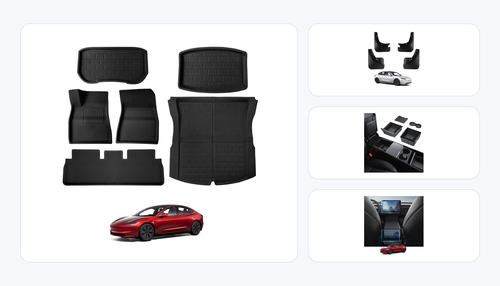
Floor mats are the first place we would refuse a vague listing. They look simple, but the real fit comes from small molded details: dead-pedal shape, rear tunnel contour, seat-rail clearance, cargo side-wall shape, and the lip height around the perimeter. If a mat is even slightly off, it can slide, curl at the edge, trap grit underneath, or leave the carpet exposed at the exact point where shoes drag in water.
For Highland owners, the safest shopping filter is strict: choose mats that identify 2024-2026 Model 3 Highland in the title or fitment field. Do not treat a 2021-2023 Model 3 mat as close enough unless the product page shows a measured Highland installation and the seller stands behind that claim.
Mud flaps and lower body protection
Mud flaps fail for a different reason: bumper edges and lower rocker areas changed enough that clip position matters. A flap can look correct in product photos and still leave a gap, sit under tension, or use a fastener angle that does not match the refreshed car. Owner complaints around Highland mud flaps usually come from this category mismatch, not from the idea that mud flaps are hard to install.
Before buying, check whether the listing has separate legacy Model 3 and Highland options. If the same SKU claims every Model 3 year without explaining the refreshed mounting points, it belongs in the risky pile.
Console, dashboard, and screen-area accessories
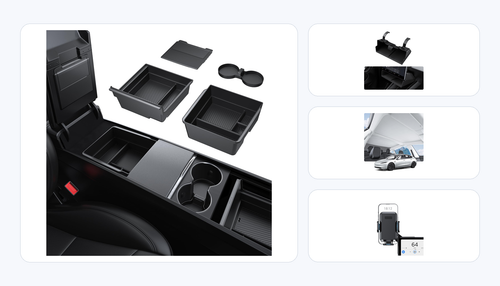
The Highland cabin is where many older Model 3 accessories become misleading. Console inserts, behind-screen trays, under-screen storage, armrest boxes, cup holder pieces, dashboard covers, and screen protectors depend on refreshed interior geometry. A tray that worked in a 2022 Model 3 can feel loose, block access, rattle, or interfere with the screen area in a Highland.
Screen protectors deserve special attention because many older kits are described by model name rather than screen package. For Highland, verify center-screen coverage and whether the rear screen is included. If the product page says only 15-inch Model 3/Y or excludes 2024 Model 3, skip it.
The 60-Second Checkout Audit
Use this quick audit before you order. It catches most Highland fitment mistakes without needing a measuring tape.
- Read the exact title. It should say 2024-2026 Model 3 Highland, 2024+ Model 3, or show a clearly separated Highland option.
- Scan the negative fitment text. If the page says Not for 2024 Model 3, do not override that warning because the product image looks similar.
- Look for installed photos. Studio-only photos are weaker evidence than a part shown in a Highland cabin, trunk, wheel well, or screen area.
- Check the category risk. Molded, clipped, wired, adhesive-positioned, and screen-sized products need stricter evidence than loose accessories.
- Confirm image and return confidence. A real product image, clear fitment language, and a fitment-aware return policy matter more than a low price.
This is also why BASENOR separates Highland-ready products inside the catalog instead of relying only on a broad Model 3 label. The point is not to make the purchase feel more complicated; it is to prevent the avoidable return where the part was made for the previous cabin or bumper.
Legacy Model 3 vs Highland: What Can Still Cross Over?
Some accessories can span generations, but they tend to be the products that do not depend on exact body or cabin geometry. Cleaning towels, some portable storage bags, general charging cable organizers, and certain maintenance accessories may still be reasonable if the product does not touch a Highland-specific shape.
Even then, treat safety and service-adjacent items differently. Tesla lifting guidance tells owners to use the designated lift points only and not to lift from the battery or side rails. That means a jack pad should support the approved lift-point process, not encourage a different lifting location. Similarly, cabin filter access and maintenance steps should match current owner information, not a generic memory of how an older Model 3 was assembled.
The simplest split is this: universal loose items can be considered after basic checks; molded protection, interior inserts, screen parts, exterior splash guards, and any electrical or clipped item should be Highland-specific.
Highland-Ready BASENOR Product Paths
For a new Highland, we would start with protection and daily-use fitment before cosmetic add-ons: mats, mud flaps, console organization, screen protection, heat control, and rear-seat/kick protection. These are the categories where poor fit is most noticeable in the first week.


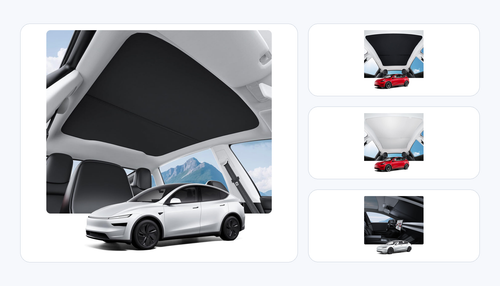
For heat and rear-seat protection, add the Highland roof sunshade and Highland anti-kick mats after confirming your interior color and use case.
Where Highland parts usually fail in real ownership
We treat Highland fitment as a physical measurement problem, not a title-matching problem. A product page can say Model 3 and still miss the refreshed console lip, cargo-side contour, rear-screen clearance, or lower rocker shape. That is why our lab check starts with the contact points: where the accessory touches the car, where it clips, where it bends, and where the owner will pull it during cleaning.
Floor mats are the easiest example. A mat can look close in a product photo, but a small mismatch around the dead pedal, front seat rail, or rear footwell edge changes how water and grit move. If the lip curls or the mat floats above the carpet, owners notice it every day. For a Highland owner, the safer test is not whether the mat says Model 3. It is whether the listing names 2024-2026 Model 3 Highland and shows the exact floor pan shape.
Mud flaps have a different failure pattern. The risk is not just length or material; it is fastener geometry. A flap that was drilled or clipped for the 2017-2023 bumper can sit under tension on the Highland lower body. That can create a visible gap, make the flap buzz, or force the installer to overtighten a clip that was never meant to hold that angle. We would rather reject a broad-fit listing than ask an owner to discover that during installation.
Console organizers and screen protectors are lower-risk only when the seller measured the refreshed cabin. Highland added rear-screen use cases and changed the interior around daily storage points. For trays, the test is whether the part drops in without pinching the lid or blocking access. For screen protectors, confirm the center screen size and whether the kit includes the rear display. A single older center-screen protector is not equivalent to a Highland front-plus-rear kit.
The same rule applies to roof shades and rear-seat protection. If a shade depends on clips, glass opening size, or trim pressure, it needs Highland-specific confirmation. If an anti-kick mat follows the rear-seat shell, it should show the refreshed seat-back shape. These are not cosmetic details; they decide whether the part feels factory-fit after a week of use.
A quick owner workflow before checkout
Before buying any Highland accessory, open the product page and check three places in order: the title, the fitment selector, and the installation photos. The title should name 2024-2026 Model 3 Highland or 2024+ Model 3. The selector should not silently group Highland with 2017-2023 Model 3. The installation photos should show the exact contact area on the refreshed car, not only a studio image of the part by itself.
If one of those three checks is missing, move the product into a maybe list instead of buying immediately. That pause prevents most avoidable returns. It is especially important for gifts, because the buyer may not know whether the owner has a Highland, a legacy Model 3, or a Model Y Juniper. In that situation, choose universal cleaning tools or accessories with explicit multi-generation compatibility instead of molded liners, mud flaps, console trays, or roof clips.
We also recommend saving the product page or order screenshot before installation. If the listing later changes its compatibility copy, you still have a record of what was promised at checkout. That matters for return conversations and for comparing the part against the car when a corner, clip, or screen edge does not line up as expected.
One final check is timing. Tesla refresh transitions can overlap inventory and aftermarket listings, so confirm your delivery year, interior layout, and screen setup against the product page on the day you buy. If the seller changes compatibility later, your saved page and order record give you a clean way to resolve the mismatch without guessing which generation the part was built around.
What We Would Avoid
- Any product whose title says Not for 2024 Model 3.
- Legacy 2017-2023 mats, mud flaps, console trays, screen protectors, and roof shades unless the product page explicitly includes Highland.
- Listings with no real installation photos, no vehicle year range, and no return language for fitment errors.
- Electrical harnesses or clipped accessories that claim broad compatibility without showing the Highland connector or trim area.
FAQ
Are all 2024 Model 3 cars Highland?
For accessory shopping in North America, treat 2024+ Model 3 as the Highland refresh generation. Use 2024-2026 Model 3 Highland fitment language when choosing shaped accessories.
Will 2017-2023 Model 3 floor mats fit a 2024 Highland?
Do not assume they will. Floor contours, seat rail clearances, and cargo areas are high-risk categories, so use Highland-specific mats.
Are universal items safe?
Some are safer, such as loose storage bags or generic cleaning tools. Anything molded, adhesive-positioned, clipped, wired, or screen-sized still needs Highland confirmation.
Do I need a special jack pad?
Follow Tesla lift-point guidance first. Tesla warns not to lift from the battery or side rails; any jack pad should support the designated lift point rather than invent a new lifting location.
What should I buy first for a Highland?
Start with the products that protect the car and solve daily friction: floor mats, mud flaps, screen protection, console organizers, roof shade, and rear-seat/kick protection.
Sources Checked
- Tesla Model 3 Owner's Manual: Parts and Accessories
- Tesla Model 3 Owner's Manual: Dimensions
- Tesla Model 3 Owner's Manual: Jacking and Lifting
- r/TeslaModel3 owner discussion on 2024 Highland fitment
- r/TeslaModel3 owner discussion on 2024 accessory compatibility
Source URLs are retained in the review metadata; the visible article keeps source names plain to avoid sending readers into bot-blocked manual/community pages.
Ready to avoid Highland fitment guesswork?
Shop BASENOR products that call out 2024-2026 Model 3 Highland fitment, with product photos and generation-specific page copy.
Shop Model 3 Highland AccessoriesUpdated June 6, 2026: Checked current Tesla owner information, Highland owner fitment complaints, and BASENOR product listings with active product URLs and image coverage.

BASENOR Team
BASENOR Product Testing Lab
BASENOR Product Testing Lab verifies fitment, materials, installation behavior, and owner tradeoffs before we recommend a Tesla accessory.