BASENOR Product Testing Lab | Model Y roof comfort guide | Updated June 2026
Is a Retractable Glass Roof Sunshade Worth It for a Tesla Model Y?
For Model Y owners, the useful question is not whether the glass roof gets warm. It does. The useful question is whether a roof shade solves the heat you actually feel, whether it fits your generation, and whether the daily install or storage tradeoff is worth it.
Bottom Line Up Front
Worth it if: you park outside, sit in the rear seats often, road trip with kids or pets, or feel radiant heat on your head and shoulders even after the A/C is running.
Buy by generation: 2020-2024 Model Y and 2025-2026 Model Y Juniper use different roof-shade fitment. Do not buy from a listing that only says "Model Y" without the year range.
Skip if: you mostly garage the car, drive short shaded routes, or only need parked windshield heat control. In that case, a windshield sunshade may solve the simpler problem with less fitment risk.
The decision rule: roof heat is not the same as cabin heat
A windshield shade blocks sun entering the front glass while parked. A glass-roof shade reduces the direct overhead load that passengers feel through the panoramic roof. Those jobs overlap, but they are not identical.
In our lab checks, BASENOR sunshade material is held to the same 99.2% UV-blocking standard we use across our Tesla shade line. That number matters for UV exposure, but it does not mean the whole cabin instantly becomes cool. A PubMed-indexed vehicle heat study found that enclosed vehicles can heat significantly within the first hour in sunlight, even at moderate outdoor temperatures. A roof shade helps most when the complaint is overhead radiant heat, rear-seat comfort, or keeping the glass from feeling like a heat panel above you.
Our practical rule is simple: if you feel heat through the roof while driving or waiting in the car, use a roof shade. If your only complaint is a hot steering wheel and dash after parking, start with a windshield shade first.
Model Y fitment map: Legacy and Juniper are not interchangeable
The 2025-2026 Model Y Juniper refresh changed enough roof and interior fit points that older "2020-2024 Model Y" shade listings should not be treated as safe shortcuts. Juniper retains the physical turn-signal stalk, unlike Model 3 Highland, but its accessory fitment still needs its own year range.
| Model Y generation | Correct shade family | Best use case | Buyer's risk |
|---|---|---|---|
| 2020-2024 Model Y | 2020-2024 glass roof sunshade | Outdoor parking, rear-seat heat, road trips | Do not assume it fits Juniper |
| 2025-2026 Model Y Juniper | Juniper-specific roof sunshade | New-owner heat control with refreshed fitment | Do not use legacy Model Y roof kits |
| Unknown Model Y year | Broad Model 3/Y windshield sunshade | Safer gift or first heat-control purchase | Does not solve overhead roof heat as directly |
BASENOR options we would compare first
For a 2026 buying guide, we start with the current Model Y Juniper option because that is the delivery-generation most new Model Y owners are shopping for now. Legacy Model Y owners are still supported, but they belong in the second comparison group, not the hero recommendation.

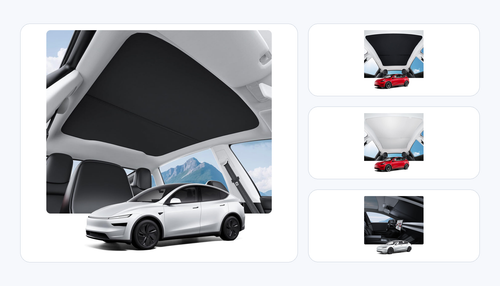
2025-2026 Model Y Juniper Roof Sunshade - No Gap Black
Best for: Juniper owners who want a cleaner roof coverage boundary and do not want to gamble on legacy Model Y parts.
Tradeoff: no-gap coverage gives better perceived finish, but it is still a physical shade you install, remove, and store.

2020-2024 Model Y Glass Roof Sunshade - Black
Best for: Legacy/standard Model Y owners who want a retractable-style roof shade for direct overhead comfort.
Tradeoff: the fitment boundary is strict. It is the wrong pick for a 2025-2026 Juniper.

2020-2024 Model Y Glass Roof Sunshade - Gray
Best for: the same Legacy Model Y roof shape, with a lighter cabin color preference.
Tradeoff: color is preference-driven, but fitment is not. Confirm the model year first.

Model 3/Y Windshield Sunshade - Nano Ice Crystal UV Block
Best for: parked windshield heat when you are not sure which Model Y generation the owner has.
Tradeoff: easier fitment, but it does not cover the panoramic roof.
What problem does a roof shade actually solve?
The Model Y has a large fixed glass roof, so heat complaints usually arrive in three different forms. The first is parked heat: the cabin is hot when you return to the car. The second is radiant heat: the A/C is running, but your head, shoulders, or rear passengers still feel warmth from above. The third is glare and visual fatigue: sunlight is not painful enough to call it heat, but it changes how comfortable the cabin feels on a long drive.
A roof shade is strongest against the second and third problems. It puts a physical barrier between the glass and the occupant, so passengers feel less direct overhead load even when the measured air temperature has not changed dramatically. That is why owners who mostly drive alone on short commutes may feel less benefit than owners who put children, pets, or adults in the second row during midday trips.
Parked heat is more layered. The PubMed vehicle heat study is useful here because it shows that an enclosed vehicle can warm quickly in sunlight. A roof shade helps reduce one path of solar load, but the windshield, side glass, cabin color, pavement temperature, and parking duration still matter. If the car sits outside for hours, the best setup is usually a windshield shade plus the correct roof shade, not a roof shade alone.
Lab note: We use the 99.2% UV-blocking benchmark for BASENOR shade material, but we do not translate that into a fake cabin-temperature promise. UV blocking, radiant comfort, and whole-cabin cooldown are related, not identical.
Install and daily-use checks before you buy
Before ordering, identify the model year from the Tesla app or vehicle paperwork, not from the delivery month alone. A 2025-2026 Model Y Juniper owner should choose a Juniper-specific shade; a 2020-2024 owner should choose the older Model Y roof-shade family. This matters because a shade can look close in a product photo but still leave edge gaps, clip tension issues, or slight sag when the roof contour is wrong.
After installation, do three checks before calling the job finished. First, look at the rear edge from the back seat and confirm the shade sits evenly instead of floating away from the trim. Second, drive over a rough road at low speed and listen for clip buzz. Third, open the doors after the car has sat in sunlight and confirm the shade has not shifted. These checks take less than five minutes and catch most fitment complaints early.
Storage is the hidden ownership cost. If you remove the shade in winter, keep panels flat and avoid loading heavy cargo on top of them. If the kit uses clips or small supports, store them in a labeled pouch. The most common avoidable failure is not material breakdown; it is losing the small hardware between seasons, then reinstalling the shade with uneven support.
Who should buy it, who should skip it?
Buy a roof shade if you have rear-seat passengers. The Model Y's second row sits directly under the glass, and passenger comfort is where roof shades earn their keep. Families notice this most on school pickup, weekend errands, and road trips where the cabin is occupied for more than a few minutes after parking outside.
Buy one if your route has sustained midday sun. In Arizona, Nevada, Texas, Southern California, Florida, and similar climates, the complaint is often not just the first five minutes after parking. It is the steady radiant load above the cabin while the A/C is already working. A roof shade reduces that overhead exposure without asking the HVAC system to solve every part of the problem by itself.
Skip it if your Model Y lives in covered parking and you love the open-glass feel. The panoramic roof is part of why many owners like the cabin. If your car is garaged at home and work, a roof shade may stay in the trunk more than it stays installed. In that case, the simpler first purchase is a windshield shade for the occasional outdoor parking day.
Skip universal roof listings that hide the year range. "Fits Model Y" is not enough in 2026. The listing needs to state the generation or model-year window clearly. A bargain part that creates edge gaps, buzz, or a return process is not cheaper once you count the time spent fixing the mismatch.
Legacy Model Y owners are still supported, but the shopping order changes
For 2020-2024 Model Y owners, the black and gray BASENOR roof shades remain the relevant product family. We list them after the Juniper option because a new 2026 guide should not lead a new buyer toward a legacy part. That ordering is not a quality judgment against the older Model Y; it is a fitment-safety rule.
If you own a 2020-2024 car, choose between black and gray based on cabin preference and how much contrast you want overhead. The functional buying decision is the same: roof shade for overhead heat, windshield shade for dash and steering-wheel heat, and both together when the car sits outside in strong sun. If you own a 2025-2026 Juniper, do not use the older shade family as a substitute.
This split also makes gift buying easier. If you do not know the recipient's Model Y year, a windshield shade is the safer low-risk gift because it spans more Model 3/Y years. A roof shade is the better comfort upgrade only when the exact vehicle generation is known.
How our lab verifies a roof-shade fitment claim
Our fitment review starts with the vehicle generation, then moves to the contact points. On a glass-roof shade, the edges matter more than the center panel because edge tension decides whether the shade sits flat, leaves daylight gaps, or develops buzz over time. A shade can use good material and still be the wrong product if the clip geometry belongs to a different roof opening.
For Model Y, the current split is simple enough to remember: 2020-2024 Model Y products serve the earlier body, and 2025-2026 Model Y Juniper products serve the refreshed body. We keep that same discipline across Tesla generations. Legacy Model 3 and Model 3 Highland are separate fitment families, just as standard Model Y and Model Y Juniper are separate fitment families. That separation prevents the most common 2026 accessory mistake: buying a discounted older listing because the product title says the model name but not the generation.
When we inspect a roof shade, we look for four practical outcomes. The first is edge coverage, especially at the front and rear corners. The second is clip security after the cabin warms up, because plastic and fabric tension can change in heat. The third is cabin clearance, which matters for tall drivers and rear passengers. The fourth is removal behavior: a good shade should not require enough force that owners avoid taking it down when the season changes.
We also separate material claims from comfort claims. Nano ice-crystal shade material can meet a UV-blocking target and still depend on installation quality, cabin airflow, and parking angle for the final comfort result. That is why our recommendation is not "every Model Y owner needs one." The correct answer is conditional: buy the shade when overhead radiant heat is the problem, choose the exact generation, and add windshield coverage when parked heat is the bigger complaint.
The 60-second pre-purchase checklist
1. Confirm your generation. If your car is a 2025-2026 Model Y Juniper, start with the Juniper no-gap roof shade. If your car is a 2020-2024 Model Y, use the 2020-2024 roof-shade family. If you are buying a gift and cannot confirm the year, choose the windshield shade instead.
2. Identify the heat complaint. Hot dash, hot steering wheel, and parked cabin heat point toward windshield coverage first. Warm headliner area, rear-seat discomfort, and glare from the roof point toward a roof shade. Owners in strong-sun states often benefit from using both, but the first purchase should match the symptom.
3. Decide whether you will leave it installed. Some owners install the roof shade in late spring and remove it after summer. Others remove it for night drives or when they want the open glass view. If you dislike handling interior accessories, the tradeoff may bother you more than the heat.
4. Inspect photos for edge coverage. Product photos should show the installed shade against the roof opening, not only folded panels on a table. Gaps near the edges are where cheap universal shades usually reveal themselves.
Real tradeoffs before buying
Install friction: a roof shade is not a software setting. If you remove it seasonally, store the panels flat and keep the clips together. If you leave it installed all summer, check that it does not sag or buzz on rough pavement.
Visibility and cabin feel: some owners love the panoramic glass look. A shade changes that open-cabin feeling. If the car is mostly used at night or in covered parking, you may not use it enough to justify the change.
HVAC is still part of the system: the Department of Energy notes that dirty filters reduce airflow and efficiency in air-conditioning systems, while EPA defines HEPA as a filtration standard. Those facts are useful, but they answer a different problem. Filters and airflow help the HVAC system work; a roof shade blocks direct sun before the cabin has to recover.
FAQ
Is a Model Y roof sunshade better than tint?
They solve different ownership problems. A removable roof shade is reversible and seasonal. Tint is permanent, depends on local rules and installer quality, and may still leave the glass itself warm.
Does a 2020-2024 Model Y roof shade fit a 2025-2026 Juniper?
Do not assume that. Buy from a listing that explicitly names 2025-2026 Model Y Juniper. The refresh changed enough fitment points that generation-specific buying is the safer rule.
Should I buy a windshield shade or roof shade first?
If the hot dash and steering wheel are the problem, start with a windshield shade. If the heat feels like it is coming from above your head or the rear seat, add a roof shade.
Will a roof shade make the A/C unnecessary?
No. It reduces direct overhead sun load, but the A/C still controls cabin air temperature. Treat the shade as a comfort layer, not an HVAC replacement.
Sources
Start with the roof shape, then choose the shade
Model Y heat comfort is easier to solve when the part matches the generation. Pick Legacy Model Y, Juniper, or a broad windshield shade before comparing colors.
Shop Model Y Accessories