Updated June 2026 · BASENOR Product Testing Lab · Model-specific fitment checklist
Before Buying Tesla Accessories: BASENOR Fitment and Value Checklist
Most Tesla accessories look simple online. The expensive mistakes happen in the details: a mat lip that catches the pedal area, a console insert that fits Legacy Model 3 but not Highland, a sunshade that leaves a roof-glass gap, or an adhesive part that cannot survive a 110°F cabin. This is the checklist our team uses before we call an upgrade worth buying.
Bottom Line Up Front
Check fitment first: Model year, refresh generation, and install area matter more than the product category. Model Y Juniper, Model 3 Highland, Legacy Model 3, refreshed Model S, and refreshed Model X do not share every interior or exterior contact point.
Buy by job, not by catalog page: Start with protection, storage, heat control, charging organization, or road-trip readiness. If an accessory cannot solve a real owner problem, skip it.
Our rule: We only recommend an upgrade when we can explain the fitment boundary, material tradeoff, installation risk, and the owner who should not buy it.
1. The fitment check: exact model year beats “fits Tesla”
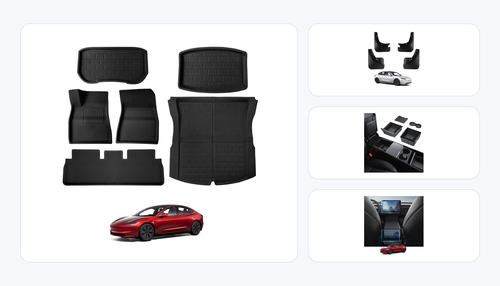
A Tesla accessory only has value if it fits the exact surface it touches. Our first pass is not brand, price, or review count. It is contact geometry. Floor mats touch the pedal box and seat rails. Console organizers touch bin depth, lid movement, cupholder shape, and charging pads. Mud flaps touch wheel-well curvature and fastener points. Sunshades touch glass size, roof curvature, and clip spacing.
The key generation split for 2026 owners is simple: 2024-2026 Model 3 Highland is not the same cabin as 2017-2023 Model 3, and 2025-2026 Model Y Juniper is not the same accessory target as 2020-2024 Model Y. Juniper also retains a physical turn-signal stalk, while Highland removed the stalk and uses steering-wheel buttons. That difference matters when you see generic “Highland/Juniper” wording on steering-column or dash-adjacent accessories.
| Vehicle group | Fitment risk | Accessories most affected | Our buying rule |
|---|---|---|---|
| Model Y Juniper 2025-2026 | New generation but still often mixed with 2020-2024 listings | Mats, mud flaps, roof shades, trunk liners, console pieces | Buy only if the page explicitly names Juniper or 2025+ |
| Model 3 Highland 2024-2026 | Stalkless controls and revised interior | Console storage, screen protectors, mud flaps, rear protection | Do not reuse Legacy Model 3 interior assumptions |
| Model S/X 2021-2026 | Different console and cargo geometry from 3/Y | Console organizers, car covers, filters, jack pads | Use S/X-specific listings unless the product is truly universal |
| Cross-model tools | Usually lower fitment risk, but still check jack points, cable length, or storage size | Jack pads, cable organizers, trash cans, small holders | Accept cross-model only when the contact point is shared |
2. The material check: every material has a tradeoff
We avoid vague quality labels because they do not help a Tesla owner choose. The useful question is: what does the material do after 30 days of owner use? TPE floor and cargo protection handles water and dirt well, but a full liner set is heavier to remove than a thin carpet mat. TPU console covers resist scuffs and grip phones better than bare plastic, but they add a visible layer on top of Tesla’s clean console design. ABS with a realistic carbon-fiber texture gives a sportier look at a lower cost than woven carbon material, but it should be described as textured ABS rather than actual carbon construction.
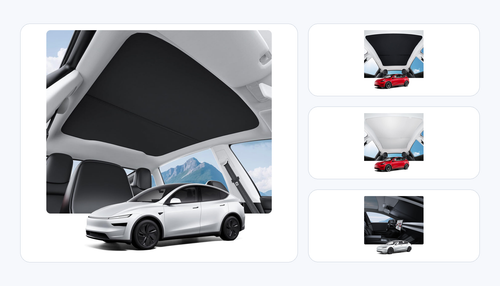
Heat-control products need a different standard. A windshield or roof sunshade is not just a comfort item in Phoenix, Las Vegas, Dallas, or inland California. We look for coverage, storage behavior, clip retention, and whether the shade still fits after repeated folding. A compact shade that owners actually use every hot day can beat a larger one that stays in the trunk.
3. The installation-risk check: reversible beats dramatic
Warranty and safety guidance is a practical filter for accessory choices: an add-on that causes damage, interferes with controls, or changes a protected system can create a very different risk profile from a reversible storage tray. Drop-in organizers, mats, sunshades, and cable holders are lower-risk because they are reversible. Anything that uses adhesive, touches sensors, routes wiring, sits near airbags, or changes exterior airflow gets a stricter review.
Adhesive parts are not automatically bad. They just need the right install conditions. Clean the surface, install on a dry day, and avoid cold or wet surfaces when the adhesive has to bond. For anything near a camera, vent, pedal area, seat rail, charging connector, or roof glass, we look for product-specific installation notes before we recommend it.
Skip the accessory if it fails any of these tests
- The listing says “fits all Tesla models” but the part touches a model-specific surface.
- The product photo hides the exact install area or uses a different vehicle generation.
- The accessory blocks a camera, vent, emergency release, airbag path, pedal travel, or seat movement.
- The seller cannot explain whether removal leaves residue, marks, or broken clips.
4. The BASENOR lab checklist before an accessory earns a recommendation
We tested this buying framework against the same failure points owners report after the first month: poor generation labeling, loose fit, heat-softened adhesive, parts that complicate cleaning, and accessories that make the cabin feel cluttered instead of more usable. The checklist below is how we decide whether a product belongs in a guide, a collection, or the skip pile.
| Check | Pass signal | Fail signal | Why it matters |
|---|---|---|---|
| Generation label | Exact years such as 2025-2026 Model Y Juniper or 2024-2026 Model 3 Highland | Only says “Model Y” or “Model 3/Y/S/X” for a shaped part | Most returns start with vague fitment language. |
| Install area | Photos show the real contact points, clips, adhesive zone, or fasteners | Only lifestyle photos, no close-up of the contact surface | Tesla interiors are minimalist, so small alignment errors stay visible. |
| Removal | Can be removed for cleaning or inspection without residue or broken tabs | Permanent-looking tape, hidden wiring, or unclear clip direction | Lease returns and resale inspections punish messy installs. |
| Safety clearance | No interference with pedals, airbag paths, cameras, vents, or seat movement | Stacks over factory mats, blocks airflow, or sits near sensor/camera fields | NHTSA records show floor-mat and pedal interference is a real safety category, not a cosmetic nitpick. |
The safety-clearance step is why we are strict about floor mats and cargo liners. Never stack a new driver-side mat over the factory mat. Never trim a mat around the pedal area unless the product maker explicitly designed it that way. And never assume a “close enough” mat is fine because it only moves a few millimeters; the driver footwell is one of the few accessory zones where small movement can become a safety issue.
For console, screen, and storage parts, the stakes are lower but the daily annoyance is higher. A tray that rattles, a phone mount that blocks sightlines, or a sunshade that takes too long to fold will eventually stop being used. Our lab score for those parts is simple: if the owner has to fight the accessory, the accessory has failed.
4. What to buy first by owner need
Owner communities such as r/TeslaModelY repeatedly surface the same practical categories: floor or cargo protection, sunshades, console storage, mud flaps, screen protection, phone placement, and charging organization. That does not mean every owner needs every item. It means those categories solve the most common early ownership friction.
Protection first
Choose mats, cargo liners, seat-back covers, mud flaps, and screen protectors if you have kids, pets, snow, gravel, construction dust, or light upholstery.
Real tradeoff: protective parts add visible layers and sometimes extra cleaning steps.
Storage first
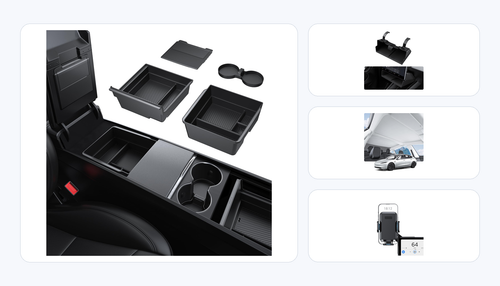
Choose console trays, under-screen storage, rear console storage, trunk bins, and cable organizers if your cabin becomes a pocket-and-cable dump after one week.
Real tradeoff: more organization pieces can make deep cleaning slower.
Heat first
Choose windshield and roof shades if you park outdoors in a hot or high-UV region. Prioritize coverage, storage pouch size, and clip retention over the largest marketing claim.
Real tradeoff: shades work only when owners actually install and remove them consistently.
Road-trip first
Choose jack pads, cable organization, air filters after the service interval, trunk separation, and emergency visibility gear if your Tesla does long drives or rideshare work.
Real tradeoff: emergency and maintenance gear takes cargo space until the day it matters.
5. BASENOR product map: where the checklist points
We selected these examples from active BASENOR catalog families because they map cleanly to the decision framework above. Treat them as starting points, not a universal cart. The exact model year on each product page still matters.

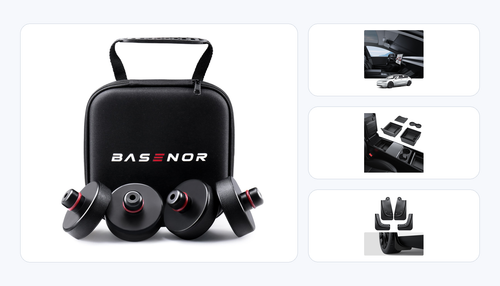
Jack pads for Model 3/Y/S/X
Use case: roadside and tire-shop protection around Tesla jack points.
Tradeoff: sits unused most days, but it prevents a high-cost mistake during lifting.
View jack pads
Model 3/Y windshield sunshade
Use case: hot-weather parking and daily cabin heat control.
Tradeoff: the best shade is the one you will fold and store every day.
View sunshadeHighland/Juniper console organizers
Use case: turns deep storage into reachable layers for cards, sunglasses, cables, toll tags, and daily carry items.
Tradeoff: removable trays must come out before a deep clean.
View console organizerJuniper and Highland mud flaps
Use case: reduces road grit impact around lower panels on wet, salted, gravel, or construction-zone roads.
Tradeoff: exterior protection is visible, so owners who want a completely factory side profile may skip it.
View Juniper mud flapsScreen protector for Model 3/Y
Use case: protects the daily control surface from rings, grit, fingerprints, and glare.
Tradeoff: matte glass changes the display finish; glossy glass keeps contrast but reflects more cabin light.
View screen protectorWall connector cable organizer
Use case: keeps home charging cable off the floor and reduces garage trip hazards.
Tradeoff: the wall location has to match your parking position, or the cable still drags.
View cable organizer6. How we separate useful reviews from hype
A five-star accessory review can still be incomplete. We look for the vehicle year, trim, how long the owner used it, whether installation happened in heat or cold, and whether the review mentions removal or cleaning. A review that says “fits my 2026 Juniper after 30 days” is more useful than ten reviews that only say “looks great.”
Our lab shorthand is: fit first, use second, style third. Style matters because owners look at these parts every day. But an accessory that looks good and rattles, blocks storage, interferes with cleaning, or does not survive heat has not earned its price.
7. What we would buy later, not on delivery day
Some accessories are useful, but only after the owner knows the car. Seat covers are a good example. If you have kids, pets, denim-heavy clothing, or white seats, covers can make sense early. If you mostly drive alone and clean the cabin weekly, seat covers can hide an interior you paid to enjoy. The same logic applies to lighting kits, wheel covers, decorative trim, frunk organizers, and screen-side gadgets.
Our recommendation is to divide the cart into preventive and preference parts. Preventive parts protect surfaces before damage starts: mats, screen protectors, mud flaps, bumper guards, and cargo liners. Preference parts change how the cabin feels: trim covers, lighting, extra storage, phone mounts, scent diffusers, and convenience holders. Buy the preventive set early if it fits your use case. Wait 2-4 weeks on preference parts so you can see where the factory layout actually bothers you.
Lease owners should be stricter. A removable cargo liner, mat set, cable holder, or sunshade is easy to justify because it protects the car and can come out before return. Adhesive trim, exterior caps, and hard-to-remove decorative pieces need more caution. If the part could leave residue, change inspection appearance, or require replacement clips during removal, it belongs in the “wait” group unless you plan to keep the car past the lease term.
Used Tesla buyers should be stricter in a different way. Match accessories to existing wear. If the console is already scratched, a cover can hide and prevent more wear. If the carpets are clean, install liners before winter. If the car already has a sunshade that fits poorly, replace it with a generation-specific one instead of adding more cabin clutter. The best accessory plan is not the biggest cart; it is the shortest path from current pain point to clean daily use.
FAQ
What is the first Tesla accessory we would buy?
For most daily drivers, protection comes first: screen protector, mats or cargo protection, and mud flaps if you drive in rain, gravel, or winter road salt. Storage and style upgrades can wait until you know your routine.
Do Model Y Juniper accessories fit older Model Y vehicles?
Do not assume they do. Some console or screen-adjacent parts may share broad logic, but mats, mud flaps, roof shades, trunk liners, and cargo pieces should be checked by model year and generation.
Will aftermarket accessories void my Tesla warranty?
A simple drop-in accessory is different from a wiring, sensor, suspension, or adhesive exterior modification. Warranty risk usually depends on whether the accessory causes damage or performance issues. When in doubt, choose reversible parts and avoid anything near airbags, cameras, pedals, or wiring.
Are “premium” Tesla accessories always better?
No. The better accessory is the one that fits your exact vehicle, solves a real problem, installs cleanly, and has a material tradeoff you accept. A more expensive part with vague fitment language can be worse than a simpler part with clear model-year proof.
Should I buy accessories before delivery day?
Buy only the low-risk essentials before delivery: screen protection, verified mats or cargo protection, and climate-specific items like a windshield shade. Wait on style, storage, and comfort accessories until you know what annoys you in the car.
Sources and verification notes
- FTC Consumer Advice - Auto warranties and service contracts
- Recharged - Tesla Model Y accessory prioritization and Juniper fitment notes
- NHTSA-hosted service bulletin - floor-mat and pedal-interference safety guidance
Customer-facing sources avoid direct competitor product pages. We also reviewed r/TeslaModelY owner discussions as qualitative demand signals, but avoid linking to pages that failed local URL verification.
Ready to stop guessing on Tesla fitment?
Start with BASENOR accessories sorted by exact Tesla model and generation, then choose the upgrades that solve your first real owner problem.
Shop Tesla Accessories
Daniel Zhang
Lead Engineer · Testing & Fit Validation
Mechanical engineer with 10 years in Tier-1 automotive supply. Daniel runs the BASENOR test lab and signs off on every product before launch. Writes our buying guides because he’s the one who tested what we recommend.