Artemis II Wet Dress Set for Feb 19 as Blue Moon Launch Ignites Lunar Race
⚡ 30-Second Brief
The News: NASA has confirmed Thursday, February 19th for the second wet dress rehearsal of Artemis II, while industry experts declare Blue Origin's upcoming Blue Moon launch as the moment the commercial lunar race becomes official.
Why It Matters: The wet dress rehearsal is the final major test before NASA's first crewed lunar flyby in over 50 years, while the commercial sector is now mounting a serious challenge to reach the Moon's surface — with implications for future human exploration and Tesla's sister company SpaceX.
Source: @NASASpaceflight and @SciGuySpace
📊 Key Figures
| Metric | Value | Context |
|---|---|---|
| Wet Dress Date | February 19, 2026 | Final major test before crewed launch |
| Artemis II Launch Window | March 6 - April 30, 2026 | First crewed lunar mission since Apollo 17 |
| Mission Duration | 10 days | Lunar flyby with 4-person crew |
| Blue Moon Mark 1 Payload | 3,000 kg (6,600 lbs) | Robotic lander capacity to lunar surface |
| Blue Origin NASA Contract | $3.4 billion | For crewed Blue Moon Mark 2 (Artemis V) |
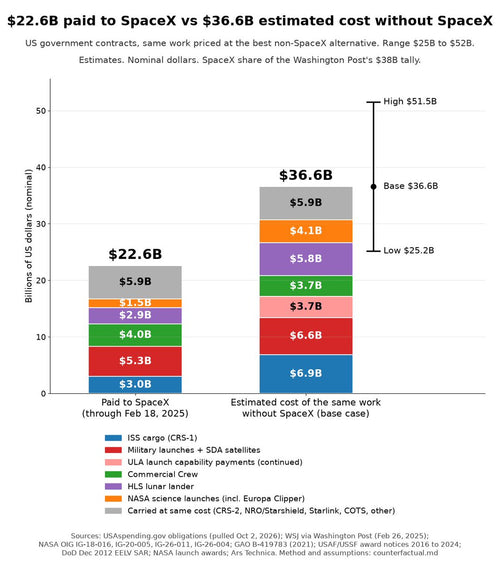
| SpaceX HLS Contract | $2.89 billion | Starship variant for Artemis III landing |
🚀 NASA Confirms Critical Artemis II Milestone
NASA's confirmation that the wet dress rehearsal will proceed on Thursday represents a crucial step forward for the Artemis II mission. This test involves fully fueling the massive Space Launch System (SLS) rocket with cryogenic propellants and running through a detailed countdown sequence, stopping just short of ignition.

The rehearsal follows successful repairs to ground support equipment after a liquid hydrogen leak was detected during a partial fueling test on February 12. NASA teams replaced a faulty filter, clearing the path for this second attempt. The wet dress rehearsal is the final major hurdle before the agency can confidently commit to a launch date within the March 6 - April 30 window.
Artemis II will carry four astronauts — NASA's Reid Wiseman, Victor Glover, Christina Koch, and Canadian Space Agency's Jeremy Hansen — on a 10-day lunar flyby mission. This will be the first time humans have left Earth orbit since Apollo 17 in 1972, and the mission will mark several historic firsts: Victor Glover will be the first person of color, Christina Koch the first woman, and Jeremy Hansen the first non-American to venture beyond Earth orbit.
🌙 The Commercial Lunar Race Heats Up
While NASA prepares for its crewed mission, the commercial space industry is experiencing its own pivotal moment. Veteran space journalist Eric Berger of Ars Technica declared that Blue Origin's upcoming Blue Moon launch will formalize what has been quietly brewing: a genuine commercial race to the lunar surface between Jeff Bezos's Blue Origin and Elon Musk's SpaceX.

Blue Origin's Blue Moon Mark 1 lander, named Endurance, stands over 8 meters tall and can deliver up to 3,000 kg of payload to the lunar surface. The robotic pathfinder mission is set to launch aboard Blue Origin's New Glenn rocket in early 2026, serving as a technology demonstration for systems including the BE-7 engine and precision landing capabilities. NASA awarded Blue Origin $6.1 million through its Commercial Lunar Payload Services (CLPS) program to carry the SCALPSS (Stereo Cameras for Lunar Plume Surface Studies) instrument.
The competition intensifies when looking at the larger picture. Blue Origin secured a $3.4 billion contract from NASA in May 2023 to develop the Blue Moon Mark 2 human lander for the Artemis V mission, currently planned for 2030. An uncrewed demonstration flight is scheduled for 2027.
On the other side, SpaceX's Starship Human Landing System holds a $2.89 billion contract for Artemis III, with the crewed lunar landing now expected no earlier than mid-2027. SpaceX has completed 49 milestones specific to HLS development and is targeting 2026 for critical tests including long-duration flight and in-space propellant transfer — a technological hurdle that must be overcome for lunar missions.
Adding fuel to the fire, Elon Musk announced on February 8 that SpaceX is pivoting focus from Mars colonization to building a 'self-growing city' on the Moon, with an uncrewed lunar landing targeted for 2027.
🔭 The BASENOR Take
| Timeline: | Feb 19: Artemis II wet dress | Early 2026: Blue Moon Mark 1 launch | March-April: Artemis II launch window | 2027: SpaceX uncrewed lunar landing target |
| Impact Level: | 🔥🔥🔥🔥 High — This marks the transition from government-only lunar access to commercial competition |
| Confidence: | 95% — Both wet dress and Blue Moon launch are imminent with confirmed dates |
Why This Matters for Tesla Owners: The commercial lunar race represents more than just a space milestone — it's a validation of the sustainable business models that underpin companies like SpaceX and Tesla. SpaceX's reusable rocket technology, pioneered through Falcon 9 and now scaling with Starship, directly parallels Tesla's approach to sustainable transportation. Success in the lunar economy could accelerate technology transfer, manufacturing innovations, and materials science breakthroughs that benefit Tesla's vehicle production.
Additionally, the competition between Blue Origin and SpaceX mirrors the broader shift in the aerospace industry toward rapid iteration and commercial viability — the same principles that have allowed Tesla to disrupt traditional automotive manufacturing. Blue Origin's decision to pause New Shepard tourism flights to focus resources on Blue Moon demonstrates the high stakes and serious commitment both companies are making to lunar exploration.
The Bigger Picture: February 19th's wet dress rehearsal is more than a technical test — it's NASA demonstrating that the Artemis program, despite delays, is moving toward reality. The simultaneous emergence of commercial lunar capabilities from both SpaceX and Blue Origin means that by 2027-2028, there could be multiple pathways to the Moon's surface, dramatically lowering costs and increasing access.
For the space community, Berger's observation that the Blue Moon launch will be 'a pivotal moment' rings true. We're witnessing the formalization of a new era where lunar access is no longer the exclusive domain of government agencies. The race is on, and both billionaire-backed companies have billions in NASA contracts, proven hardware in development, and aggressive timelines.
📰 Deep Dive: From Government Monopoly to Commercial Competition
The story unfolding in February 2026 is one of parallel tracks converging toward a common goal. NASA's Artemis program represents the continuation of government-led exploration, building on decades of spaceflight experience with the most powerful rocket ever built and a spacecraft designed for deep space human missions. The February 19th wet dress rehearsal, following repairs to the liquid hydrogen system, is the agency's methodical approach to ensuring crew safety.
Meanwhile, the commercial sector has quietly matured to the point where it can credibly compete for lunar surface access. Blue Origin's Blue Moon Mark 1, having recently completed thermal vacuum testing at Johnson Space Center, represents a fundamentally different approach: rapid development, commercial hardware, and an iterative testing philosophy. The pathfinder mission will validate technologies that scale directly to the crewed Mark 2 variant.
SpaceX's approach is even more aggressive. The Starship HLS variant leverages the fully reusable Starship architecture, which — if successful — could deliver far more payload to the lunar surface at dramatically lower costs than any previous system. However, NASA Administrator Sean Duffy's October comments that SpaceX was 'behind' on development milestones suggest the company faces significant technical challenges, particularly around propellant transfer and long-duration flight.
What makes this moment particularly significant is the validation it provides to commercial space business models. Both Blue Origin and SpaceX have invested billions of their own capital alongside NASA contracts, betting that the lunar economy will eventually support sustainable commercial operations. If Blue Moon successfully lands in 2026 and SpaceX achieves its 2027 uncrewed landing, the Moon will have gone from a government-only destination to a competitive commercial marketplace in less than a decade.
The implications extend beyond space exploration. The manufacturing techniques, materials science, autonomous systems, and life support technologies being developed for lunar missions have direct applications in terrestrial industries — including automotive, energy storage, and sustainable manufacturing. For Tesla owners watching SpaceX's progress, the company's lunar ambitions represent more than just Elon Musk's vision; they're a proving ground for technologies that could eventually influence vehicle design, battery systems, and manufacturing efficiency.
As we approach the February 19th wet dress rehearsal and the early 2026 Blue Moon launch, the space community is holding its breath. If both succeed, we'll look back on February 2026 as the month the commercial lunar race became undeniably real.
🚀 Following the Starship program? See every test flight, official outcome and the next launch window in our SpaceX Starship Tracker.
Sources & reporting notes
The links below identify the material source records used for this report.
- @NASASpaceflight on X (2026-02-16T20:31:02.000Z) — Direct source
- @SciGuySpace on X (2026-02-16T20:02:31.000Z) — Direct source
Source links are preserved as published or accessed. See our editorial standards and corrections policy.
The BASENOR Editorial Desk covers Tesla, SpaceX, and related technology, curating reporting from primary sources — official accounts, regulatory filings, and software release data. Every article passes source-record and fact-checking review before publication. About the newsroom.
This report was curated by the BASENOR Editorial Desk from the sources listed above. Read our editorial standards or email editorial@basenor.com to report an error.