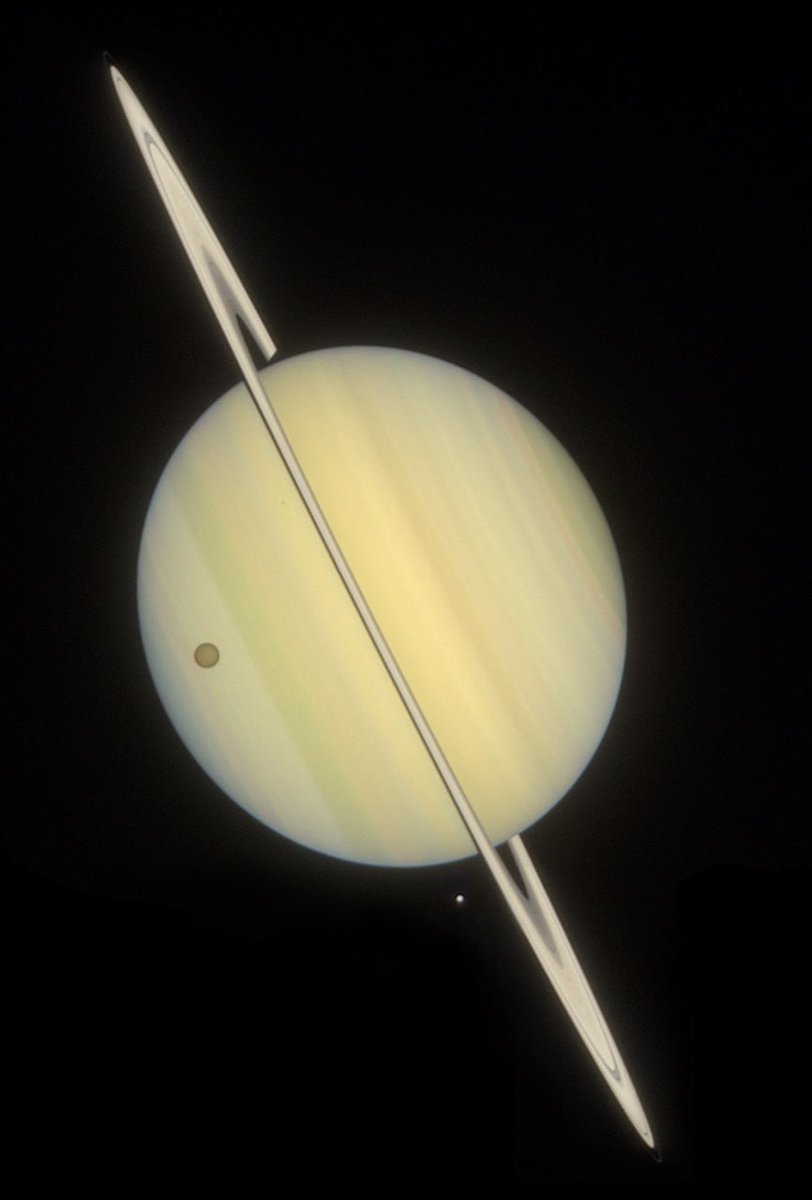
The News: Elon Musk declared that humanity will one day "sail through the moon belts of Saturn," signaling an interplanetary ambition that stretches far beyond SpaceX's current Mars focus.
Why It Matters: This vision — paired with real, near-term SpaceX involvement in Saturn-system missions — shows the company's trajectory extends well past the Red Planet.
Source: @elonmusk on X
Elon Musk Eyes Saturn: SpaceX's Interplanetary Vision Goes Beyond Mars
Mars gets all the headlines, but Elon Musk just reminded the world that SpaceX's ambitions don't stop at the Red Planet. In a single, evocative post on X, Musk cast his gaze 900 million miles further out: "One day, we shall sail through the moon belts of Saturn." It's the kind of statement that sounds like poetry — until you realize the infrastructure to make it happen is already being built.

From Mars Colony to Saturn's Rings: The Expanding Roadmap
SpaceX's official mission has always been to make humanity a multi-planetary species, with Mars as the primary destination. Musk has repeatedly described a self-sustaining Martian colony as the ultimate insurance policy for human civilization. But this latest statement is a reminder that Mars is a waypoint, not the finish line.
Musk has previously floated the idea of Starship — SpaceX's fully reusable super-heavy launch system — serving as a "jumping-off point for humanity to other places in the solar system." He has specifically mentioned Saturn's moon Enceladus and Jupiter's moon Europa as potential future destinations. Saturn's moons alone number over 140, many of them scientifically extraordinary. Titan has a thick nitrogen atmosphere and liquid methane lakes. Enceladus shoots water vapor geysers into space, hinting at a subsurface ocean. These aren't just scenic destinations — they're among the most compelling places in the solar system to search for signs of life.
📊 Key Figures
| Metric | Value | Context |
|---|---|---|
| NASA Dragonfly contract (SpaceX) | $256.6M | Falcon Heavy launch to Titan |
| Dragonfly launch window | Jul 5–25, 2028 | Kennedy Space Center, Florida |
| Saturn's known moons | 140+ | Most of any planet in our solar system |
| Tweet views (first 22 min) | 380,802 | 5.4K likes, 611 retweets |
SpaceX Already Has Skin in the Saturn Game
This isn't pure daydreaming. SpaceX is already contracted to launch the first mission to Saturn's moon system in a generation. NASA awarded SpaceX a $256.6 million contract to provide launch services for the Dragonfly mission — a rotorcraft-lander designed to hop between sites on Titan, sampling its surface to study prebiotic chemistry and search for signs of life. The launch is scheduled between July 5 and 25, 2028, aboard a Falcon Heavy from Kennedy Space Center.
Dragonfly won't carry humans, but it represents something important: SpaceX's rockets are already the chosen vehicle for humanity's first serious exploration of the Saturn system in decades. That's not a coincidence — it's infrastructure development, one contract at a time.
🔭 The BASENOR Take
Timeline: Long-term (2040s and beyond for crewed Saturn missions, realistically)
Impact Level: Visionary — directional, not operational
Confidence: High that SpaceX will reach Saturn's system robotically this decade (Dragonfly, 2028). Low that crewed missions happen within 20 years.
Analysis: Musk's Saturn post is best understood as a statement of intent, not a product roadmap. The pattern is consistent with how he has always operated: announce an audacious destination, then build the hardware that makes it incrementally possible. He said humans would land on Mars within a decade — multiple times. The dates have slipped, but the hardware (Starship) is real and flying. The same logic applies here. Saturn is the next horizon on a map that Musk is drawing in real time. The Dragonfly contract shows SpaceX is already the launch provider of choice for Saturn-bound missions. If Starship achieves its cost-per-kilogram targets, crewed deep-solar-system missions stop being science fiction and start being engineering problems.
What This Means for the SpaceX Roadmap
For Tesla owners who follow SpaceX closely, the Saturn post is a useful calibration tool. It confirms that Musk views the Mars program not as the destination but as the first step in a much longer journey. Starship, currently being tested for Earth orbit and lunar missions, is explicitly designed as an interplanetary vehicle. Its architecture — full reusability, in-orbit refueling, massive payload capacity — is the only realistic near-term platform that could eventually reach the outer solar system with humans aboard.
The phrase "moon belts of Saturn" is also technically precise. Saturn's 140+ moons aren't randomly scattered — many cluster in distinct orbital families and resonances, creating a complex, layered system that a future crewed spacecraft would navigate much like a ship threading an archipelago. Musk clearly knows the geography he's describing.
For now, the nearest milestone is Dragonfly in 2028. After that, a crewed Mars landing — likely in the 2030s if Starship development stays on track. Saturn comes after. But the fact that Musk is publicly framing it as an inevitability, rather than a fantasy, matters. It shapes hiring, it shapes investment, and it shapes what SpaceX engineers believe they're working toward. For more on SpaceX's current mission cadence, see our SpaceX coverage.
📰 Deep Dive
Musk's choice of words — "sail through" — is worth sitting with. It evokes the age of exploration, the image of a vessel moving through a complex, beautiful, and dangerous environment. Saturn's ring system and its dense moon population genuinely resemble an ocean archipelago in some ways: gravitational currents, orbital resonances, and icy debris fields that a crewed ship would need to navigate carefully. The romanticism in the framing is intentional, and it's the same rhetorical move Musk has used since the earliest SpaceX days to attract the kind of engineers and investors who want to be part of something historic.
What's different now compared to, say, 2012, is that the hardware is real. Starship has completed orbital test flights. Falcon Heavy has already launched missions to the outer solar system. The gap between vision and capability is narrower than it has ever been. A single tweet about Saturn's moon belts lands differently when the company behind it is the one NASA just paid $256.6 million to send a spacecraft there in two years.
The broader implication for the space industry is that SpaceX is positioning itself as the end-to-end provider for deep-space exploration — not just low Earth orbit or the Moon, but the entire solar system. If that positioning holds, the company Musk built to save humanity from extinction on one planet may end up being the vehicle that spreads it across a dozen worlds. Saturn, it turns out, was always on the itinerary.
🚀 Following the Starship program? See every test flight, official outcome and the next launch window in our SpaceX Starship Tracker.
Related Gear
Gear up your Tesla with tested, custom-fit BASENOR accessories — shop Tesla accessories →
Sources & reporting notes
The links below identify the material source records used for this report.
- @elonmusk on X (2026-03-18T13:43:25.000Z) — Direct source
Source links are preserved as published or accessed. See our editorial standards and corrections policy.
The BASENOR Editorial Desk covers Tesla, SpaceX, and related technology, curating reporting from primary sources — official accounts, regulatory filings, and software release data. Every article passes source-record and fact-checking review before publication. About the newsroom.
This report was curated by the BASENOR Editorial Desk from the sources listed above. Read our editorial standards or email editorial@basenor.com to report an error.