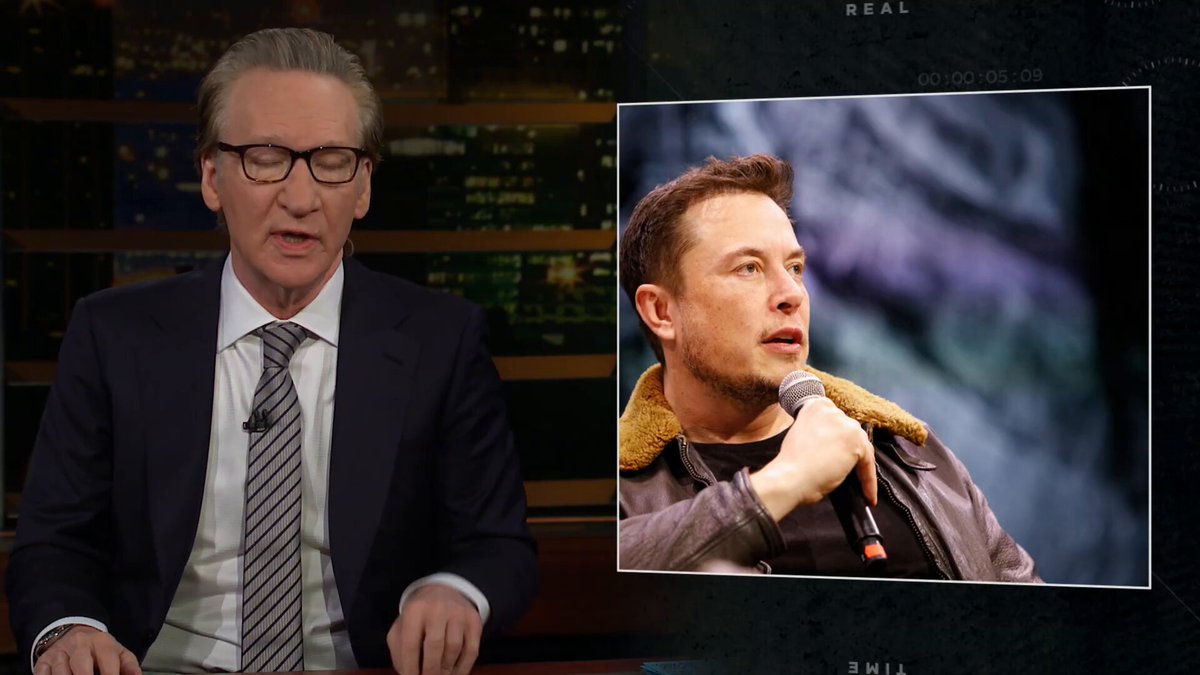
The News: Bill Maher publicly named Elon Musk as the sharpest voice on AI risk, spotlighting Musk's long-standing warning that AI regulation will arrive too late unless it's proactive.
Why It Matters: Musk's AI worldview directly shapes the development philosophy behind xAI and Grok — and signals how he approaches AI safety across Tesla's autonomous driving stack.
Source: @SawyerMerritt on X
Elon Musk on AI Existential Risk: Why He Says Time Is Already Running Out
Elon Musk has been sounding the alarm on artificial intelligence for nearly a decade. On Friday night, that message got a mainstream amplifier: Bill Maher called Musk "the smartest" person on the subject of AI — and quoted him directly.

The quote Maher highlighted cuts straight to the core of Musk's position: "I am very close to the cutting edge in AI and it scares the hell out of me. By the time we are reactive with AI regulation it is too late. AI is a fundamental existential risk for humanity."
This isn't a new position for Musk — it's one he's held consistently since at least 2017. But the context around that view has grown considerably more complex now that he's simultaneously one of the world's most prominent AI builders.

📊 Key Figures
| Date | Statement / Action |
|---|---|
| July 2017 | First public call for proactive AI regulation, warning problems will arrive faster than society expects |
| Feb 28, 2025 | On Joe Rogan: estimated only a 20% chance of AI-driven annihilation; predicted AI smarter than all humans combined by 2029–2030 |
| April 8, 2025 | Urged U.S. federal agencies to establish immediate legal frameworks for AI oversight |
| July 31, 2025 | xAI signed only the safety/security chapter of the EU's voluntary AI Code of Practice — rejected transparency and copyright chapters as harmful to innovation |
| Dec 3, 2025 | Called AI "potentially destructive" if unmanaged; flagged hallucination as a critical unsolved challenge |
| March 27, 2026 | Warned of a "tsunami of AI" arriving; argued AI must be rigorously truthful or risk becoming dangerous |
| April 18, 2026 | Bill Maher publicly endorses Musk's AI risk framing on national television |
🔭 The BASENOR Take
Timeline: Musk has held this position for nearly 9 years — long before xAI existed
Impact Level for Tesla Owners: Medium-term — shapes FSD philosophy, xAI/Grok development, and Optimus safety architecture
Confidence in Musk Acting on This: High — xAI's EU Code of Practice decision shows he's making concrete regulatory choices, not just talking
There's an obvious tension worth naming: Musk is simultaneously the person most loudly warning about AI danger and one of the most aggressive builders of AI systems. He runs xAI (Grok), Tesla's autonomous driving team, and has previously co-founded OpenAI before departing. His answer to that apparent contradiction has always been consistent — better that safety-focused builders are at the frontier than leaving it entirely to others.
The xAI decision on the EU Code of Practice is a useful data point here. The company signed onto the safety and security chapter but explicitly rejected transparency and copyright requirements, calling them "profoundly detrimental to innovation." That's not the behavior of a company that treats all regulation as good regulation — it's a selective, strategic approach that prioritizes existential risk mitigation over disclosure requirements.
For Tesla owners, the practical implication of this worldview shows up in how the company approaches FSD and Autopilot development. Musk's repeated emphasis on AI truthfulness — his March 2026 warning that forcing AI to believe untrue things makes it dangerous — maps directly onto how Tesla's autonomous systems are trained and validated. A system that hallucinates or is trained on distorted data isn't just a product problem; in Musk's framework, it's a civilizational one.
Whether you find Musk's AI risk framing credible or self-serving, the mainstream validation from figures like Maher signals something worth tracking: the regulatory and cultural conversation around AI is accelerating, and the companies building it — including Tesla — are going to face increasing pressure to demonstrate that their safety philosophies are more than talking points.
Related Gear
Gear up your Tesla with tested, custom-fit BASENOR accessories — shop Tesla accessories →
Sources & reporting notes
The links below identify the material source records used for this report.
- @SawyerMerritt on X (2026-04-18T03:27:41.000Z) — Direct source
- @SawyerMerritt on X (2026-04-18T03:27:41.000Z) — Direct source
Source links are preserved as published or accessed. See our editorial standards and corrections policy.
The BASENOR Editorial Desk covers Tesla, SpaceX, and related technology, curating reporting from primary sources — official accounts, regulatory filings, and software release data. Every article passes source-record and fact-checking review before publication. About the newsroom.
This report was curated by the BASENOR Editorial Desk from the sources listed above. Read our editorial standards or email editorial@basenor.com to report an error.