📌 UPDATE — June 8, 2026
SpaceX has officially unveiled its AI1 satellite — the first generation of its orbital AI compute platform — boasting a 150 kW peak compute payload, 120 kW average, 70 kW per ton, and an interchangeable compute provider design. The satellite deploys to a massive 70-meter wingspan. Alongside the reveal, SpaceX announced the Gigasat factory in Bastrop, Texas, spanning 1,000+ acres with over 11 million sq ft of building potential, set to produce AI satellites and solar components (ingots, wafers, and cells) by end of 2027. Elon Musk also detailed Terafab — a ~100 million sq ft manufacturing facility projected to be 10× the size of Giga Texas — targeting a staggering 1 TW/year output, double current total U.S. annual energy consumption.


| Asset | Key Spec | Timeline |
|---|---|---|
| AI1 Satellite | 150 kW peak compute · 70m wingspan | Unveiled June 2026 |
| Gigasat Factory (Bastrop, TX) | 1,000+ acres · 11M+ sq ft potential | Production by late 2027 |
| Terafab | ~100M sq ft · 1 TW/year output | TBD |
📌 UPDATE — June 8, 2026
SpaceX has released a new 30-minute interview with Elon Musk, filmed on-site at the Starlink terminal factory in Bastrop, Texas, offering a rare look inside SpaceX's manufacturing operations. The interview focuses specifically on SpaceX's technical capability to manufacture, launch, and operate AI satellites at scale — the most detailed public-facing breakdown of the company's AI satellite ambitions to date. This comes directly from SpaceX's official channels, signaling the company is actively shaping its own narrative around the AI expansion.

📌 UPDATE — June 5, 2026
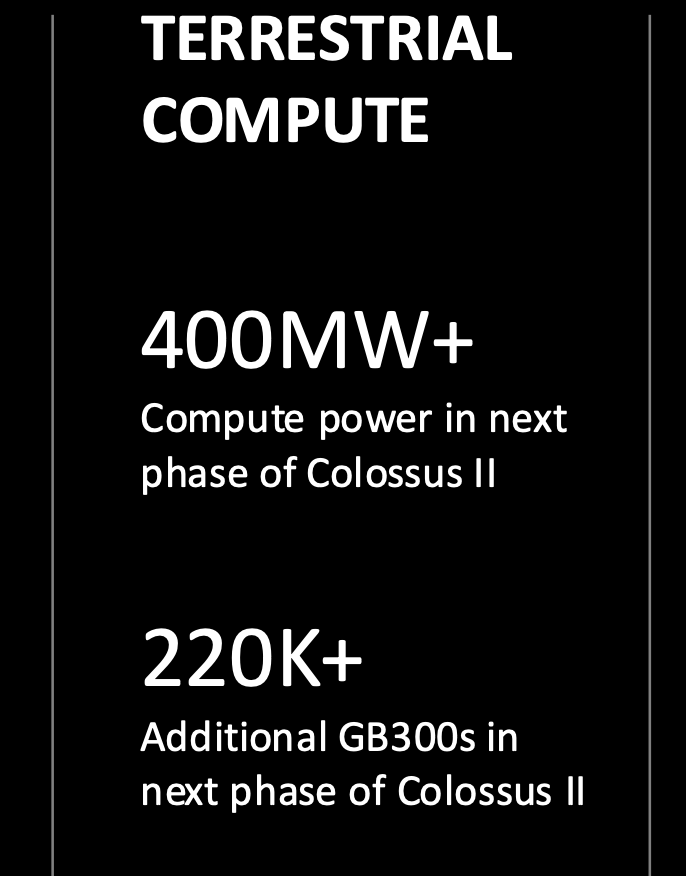
SpaceX is set to bring additional compute capacity online soon, according to a post shared by tech reporter Sawyer Merritt on June 5, 2026. While specific details on the scale or timeline remain undisclosed, the expansion signals SpaceX is actively building out its computational infrastructure — a critical enabler for its growing AI ambitions, Starlink network management, and Starship development programs. The move aligns with the company's recently broadened mission to incorporate AI, suggesting internal demand for processing power is accelerating faster than previously indicated. 🔍 The exact scope and location of the new compute resources have not been officially documented by SpaceX.
@SawyerMerritt · Jun 5, 2026
"SpaceX has more compute capacity coming online soon."
📌 UPDATE — June 5, 2026
SpaceX's AI compute ambitions are already generating staggering revenue: Anthropic and Google are now paying SpaceX a combined $2.17 billion per month for compute capacity, according to reporter Sawyer Merritt. That translates to an annual revenue run rate of $26 billion — from compute alone. This makes SpaceX's orbital and ground-based AI infrastructure play far more than speculative; it's already one of the company's most lucrative business lines, rivaling Starlink's trajectory in its early growth years. The deals underscore how quickly Big Tech is racing to secure non-traditional compute sources as demand for AI infrastructure outpaces conventional data center supply.

via @SawyerMerritt · June 5, 2026 · 62K views
📌 UPDATE — June 5, 2026
SpaceX has entered into a landmark $920 million per month Cloud Service Agreement with Google to provide compute capacity, according to a new filing disclosed today. The deal represents one of the largest known compute infrastructure agreements in the industry and signals that SpaceX's AI ambitions are already translating into major commercial revenue streams — not just internal projects. This partnership with Google positions SpaceX as a serious player in the cloud compute market, complementing its orbital data center strategy discussed below. The sheer scale of the contract — nearly $11 billion annually — adds significant weight to the company's rumored $2T IPO valuation thesis.

📌 UPDATE — June 5, 2026
New strategic details have emerged around xAI's satellite ambitions that go well beyond simply renting out orbital compute. According to analyst @wholemars, the vision involves launching Starlink-style satellites equipped with GPUs — not just to sell capacity to third parties, but to train xAI's own frontier AI models directly in orbit. This would allow xAI and SpaceX to capture the entire value chain: infrastructure, compute, and model development, all under one roof. If realized, this positions the venture less as a cloud competitor and more as a vertically integrated AI superpower operating from space.

SpaceX has quietly rewritten its own story. The company founded to make life multiplanetary now officially counts a Starlink constellation and an 'AI solution' as core pillars of its mission — a shift that, when you dig into the details, represents one of the most ambitious pivots in tech history.

From Rockets to Orbital AI Infrastructure
The tweet is brief, but the strategy behind it is anything but. According to SpaceX's IPO filing documents, the company's updated mission now extends to 'understand the true nature of the universe, and to extend the light of consciousness to the stars' — language that signals a company thinking well beyond launch manifests and reusable boosters.
The concrete expression of that ambition is orbital AI data centers. SpaceX has filed with the FCC for approval to launch and operate a constellation of one million satellites designed to function as space-based compute infrastructure for AI workloads. The first deployments are projected to begin in 2028, using Starship as the heavy-lift vehicle. Each ton of satellite hardware is estimated to generate 100 kW of compute power, meaning the full constellation could theoretically add 100 gigawatts of AI compute capacity annually — with a long-term target of 1 terawatt per year.
The logic for doing this in orbit, rather than on the ground, comes down to physics. Terrestrial AI data centers are projected to consume tens of gigawatts of power by 2030, straining electrical grids and requiring massive cooling infrastructure. Space-based systems can draw on continuous solar power and radiate heat passively into the cold of space — constraints that simply don't exist on the ground. Elon Musk stated in February 2026 that within two to three years, space will likely be the most cost-effective environment for generating AI compute.
The xAI Acquisition: The Engine Behind the Mission Shift
The 'AI solution' referenced in SpaceX's tweet has a specific origin point: the acquisition of xAI on February 2, 2026, in a deal valued at $250 billion, creating a combined entity worth $1.25 trillion. That deal wasn't just a financial transaction — it restructured how SpaceX thinks about its product portfolio.
Following the acquisition, xAI reorganized into four technical units: Grok (conversational AI and real-time information retrieval), Coding (automated software engineering), Imagine (generative video and visual intelligence), and Macrohard, a new initiative focused on a 'general computer use' agent capable of executing complex engineering tasks autonomously — including the design and simulation of rocket engine components. That last unit is particularly notable: AI that can help design the rockets that will launch the satellites that run the AI.
Grok itself is being integrated directly into the Starlink V3 constellation, which is scheduled to launch in 2026 and will significantly expand the network's capacity. The goal is low-latency edge computing delivered globally via satellite — AI at the edge, from orbit.
The IPO and the Numbers Behind the Vision
SpaceX's expanded mission isn't just a philosophical statement — it's the foundation of a public market pitch. The company has confirmed plans to list on the Nasdaq Exchange under the ticker SPCX, targeting a $2 trillion valuation. The IPO filing cites a potential revenue opportunity from AI of up to $26.5 trillion, a figure that dwarfs anything the launch business alone could generate.
Already, the commercial AI infrastructure play is generating real revenue. SpaceX has a contract with Anthropic to provide AI compute at $1.25 billion per month — a data point that makes the orbital data center ambition feel less speculative and more like a logical scale-up of an existing business line.
Proceeds from the IPO are earmarked for expanding AI, rocket launch, and satellite infrastructure — the three pillars now explicitly named in SpaceX's mission.
What This Means Going Forward
SpaceX has always been a company that used one capability to fund the next one: commercial launches funded Falcon 9 reusability, reusability funded Starlink, and Starlink revenue is now funding Starship. The pattern suggests that orbital AI infrastructure isn't a moonshot — it's the next rung on a ladder the company has been climbing methodically for two decades.
Whether a million-satellite AI constellation can be deployed on the timelines SpaceX is projecting, and whether the economics hold at scale, are questions that will take years to answer. But the mission statement has changed, the regulatory filings are in, the xAI integration is underway, and the IPO is weeks away. SpaceX isn't announcing a vision — it's executing one.
🚀 Following the Starship program? See every test flight, official outcome and the next launch window in our SpaceX Starship Tracker.
Sources & reporting notes
The links below identify the material source records used for this report.
- @SpaceX on X (2026-06-04T20:20:03.000Z) — Direct source
- @wholemars on X (2026-06-05T15:14:29.000Z) — Direct source
- @SawyerMerritt on X (2026-06-05T18:58:57.000Z) — Direct source
- @SawyerMerritt on X (2026-06-05T18:58:57.000Z) — Direct source
- @SawyerMerritt on X (2026-06-05T19:02:24.000Z) — Direct source
- @SawyerMerritt on X (2026-06-05T20:04:08.000Z) — Direct source
- @SawyerMerritt on X (2026-06-08T21:39:42.000Z) — Direct source
- @SpaceX on X (2026-06-08T21:37:02.000Z) — Direct source
- @SawyerMerritt on X (2026-06-08T22:36:11.000Z) — Direct source
- @SawyerMerritt on X (2026-06-08T22:28:27.000Z) — Direct source
- @SawyerMerritt on X (2026-06-08T22:14:49.000Z) — Direct source
Source links are preserved as published or accessed. See our editorial standards and corrections policy.
The BASENOR Editorial Desk covers Tesla, SpaceX, and related technology, curating reporting from primary sources — official accounts, regulatory filings, and software release data. Every article passes source-record and fact-checking review before publication. About the newsroom.
This report was curated by the BASENOR Editorial Desk from the sources listed above. Read our editorial standards or email editorial@basenor.com to report an error.