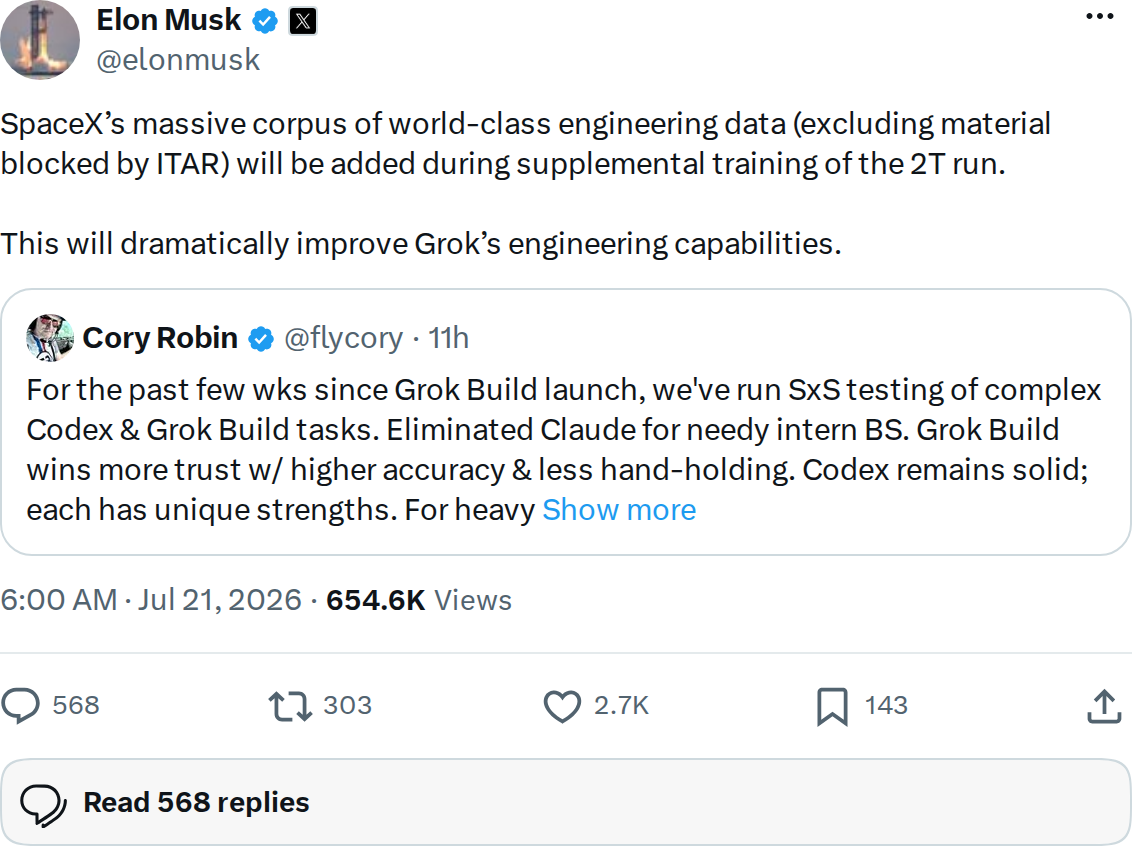
Elon Musk confirmed early Tuesday that xAI's Grok will be trained on SpaceX's internal engineering corpus as part of the model's next major training run. The data — everything except material blocked by U.S. ITAR export controls — will be folded into supplemental training of what Musk calls the '2T run,' a reference to the roughly two-trillion-token training pass xAI has been building toward. Musk's framing was direct: this will 'dramatically improve Grok's engineering capabilities.'

What Musk actually said
The post is short, but every clause matters. Three specific claims are on the table:
- Source data: SpaceX's 'massive corpus of world-class engineering data.' That implies design files, test data, simulation output, internal technical documentation, and the tacit engineering knowledge generated across Falcon, Dragon, Starship, and Starlink programs.
- Legal carve-out: Anything covered by the International Traffic in Arms Regulations is excluded. ITAR restricts export — including access by foreign nationals — of defense and space-related technical data. That is a non-trivial slice of SpaceX's most sensitive material, particularly around launch vehicle propulsion, guidance, and government payloads.
- Training stage: The data will enter during 'supplemental training' of the 2T run, not the base pretraining pass. In practice, that means Grok's foundation model is trained on a broad corpus first, and SpaceX data is layered in later as a targeted capability boost.
Why this is a bigger deal than a normal data announcement
Foundation models are largely trained on the public web, licensed text collections, code repositories, and synthetic data. What almost none of them have is direct access to a working aerospace company's internal engineering ledger. SpaceX has spent more than two decades iterating on hardware where the feedback loop is unusually tight: design, simulate, build, fly, recover data, redesign. That process generates exactly the kind of grounded, cause-and-effect engineering data that public sources cannot replicate.
If xAI can successfully condition Grok on that corpus, the model gains something rival systems structurally cannot get: pattern exposure to how a first-principles engineering organization actually solves problems — from materials selection to thermal management to failure analysis. That is the specific capability gap Musk is targeting when he says 'engineering capabilities,' not general reasoning.
The ITAR question
The ITAR exclusion is the single most important qualifier in the announcement, and it will shape how useful the resulting model actually is. ITAR governs the export of defense articles and technical data on the United States Munitions List, and space launch technology sits squarely on that list. Practically, that means:
- Propulsion design details for Merlin, Raptor, and related engines are almost certainly out.
- Guidance, navigation, and control specifics for launch vehicles are out.
- Anything tied to national security payloads, classified missions, or government contracts is out.
- What likely remains in-scope: manufacturing process knowledge, general materials science, structural engineering, avionics practices not tied to weapons systems, Starlink hardware design at the non-restricted level, ground systems, and a large volume of test methodology.
Even with those carve-outs, the residual dataset is substantial. And critically, xAI does not need the restricted material to lift Grok's engineering reasoning meaningfully — it needs enough high-signal, cause-and-effect engineering text to reshape the model's priors.
How this fits xAI's broader strategy
Musk has been explicit for more than a year that Grok's differentiation runs through the assets of his other companies. Tesla contributes real-world driving video and manufacturing data. X contributes conversational, real-time information. SpaceX now contributes engineering rigor. Neuralink and the Boring Company sit in the same orbit for future data contributions.
The 2T run reference is significant on its own. xAI has been scaling training compute aggressively out of its Memphis Colossus cluster, and each successive Grok generation has been trained on progressively larger token counts and model sizes. Supplemental training passes are cheaper than a full pretraining run and let xAI target specific capability improvements — engineering, math, coding — without rebuilding the base model from scratch.
The competitive read
OpenAI, Anthropic, and Google have all been racing to close capability gaps in technical domains — code, math, and scientific reasoning. None of them own a hardware company that ships rockets. The closest analogue is Google's access to DeepMind's internal research and Alphabet's broader engineering data, but that pool is qualitatively different from operational aerospace hardware data.
Whether this actually translates into a measurable Grok advantage depends on execution: how the SpaceX data is cleaned, tokenized, and mixed into the supplemental training curriculum; how ITAR compliance is enforced at data-selection time; and whether xAI can evaluate the resulting model on engineering benchmarks that would prove out the claim.
What Tesla owners should watch
Grok is already integrated into Tesla vehicles as an in-car voice assistant, and its capabilities directly affect how useful that integration becomes over time. A version of Grok with materially stronger engineering reasoning has downstream implications for:
- In-car technical questions — diagnosing behaviors, explaining warning messages, walking through settings.
- Owner-facing documentation lookup, where an engineering-tuned model is more likely to reason correctly about vehicle systems rather than hallucinate.
- Longer-term, any Tesla-side agentic use cases that lean on Grok for planning or reasoning.
What to watch next
- Release timing for the 2T-run Grok generation. Musk did not commit to a date. Prior xAI cadence suggests supplemental training passes ship on the order of weeks-to-months after being announced, but this has not been confirmed for the current run.
- Benchmark disclosures. Expect xAI to publish engineering-specific eval results if the training pass delivers what Musk is claiming. If those numbers don't appear, the improvement likely didn't materialize.
- Regulatory scrutiny. Feeding proprietary corporate data across affiliated companies — even with ITAR carve-outs — will attract questions from export-control lawyers and, potentially, from federal agencies with jurisdiction over SpaceX's government contracts.
- Tesla-side rollout. Whether and when the upgraded Grok appears in the Tesla in-car assistant, and whether Tesla owners can tell the difference in day-to-day use.
For now, this is an announcement — a specific, technically credible one, but still an announcement. The interesting evidence will be what the resulting model can actually do.
Related Gear
Gear up your Tesla with tested, custom-fit BASENOR accessories — shop Tesla accessories →
Sources & reporting notes
The links below identify the material source records used for this report.
- @elonmusk on X (2026-07-21T06:00:01.000Z) — Direct source
Source links are preserved as published or accessed. See our editorial standards and corrections policy.
The BASENOR Editorial Desk covers Tesla, SpaceX, and related technology, curating reporting from primary sources — official accounts, regulatory filings, and software release data. Every article passes source-record and fact-checking review before publication. About the newsroom.
This report was curated by the BASENOR Editorial Desk from the sources listed above. Read our editorial standards or email editorial@basenor.com to report an error.