📌 UPDATE — April 29, 2026
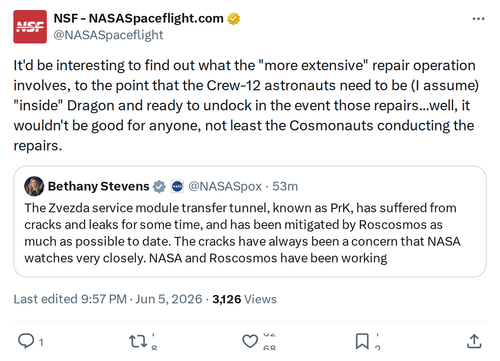
Falcon Heavy has successfully launched the Viasat-3 F3 mission to orbit. SpaceX confirmed the launch via their official account, sharing a live stream link shortly before liftoff. NASASpaceflight captured the T-22 minute vent during pre-launch preparations, and Elon Musk amplified the event with a post that drew over 1.3 million views. The mission marks Falcon Heavy's long-awaited return to flight following its 18-month stand-down.
📡 @SpaceX via X — April 29, 2026
📌 UPDATE — April 29, 2026
SpaceX is proceeding with a second launch attempt for Falcon Heavy's ViaSat-3 F3 mission today, April 29. SpaceX confirmed all systems are go, with an 85-minute window opening at 10:13 a.m. ET from Florida. Teams are monitoring weather conditions ahead of the attempt.

📌 UPDATE — April 27, 2026
SpaceX has scrubbed the original April 27 launch attempt and is now targeting Wednesday, April 29 for the Falcon Heavy ViaSat-3 F3 mission from Florida. The launch window opens at 10:13 a.m. ET and spans 85 minutes. No reason for the delay has been officially stated. The announcement was made directly by SpaceX on X earlier today.

— @SpaceX via X · April 27, 2026
📌 UPDATE — April 27, 2026
Falcon Heavy has rolled out to Launch Complex 39A at Kennedy Space Center ahead of today's ViaSat-3 F3 mission. SpaceX confirmed the 85-minute launch window opens at 10:21 a.m. ET — the rocket is on the pad and ready to go. The rollout was announced early this morning via SpaceX's official account alongside footage of the vehicle at the pad.
@SpaceX · April 27, 2026"Falcon Heavy is at pad 39A in Florida ahead of tomorrow's launch of the @ViaSat-3 F3 mission. The 85-minute launch window opens at 10:21 a.m. ET"

👍 2,299 · 🔁 377 · 👁 86,544
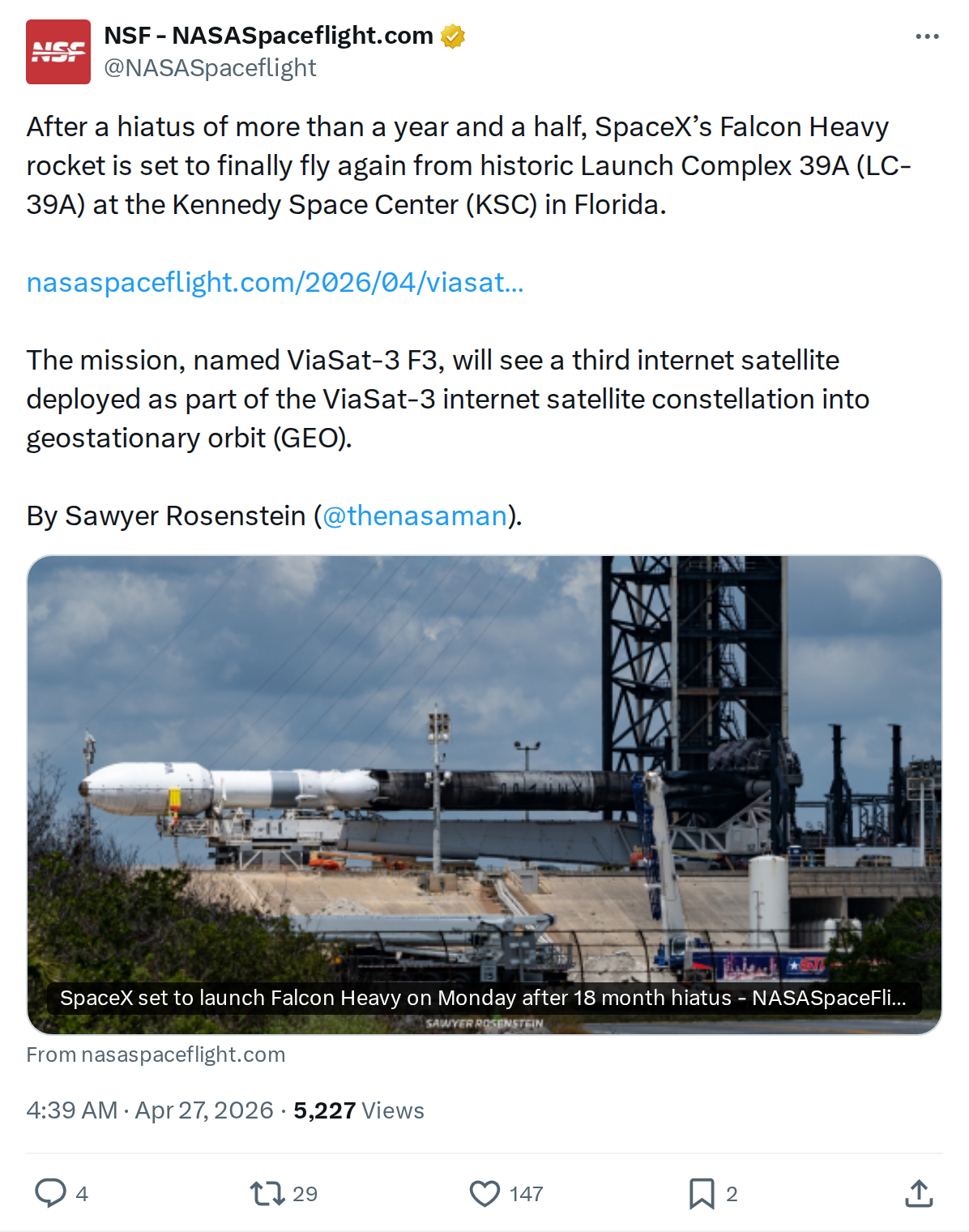
The News: SpaceX's Falcon Heavy is returning to flight on April 27, 2026, after an 18-month hiatus — its 12th mission overall — carrying the ViaSat-3 F3 communications satellite to geosynchronous transfer orbit.
Why It Matters: Falcon Heavy is the world's second most powerful operational rocket. Its return confirms SpaceX's continued dominance in heavy-lift commercial launch, and the booster recovery attempt is worth watching live.
Source: @NASASpaceflight on X

Falcon Heavy Is Back — 18 Months Is a Long Time in Rocketry
SpaceX's Falcon Heavy last flew in October 2024, carrying NASA's Europa Clipper on its journey to Jupiter's moon. Since then, the three-core heavy-lift vehicle has sat quiet while Starship development dominated the headlines. That changes tomorrow.
The ViaSat-3 F3 mission — also known as ViaSat-3 Asia-Pacific — will lift off from Launch Complex 39A at Kennedy Space Center, the same pad that launched Apollo 11 and the Space Shuttle. The window opens at 10:21 a.m. EDT (14:21 UTC) on April 27, with a backup opportunity on April 28 at 10:17 a.m. ET if needed.
📊 Key Figures
| Metric | Value | Context |
|---|---|---|
| Launch Window Opens | 10:21 a.m. EDT | April 27, 2026 |
| Hiatus Duration | ~18 months | Last flew Oct 2024 (Europa Clipper) |
| Overall Flight Number | 12th | Debuted February 2018 |
| Engines | 27 Merlin engines | 3 Falcon 9 cores strapped together |
| Thrust at Liftoff | ~5.1 million lbs | 2nd most powerful operational rocket |
| Target Orbit | Geosynchronous Transfer Orbit | ViaSat-3 Asia-Pacific broadband sat |
| Side Boosters | B1072 & B1075 | Landing at LZ-2 and LZ-40, CCSFS |
The Mission: ViaSat-3 F3 Explained
ViaSat-3 F3 is the third satellite in ViaSat's next-generation broadband constellation, specifically targeting high-throughput internet service for the Asia-Pacific region. The previous two satellites in the series cover the Americas and EMEA. Once operational, the full constellation is designed to deliver significantly higher capacity than ViaSat's previous generation of satellites.
Geosynchronous transfer orbit (GTO) is a demanding destination — it requires the rocket to do more work than a low-Earth orbit mission, which is exactly why Falcon Heavy's triple-core configuration earns its keep here. A single Falcon 9 couldn't manage this payload to this orbit.
Booster Recovery: The Part Worth Watching
One of the signature spectacles of any Falcon Heavy launch is the synchronized landing of the two side boosters. For ViaSat-3 F3, boosters B1072 and B1075 are expected to return to Cape Canaveral Space Force Station — landing at Landing Zone 2 and Landing Zone 40 — just minutes after liftoff.
The central core, however, will be expended. GTO missions demand maximum performance from the center core, leaving insufficient propellant for a recovery burn. It will fall into the Atlantic Ocean. This is a known trade-off for high-energy missions and not a surprise.
🔭 The BASENOR Take
Timeline: Launch April 27, 2026 | Backup: April 28, 2026
Impact Level: Medium-High — significant for SpaceX's commercial manifest and heavy-lift cadence
Confidence: High — confirmed launch window, vehicle on pad
Eighteen months is an eternity in the current launch market. While Falcon Heavy sat idle, SpaceX's Falcon 9 was flying at a record pace and Starship was racking up test milestones. The gap raises a legitimate question: is Falcon Heavy becoming a niche vehicle, reserved only for payloads that Falcon 9 simply can't handle?
The answer is probably yes — and that's not a bad thing. Falcon Heavy's role has always been the heavy-lift specialist. With Starship eventually targeting even larger payloads, Falcon Heavy may settle into a specific corridor of missions: large GTO commercial satellites, deep-space science payloads (like Europa Clipper), and national security launches that require its unique performance envelope.
For the ViaSat-3 program, getting this third satellite up completes the global constellation architecture ViaSat has been building toward. The Asia-Pacific coverage gap closes once F3 reaches its operational slot — meaningful for aviation and maritime broadband customers across one of the world's busiest regions.
Watch the synchronized booster landings. After 18 months away, SpaceX will want a clean return. For our full SpaceX coverage, follow the tag.

Sarah focuses on Tesla Energy, SpaceX missions, and the broader Musk AI portfolio. Former data analyst in clean energy. Based in San Francisco.
Sources verified at publish time. Spotted an inaccuracy? Email editorial@basenor.com.