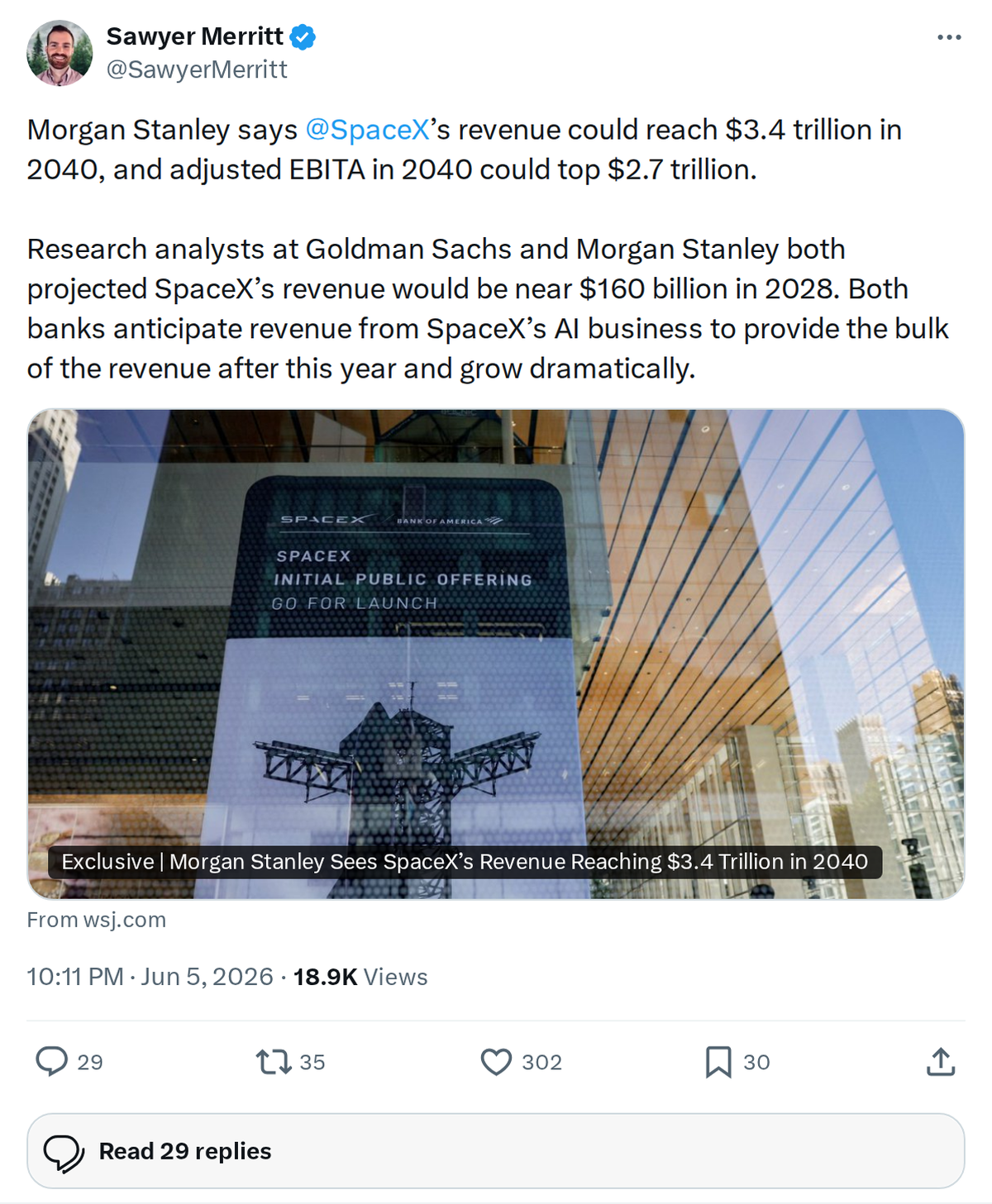
Wall Street is putting staggering numbers on SpaceX's future. Morgan Stanley projects the company's annual revenue could reach $3.4 trillion by 2040 — with adjusted EBITDA topping $2.7 trillion in the same year. The figures were shared with top investors on June 4, 2026, as SpaceX enters the roadshow phase of what analysts expect to be the largest IPO in history.

Two Banks, One Consensus — Then They Diverge
Morgan Stanley and Goldman Sachs — the two lead underwriters among 21 banks working on the SpaceX IPO — actually agree on the near term. Both project SpaceX revenue of approximately $160 billion by 2028, a figure that would represent a roughly 8.5x increase from the $18.7 billion the company reported in 2025.
The divergence comes in the medium term. For 2030, Morgan Stanley forecasts total revenue around $330 billion, while Goldman Sachs projects a more aggressive $470+ billion. The gap is largely explained by how each bank models SpaceX's AI business — particularly the revenue potential following its merger with xAI.
| Metric | Morgan Stanley | Goldman Sachs |
|---|---|---|
| 2025 Revenue (actual) | $18.7B | $18.7B |
| 2028 Revenue (projected) | ~$160B | ~$160B |
| 2030 Revenue (projected) | ~$330B | $470B+ |
| 2030 AI Revenue (projected) | ~$190B | ~$322B |
| 2040 Revenue (projected) | $3.4T | N/A |
| 2040 Adj. EBITDA (projected) | $2.7T+ | N/A |
The AI Multiplier
The trillion-dollar trajectory only makes sense when you factor in the xAI merger. SpaceX's AI segment generated $3.2 billion in revenue in 2025 — a meaningful but relatively modest number. Morgan Stanley sees that figure scaling to $190 billion by 2030; Goldman Sachs goes further at $322 billion. By 2040, under Morgan Stanley's bull case, AI becomes the dominant revenue driver — not rockets, not Starlink.
That's a fundamental reframing of what SpaceX actually is. The launch business and satellite internet network that built the company's reputation would, under these projections, be supporting infrastructure for a global AI and compute platform — one that happens to operate in orbit.
IPO Context: Why These Numbers Are Public Now
These projections aren't academic. They were shared with investors as SpaceX conducts its IPO roadshow, targeting a raise of roughly $75 billion — which would make it the largest public offering in history. Morgan Stanley and Goldman Sachs hold the top two underwriting roles, which explains why both firms are publishing detailed long-range models: they're making the case to institutional buyers.
SpaceX reported a net loss of $4.9 billion in 2025 despite the $18.7 billion in revenue, so the investment thesis is entirely forward-looking. Buyers are being asked to price in a trajectory that bends sharply upward — from an $18.7B revenue base today to $160B within two years, and $3.4T within fourteen.
Whether those numbers prove prescient or wildly optimistic will depend on how quickly Starlink scales globally, how the xAI integration performs, and whether SpaceX can maintain its launch cadence advantage as competitors mature. But the fact that two of Wall Street's most rigorous institutions are publishing trillion-dollar forecasts — in a roadshow context where credibility is on the line — signals that serious money is treating this as a plausible scenario, not a fantasy.
Sources & reporting notes
The links below identify the material source records used for this report.
- @SawyerMerritt on X (2026-06-05T14:11:50.000Z) — Direct source
Source links are preserved as published or accessed. See our editorial standards and corrections policy.
The BASENOR Editorial Desk covers Tesla, SpaceX, and related technology, curating reporting from primary sources — official accounts, regulatory filings, and software release data. Every article passes source-record and fact-checking review before publication. About the newsroom.
This report was curated by the BASENOR Editorial Desk from the sources listed above. Read our editorial standards or email editorial@basenor.com to report an error.