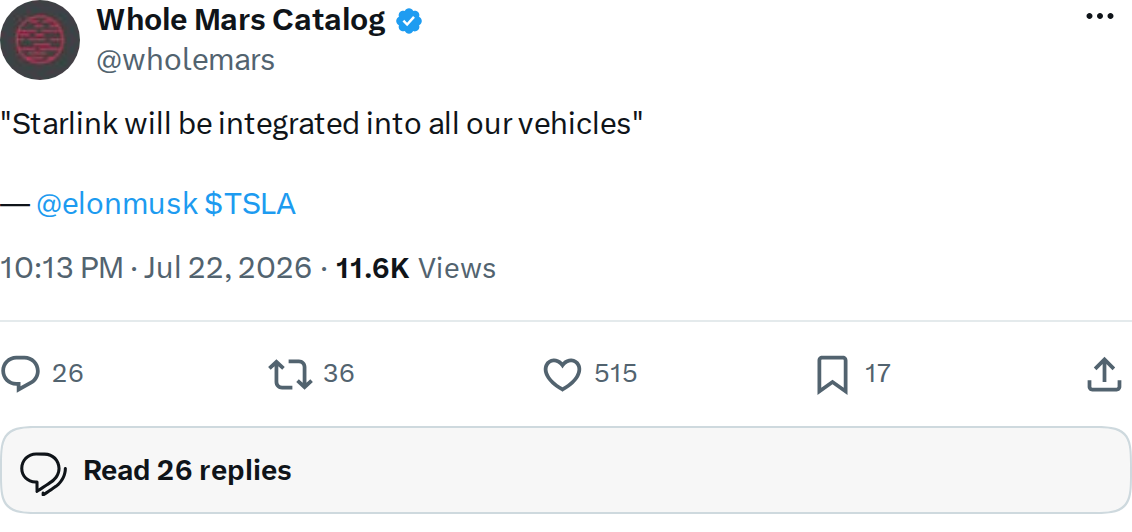
Elon Musk has confirmed that Starlink satellite connectivity will be integrated into every Tesla vehicle, extending SpaceX's low-Earth-orbit internet service from the Cybercab robotaxi to the entire consumer fleet. The disclosure came via a short reply Musk made on X, surfaced by Whole Mars Catalog on July 22, 2026, and marks the clearest signal yet that Tesla intends to make satellite-backed connectivity a standard feature rather than a Cybercab exclusive.

What Musk Actually Said
The quote is short and unambiguous: “Starlink will be integrated into all our vehicles.” There is no timeline, no pricing, no list of which trims or model years get the hardware first. What Musk is signaling, though, is a policy direction — Starlink is no longer a Cybercab-only feature earmarked for autonomous fleet operations. It is a fleet-wide roadmap item.
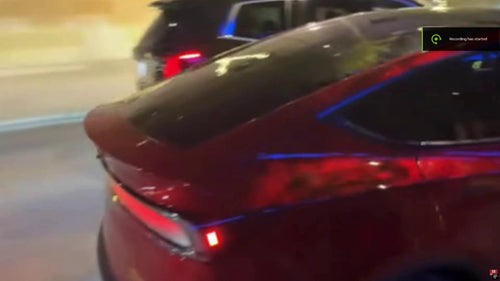
That framing matters because, until this week, the only officially confirmed Starlink integration was on the Cybercab robotaxi. Tesla showcased the setup at its renovated Santana Row showroom in California on July 20-21, 2026, according to Teslarati and Electrek, and Tesla's VP of AI Ashok Elluswamy publicly described how the system fits into the Cybercab's architecture. Musk's follow-on remark two days later widens the scope from one vehicle to the entire lineup.
How Starlink Is Being Used in the Cybercab
The Cybercab implementation is the template, so it's worth understanding what Tesla actually built. According to Elluswamy's public comments reported by Teslarati and Tesla Oracle, Starlink connectivity in the Cybercab handles three roles:
- Navigation and mapping updates — keeping the fleet's map data and routing current, particularly in areas with spotty cellular coverage.
- Customer service and back-end fleet management — two-way communication between the vehicle, riders, and Tesla's operations team.
- Passenger connectivity — 4K streaming, video calls, and gaming during rides.
Critically, Elluswamy stressed that Starlink is not a safety-critical system on the Cybercab. The autonomous driving stack runs locally on the vehicle's compute; satellite connectivity is an amenity and an operations tool, not a dependency for safe operation. That distinction is important for any owner wondering whether a satellite drop-out could affect driving behavior — per Tesla's own statements, it cannot.
The Hardware: Starlink V5
Tesla is deploying the newest Starlink V5 terminal, which is what makes vehicle integration practical in the first place. Compared to the previous V4 hardware, according to specifications published across SpaceX's own communications and outlets including PCMag and Engadget:
| Spec | Starlink V5 | Starlink V4 (prior gen) |
|---|---|---|
| Average power draw | 35-50 W | 75-100 W |
| Download speed | 375+ Mbps | Lower |
| Wind resistance | Up to 265 km/h | ~97 km/h |
| Form factor | Smaller, lighter | Larger, heavier |
Two of those numbers matter most for automotive use. The halved power draw brings the terminal into a range where continuous operation doesn't meaningfully dent range on a moving EV. And the jump in rated wind resistance to 265 km/h is what makes it feasible to mount a low-profile terminal on a vehicle roof without aerodynamic or durability concerns at highway speed.
What This Means for Existing Tesla Owners
Here is where Musk's statement needs to be read carefully. He said Starlink will be integrated into all Tesla vehicles — that is forward-looking language. There is no indication that current Model 3, Model Y, Cybertruck, or existing Model S/X vehicles will receive retrofit Starlink hardware. The Model S and Model X production line was ended around May 2026 and is being converted to Optimus production, so those vehicles are frozen at their current hardware configuration regardless.
The realistic reading: Starlink will start appearing as factory-installed hardware on future vehicles built after some yet-to-be-announced cut-in date, with the Cybercab as the first production example. Whether Tesla offers a retrofit path for recent Model 3, Model Y, and Cybertruck vehicles has not been addressed, and owners should not assume one is coming.
The Open Questions
Musk's one-line disclosure leaves the commercial and technical questions wide open. Tesla has not stated:
- Pricing. Whether Starlink connectivity will be bundled into Tesla's existing Premium Connectivity subscription, offered as a separate satellite tier, or included free. Tesla has not disclosed a subscription model for the Cybercab implementation either.
- Timeline. No production start date has been given for consumer vehicles. The Cybercab began volume production in April 2026 with over 500 units in testing as of July 2026.
- Cellular relationship. Whether Starlink replaces or complements the existing LTE modem in Tesla vehicles. A hybrid model — cellular where available, satellite fallback in dead zones — is the most technically sensible approach but has not been confirmed.
- Regulatory scope. Starlink's direct-to-vehicle integration will need spectrum and licensing approval on a country-by-country basis, which will likely stagger the rollout by market.
Why This Matters Beyond Tesla
The strategic logic of Starlink-in-every-Tesla goes beyond in-car Netflix. A fleet of millions of always-connected vehicles gives Tesla a fundamentally different data pipe for FSD training uploads, over-the-air update delivery, and — most importantly for the robotaxi thesis — reliable operational control of autonomous vehicles in cellular-weak areas. Rural highways, national parks, mountain passes, and border regions become tractable for a Cybercab-style service in a way they aren't with cellular alone.
It also deepens the operational lock-in between Tesla and SpaceX. Neither company has ever formally confirmed a commercial relationship on Starlink pricing, but Musk's willingness to commit the entire vehicle fleet to Starlink strongly implies favorable internal terms. Competing automakers looking at satellite connectivity — some of whom have partnered with Iridium or with Starlink's rivals — will now have to price against a Tesla-SpaceX package.
What to Watch Next
Three concrete signals will indicate how quickly Musk's statement translates into shipping product. First, whether Tesla addresses Starlink integration in its next earnings call or at its next product event. Second, whether teardowns or FCC filings of new-build Model Y and Cybertruck vehicles begin showing Starlink antenna hardware. And third, whether Tesla updates its Premium Connectivity terms — the subscription page is the most likely place a satellite tier would first appear.
For now, the news is a direction, not a delivery date. But it's a clear one: Tesla is treating satellite connectivity as core infrastructure, not a Cybercab novelty.
🚕 Following the Robotaxi rollout? See every operating city, launch date and announced market in our Tesla Robotaxi Tracker.
Related Gear
Gear up your Tesla with tested, custom-fit BASENOR accessories — shop Tesla accessories →
Sources & reporting notes
The links below identify the material source records used for this report.
- @wholemars on X (2026-07-22T22:13:02.000Z) — Direct source
Source links are preserved as published or accessed. See our editorial standards and corrections policy.
The BASENOR Editorial Desk covers Tesla, SpaceX, and related technology, curating reporting from primary sources — official accounts, regulatory filings, and software release data. Every article passes source-record and fact-checking review before publication. About the newsroom.
This report was curated by the BASENOR Editorial Desk from the sources listed above. Read our editorial standards or email editorial@basenor.com to report an error.