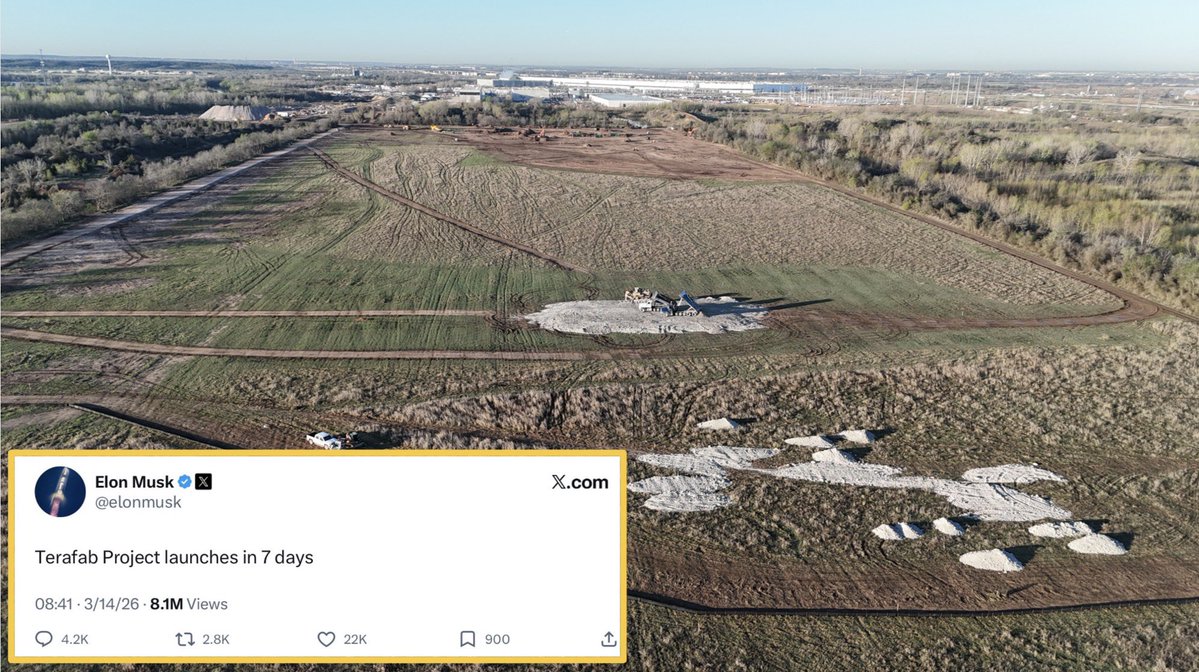
The News: Massive site preparation is underway north of Giga Texas, with Elon Musk hinting at the start of the Terafab project alongside plans for a dedicated factory targeting 10 million Optimus robots per year.
Why It Matters: This is the largest industrial construction project in Tesla's history — a purpose-built Optimus manufacturing campus that could redefine the company's revenue model far beyond electric vehicles.
Source: @JoeTegtmeyer on X
Giga Texas Is Growing Into Something Entirely New: Terafab, the Optimus Mega-Factory, and a Campus That Could Hit 15 Million Sq Ft
Drone operator and Giga Texas watcher Joe Tegtmeyer flagged something significant this morning: the land directly north of the existing Giga Texas facility is being actively cleared and prepped at a scale that's hard to overstate. Combined with Elon Musk hinting at the official start of the Terafab project — and confirmed plans for a factory capable of producing 10 million Optimus robots annually — what's taking shape in Austin may be the most consequential industrial build in Tesla's history.

What's Actually Being Built North of Giga Texas
The construction activity Tegtmeyer documented sits off the existing Giga Texas property boundary — meaning Tesla has acquired or is developing adjacent land specifically for this expansion. The visible work includes ground clearing, soil reclamation, and infill operations consistent with the early stages of a major foundation pour. This isn't landscaping. This is the groundwork for an entirely new campus.
According to permit documents now circulating — and flagged by Tegtmeyer in a follow-up post — Tesla is seeking to add over 5.2 million square feet of new building space to the Giga Texas campus by end of 2026. If completed on that timeline, the total campus footprint would reach approximately 15 million square feet, making it one of the largest manufacturing facilities on the planet.

📊 Key Figures
| Metric | Value | Context |
|---|---|---|
| Optimus Annual Production Target | 10 million units | Giga Texas, by 2027 |
| New Square Footage (Permits Filed) | 5.2M+ sq ft | Target: complete by end of 2026 |
| Projected Total Campus Size | ~15 million sq ft | Post-expansion |
| Optimus Factory Footprint (est.) | 1–2 million sq ft | Dedicated Optimus building |
| Estimated Construction Investment | $5B – $10B | Construction + equipment |
| Optimus Version Targeted for Texas | Optimus V4 | Higher volume; V3 prototypes at Fremont |
Terafab: What We Know About the Name and the Concept
"Terafab" is the term Elon Musk has used to describe a factory-of-factories concept — a facility designed not just to manufacture products, but to manufacture the machines that manufacture products, at a scale measured in tera (trillions) of units over time. The hint that Terafab is now beginning in earnest at Giga Texas suggests the North Campus isn't just an Optimus factory — it's the first physical instantiation of a much larger manufacturing philosophy.
Think of it this way: Giga Texas currently produces Model Y and Cybertruck. The North Campus expansion appears designed to produce Optimus robots — and potentially the tooling and automation equipment that will eventually build those robots at scale without equivalent human labor input. That's a compounding loop that Tesla has telegraphed for years, and the permits and site work suggest it's no longer theoretical.
The Optimus Production Roadmap
Based on verified reporting and Musk's public statements, the current Optimus production plan breaks down as follows:
- Now through 2026: Optimus robots performing simple tasks inside Tesla factories; training operations expanding to the Austin Gigafactory. A smaller Fremont line building Optimus V3 prototypes targeting up to 1 million units annually for algorithm refinement and internal use.
- Late 2026: Major structural work on the North Campus expected to conclude; equipment installation begins.
- 2027: Full-scale Optimus V4 production at Giga Texas targeting 10 million units per year. This is the version Musk has confirmed will be built in Texas at "much higher volume."
The distinction between V3 (Fremont, lower volume, algorithm training) and V4 (Texas, mass production) is important. Fremont is the R&D ramp. Texas is the commercial launch.
🔭 The BASENOR Take
Timeline: Site prep active now → Structural completion late 2026 → Optimus V4 production 2027
Impact Level: 🔴 Transformational — this is not an incremental factory expansion
Confidence: High on construction activity (visual confirmation + permits). Medium on 10M/year by 2027 (ambitious; Tesla's ramp timelines historically slide). High on Terafab concept being real.
Analysis: The 10 million Optimus units per year figure is the headline, but the more important signal is the permit scope: 5.2 million square feet of new construction by end of 2026 is an extraordinarily aggressive build timeline. For context, the original Giga Texas facility — which produces two vehicle lines — took years to reach full operation. Tesla is attempting to compress that timeline dramatically for a product category (humanoid robots) that has never been manufactured at anything close to this scale by anyone. The Terafab framing matters because it signals Tesla isn't just building a factory — it's building the infrastructure to iterate and scale manufacturing itself. If even a fraction of this capacity comes online on schedule, the revenue implications for Tesla as a company dwarf anything in its vehicle business.
📰 Deep Dive
What makes this moment different from previous Optimus announcements is the physical evidence. Tegtmeyer's drone footage and the associated permit filings move this from "Elon said it on stage" to "ground is being broken." The combination of site prep activity, permit documentation, and a direct hint from Musk about Terafab starting gives this story a level of corroboration that earlier robot factory announcements lacked.
The $5–10 billion investment estimate for a 10-million-unit Optimus factory is also worth sitting with. That's a capital commitment in the range of building an entirely new Gigafactory — except this one produces robots rather than cars. Tesla would need to fund this alongside ongoing vehicle production ramps, energy storage expansion, and FSD development. The financial execution here is as consequential as the engineering challenge.
For Tesla owners watching the company's long-term trajectory, the Giga Texas North Campus is the clearest physical signal yet that Tesla's leadership genuinely believes Optimus — not vehicles, not energy — will be the company's largest business within this decade. Whether that conviction translates into 10 million robots by 2027 or something considerably more modest, the infrastructure being laid right now in Austin will shape what Tesla looks like for the next 20 years.
🤖 Tracking Tesla's humanoid robot? See every Optimus production milestone and appearance in our Tesla Optimus Tracker.
Related Gear
Gear up your Tesla with tested, custom-fit BASENOR accessories — shop Tesla accessories →
Sources & reporting notes
The links below identify the material source records used for this report.
- @JoeTegtmeyer on X (2026-03-14T15:11:34.000Z) — Direct source
- @JoeTegtmeyer on X (2026-03-14T15:37:23.000Z) — Direct source
Source links are preserved as published or accessed. See our editorial standards and corrections policy.
The BASENOR Editorial Desk covers Tesla, SpaceX, and related technology, curating reporting from primary sources — official accounts, regulatory filings, and software release data. Every article passes source-record and fact-checking review before publication. About the newsroom.
This report was curated by the BASENOR Editorial Desk from the sources listed above. Read our editorial standards or email editorial@basenor.com to report an error.