📌 UPDATE — July 11, 2026
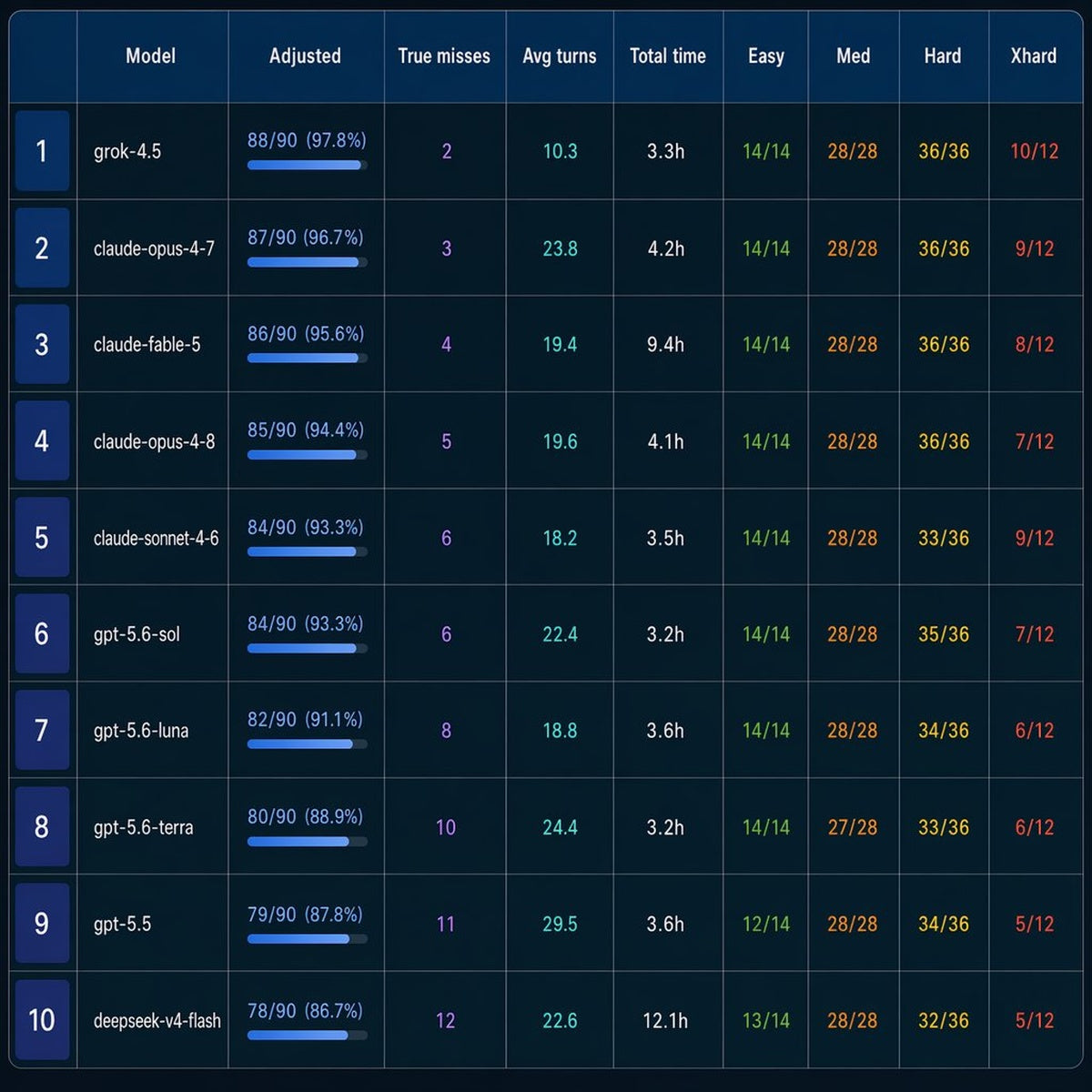
Elon Musk has shared new benchmark data confirming that Grok 4.5 has secured second place on real-world software engineering tasks, trailing only Fable. This positions Grok 4.5 ahead of competing models from OpenAI, Anthropic, and Google in this specific evaluation category — a notable leap for xAI's LLM lineup. Musk also shared a full Grok 4.5 review video, offering a closer look at its capabilities in action.

📊 via @elonmusk · Jul 11, 2026
📌 UPDATE — July 11, 2026
Elon Musk has pushed back on media reports suggesting Tesla and SpaceX were mandated to adopt Grok 4.5 exclusively. In a post on X, Musk clarified that he simply asked both companies to test Grok 4.5 for specific tasks — and explicitly stated they should keep using competing AI models if those perform better. The statement directly contradicts narratives framing the internal rollout as a forced, company-wide switch driven by Musk's ownership of xAI.
"I just asked Tesla & SpaceX to try out Grok 4.5 to see if it solves their task, not use it no matter what! They should continue to use other AI models if those models outperform Grok." — @elonmusk, July 11, 2026

Elon Musk posted a simple but pointed update on July 10: Grok is "closing the loop on real-world use cases." It's a deliberate pivot in how xAI is framing its AI — less about topping leaderboards, more about being genuinely useful to professionals doing real work. The timing lines up with the release of Grok 4.5 two days earlier, and the details behind that launch are worth unpacking.

What is Grok 4.5 and when did it launch?
Grok 4.5 launched on July 8, 2026, developed in collaboration with AI coding startup Cursor. Unlike previous versions that competed primarily on general reasoning benchmarks, 4.5 is explicitly designed around professional workflows — software engineering, legal work, financial analysis, and AI agent tasks. Musk described it as "roughly comparable to Opus 4.7, but much faster," and emphasized that the goal is "closing the loop on real-world usefulness, not benchmarks."
Who is actually using it, and are they finding it useful?
According to Musk, engineers at Tesla and SpaceX are among the early users — and he says they find it "genuinely useful." That's a meaningful signal. These aren't casual users asking chatbots trivia questions; they're working across large codebases, running technical analysis, and debugging complex systems. If Grok 4.5 is passing muster with that crowd, it suggests the model has moved past the demo-impressive-but-brittle-in-practice phase that has plagued many AI releases.
What can Grok 4.5 actually do in practice?
The model targets three professional domains in particular. In software engineering, it works across large codebases, generates production-ready code, debugs software, and plans development tasks — making it a direct competitor to tools like GitHub Copilot at the enterprise level. For legal professionals, it handles contract review, case file summarization, regulatory analysis, and drafting. In finance, it supports investment research, due diligence, financial statement analysis, and risk assessment. On the technical side, it delivers 80 transactions per second and offers twice the token efficiency of comparable leading models, according to xAI.
How does the pricing work?
Grok 4.5 is available via API at $2 per million input tokens and $6 per million output tokens. A faster premium tier is priced at $4 per million input tokens and $18 per million output tokens. For context, the model was trained across tens of thousands of NVIDIA GB300 GPUs — the infrastructure investment is substantial, and the tiered pricing reflects the performance difference between standard and premium response speeds.
Where can you access Grok 4.5 right now?
It's currently available through Grok Build (xAI's agentic coding CLI, which launched in May 2026 and supports up to eight parallel sub-agents), across all Cursor plans, and through the xAI console. EU access to xAI console products is expected in mid-July 2026. Grok 4.5 is also the default model inside Grok Build, which is compatible with Anthropic's Skills system.
How does Grok 4.5 fit into the broader Grok roadmap?
The version progression has accelerated noticeably. Grok 4.3, released in May 2026, introduced a 2-million-token context window — matching Gemini 3.1 Pro as the largest among Western closed-model AIs at the time. Grok Imagine 1.0, launched in February 2026, generates 720p videos up to 10 seconds with synchronized audio and produced 1.245 billion videos in its first 30 days. The pattern is consistent: xAI is shipping faster and targeting specific capability gaps rather than chasing a single general-purpose model. Grok 4.5 is the clearest expression yet of that strategy — narrower scope, higher practical ceiling, faster inference.
The "closing the loop" framing matters. For months, the AI industry has been rightly criticized for models that perform brilliantly in controlled evaluations but stumble when deployed in messy, real-world workflows. If Grok 4.5 is genuinely holding up under the demands of Tesla and SpaceX engineering teams, that's a harder test than any public benchmark — and a more honest measure of where the technology actually stands.
Sources & reporting notes
The links below identify the material source records used for this report.
- @elonmusk on X (2026-07-10T16:03:15.000Z) — Direct source
- @elonmusk on X (2026-07-11T04:08:21.000Z) — Direct source
- @elonmusk on X (2026-07-11T05:30:35.000Z) — Direct source
- @elonmusk on X (2026-07-11T05:28:20.000Z) — Direct source
Source links are preserved as published or accessed. See our editorial standards and corrections policy.
The BASENOR Editorial Desk covers Tesla, SpaceX, and related technology, curating reporting from primary sources — official accounts, regulatory filings, and software release data. Every article passes source-record and fact-checking review before publication. About the newsroom.
This report was curated by the BASENOR Editorial Desk from the sources listed above. Read our editorial standards or email editorial@basenor.com to report an error.